
No one likes to admit weakness, but I will here: after years of heavy teaching loads and graduate school stress, I am prone to burn out. I used to think that I was invincible, a survivor who overcame those horrible stretches of apathy by plowing straight through them. In reality, I was only papering over my needs and making the situation worse.
Today things are different. I recognize the signs of burn-out more easily, those dark twinges that hang just outside of my metaphysical peripheral vision. Unlike then, I realize now that if I don’t take care of myself, I’m no good to anyone: family, friends, students, and colleagues alike. So I draw boundaries at the end of each semester, knowing that I need to take some precious time to recharge my batteries so to speak.
One thing that always helps me recuperate and regain my joie de vivre is food, particularly cooking. When life gets hectic and the stacks of papers that I need to grade grow higher, I pretty much cease to cook at home — an obvious mistake as cooking calms me and the food that I prepare nourishes both my body and spirit. I love trying new recipes and cooking from new cookbooks, but when I am really aching for something soul-sustaining, what I love most are recipes from family and friends. Those recipes and dishes are the ones that are really special because they make me feel as if that person is in the kitchen with me even though they may be thousands of miles away.
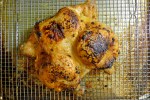
I’ve been spatchcocking a lot of chickens lately. Partly because I’ve finally invested in a good pair of very sharp, spring-loaded shears, and also because I like how evenly and quickly the chicken cooks. The white meat emerges tender and moist from the oven, the dark meat is rich and succulent, and the skin comes out crispy, burnished, and golden.
For this particular chicken, I finally got around to trying a maple syrup-kissed rub/marinade that Victoria over at Bois de Jasmin mentioned in the comment thread of her post on Hot and Spicy Cranberry Sauce. Many people think of Bois de Jasmin as a perfume blog, but I always consider it much more than that: a celebration of life and of all things fragrant, including food and drink. Given that the olfactory and the gustatory are so intimately intertwined, is it surprising that many perfume lovers happen to be fine gastronomes as well?
Victoria calls this chicken an improvisation, but I call it genius. The chicken feels infused with a terrific depth of flavor. The maple syrup caramelizes to a sticky, burnt sugar-like glaze. Victoria uses a mortar and pestle to render the garlic cloves into a smooth paste. I would have done the same if I had one. However, as I do not, I made do with a garlic press. Regardless of which technique you choose, the garlicky chicken roasting in the oven will make your kitchen smell mouthwatering good. I used a pinch of cayenne pepper in place of a pinch of paprika, but Victoria also suggests a little bit a garam masala added to the mix — a delicious idea that I look forward to trying as soon as I get back to NYC.
As for the coconut oil-roasted sweet potatoes, I never would have tried a so-called Paleo recipe if not for On-Ke, who had recently completed 30 days of eating Paleo along with her daughter Siobhan and her family. I had initially gotten to know Siobhan through her wonderful blog Garden Correspondent. When we finally met in person, it was as if I had known her for years. Laughing and chatting animatedly over Italian coffee and pastries, Siobhan decided that she needed to introduce me to her mother, another “culture vulture” who lives rather conveniently around the corner from me. Needless to say, we hit it off right away and have spent this past fall terrorizing the city in a good way: museum visits, perfume sniffing outings, theater performances, and always food, glorious food! Siobhan, you are missed!
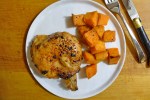
One afternoon, On-Ke served me a roasted and roughly cut up kabocha squash that was rubbed with coconut oil, seasoned with salt, and studded with cracked black peppercorns. Super classy woman that I am, I devoured what must have been half a pumpkin in one sitting. I couldn’t help it; there was something about that subtle coconut flavor that made that roasted kabocha squash even more irresistible. Ever since that afternoon, this has been my preferred way to cook just about any squash or yam. As I thought about a perfect complement for Victoria’s chicken, I couldn’t come up with a better one than these sweet potatoes roasted in the same way.
Special Equipment:
A good, sharp pair of cooking shears
One wire rack to fit the sheet pan
Ingredients:
For the sweet potatoes:
2 large sweet potatoes, peeled and cut into 1-inch pieces
2 tablespoons of coconut oil (I prefer unrefined coconut oil because the coconut flavor is stronger)
Salt and freshly ground pepper to taste
For the roasted chicken:
1 whole chicken
1 tablespoon of dark amber maple syrup
3-4 cloves of garlic, finely minced or even better, pulverized using a mortar and pestle with a little course salt
2 tablespoons of good olive oil
A pinch of cayenne pepper, paprika, or garam masala
1 teaspoon of kosher salt
Freshly ground pepper to taste
How to prepare:
1. Preheat the oven to 400°.
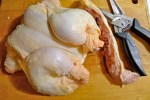
2. While the oven is warming up, you can begin to prep the chicken. To spatchcock any bird, flip the bird over so that its breast is facing down on the cutting board and its back is facing upright. Using a good, sharp pair of sturdy kitchen shears, remove the backbone by cutting along either side of it. Remove any excess skin that is dangling from the neck hole. Turn the bird breast-side-up. Remove the wishbone with a sharp knife. Now with the heel of your hand, press directly down on the breast bone until you hear a crack. Congratulations! You have just spatchcocked a bird! To finish, tuck the wings behind the breast. For the legs, you can make small slits in the skin on either side of where the tail used to be and push the ends of each respective leg through them. You can also leave the wings and legs as they are. Your chicken will taste the same either way, but as a firm believer in trussing, I like to have everything looking neat. To help visualize this, here is a video.
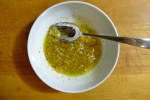
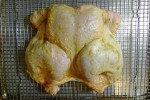
3. Combine the maple syrup, garlic, olive oil, cayenne pepper, salt and pepper in a small bowl. Rub the mixture evenly all over the chicken. Lay the chicken out on a rack-lined sheet pan and let it marinate uncovered on the counter for about 40 minutes to an hour.
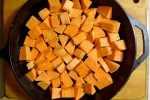
4. While the chicken is marinating, use your hands to rub each piece sweet potato with coconut oil. Season the pieces liberally with flaky salt and freshly ground black pepper, and spread them out in an even layer over another baking tray or in the bottom of a cast iron pan. I like my roasted sweet potatoes to be on the very roasted side, not exactly burnt, but just so that the surface sugars are caramelized. This should take about 40 minutes or so. If you prefer yours to be less roasted, you can remove them from the oven when they are softened and can be easily pierced with the point of a sharp knife.
5. When the sweet potatoes are done, remove them from the oven. Put the chicken in the oven and carefully pour about 2 to 2 1/2 cups of water into the bottom of the sheet pan. The water should not touch the bottom of the wire rack. Roast the chicken until it reaches an internal temperature of 165°, this should take between 1 hour and 1.5 hours depending on how big your chicken is. If at any point you notice that the garlic is beginning to burn, you can loosely tent the chicken with a sheet of aluminum foil, removing it when the it is almost done so that the skin can brown. When the chicken is done, take it out of the oven and let it rest for 10-20 minutes before carving.
Serve the chicken with the roasted sweet potatoes.




 coolcookstyle