Prosciutto e melone (Prosciutto and Melon)


One of my favorite things to eat in late summer is prosciutto e melone.

The silky saltiness of the paper-thin ham delicately draped over sweet, heady melon is truly irresistible this time of year.

How’s that for a extra-hefty dose of hyperbole?

But seriously, it’s hard not to wax poetically about it. If the melons are ripe and fragrant (melons have been in the market for a few weeks now), and the prosciutto is the finest San Daniele you can get your hands on, you should.

There is no recipe for prosciutto and melon, because it is exactly just that: prosciutto and melon.

I feel very strongly, though, that as there are only 2 ingredients, there should be some clear guidelines:

1. If you do not have ripe melons, do not make prosciutto e melone.

2. Some people think honeydew is an acceptable melon. It is not.

Cantaloupe or nothing, people.

3. Do not use domestic prosciutto, which is fine for cooking, but it too salty for salad. You want the good stuff: the golden pinky-hued San Daniele. The best you can buy. You don’t need too much of it. About a quarter pound is more than enough for two people.

Buy the best. It is worth it.

4. Just slice your melon. You can do wedges or melon balls, however you want it. Drape the ham seductively across it. You want sexy ham folds, ribbons of air-dried pork tufted like satin pig-sheets over your musky melon. That’s what you want.

Do not:

1. . . . wrap your prosciutto around your melon like this.

2. . . . wrap your prosciutto around your melon, and impale it on a skewer with a freakin’ cherry tomato like this.

3.  . . . drizzle it with olive oil. Do not add pepper. It does not need salt. It doesn’t.

4.  . . . add a ball of mozzarella cheese, a glop of pesto, a shred of basil, dusting of dried herbs, or a bed of greens. Don’t sauce it. Don’t even have a sauce near it. Just don’t.

It is truly best as it is!

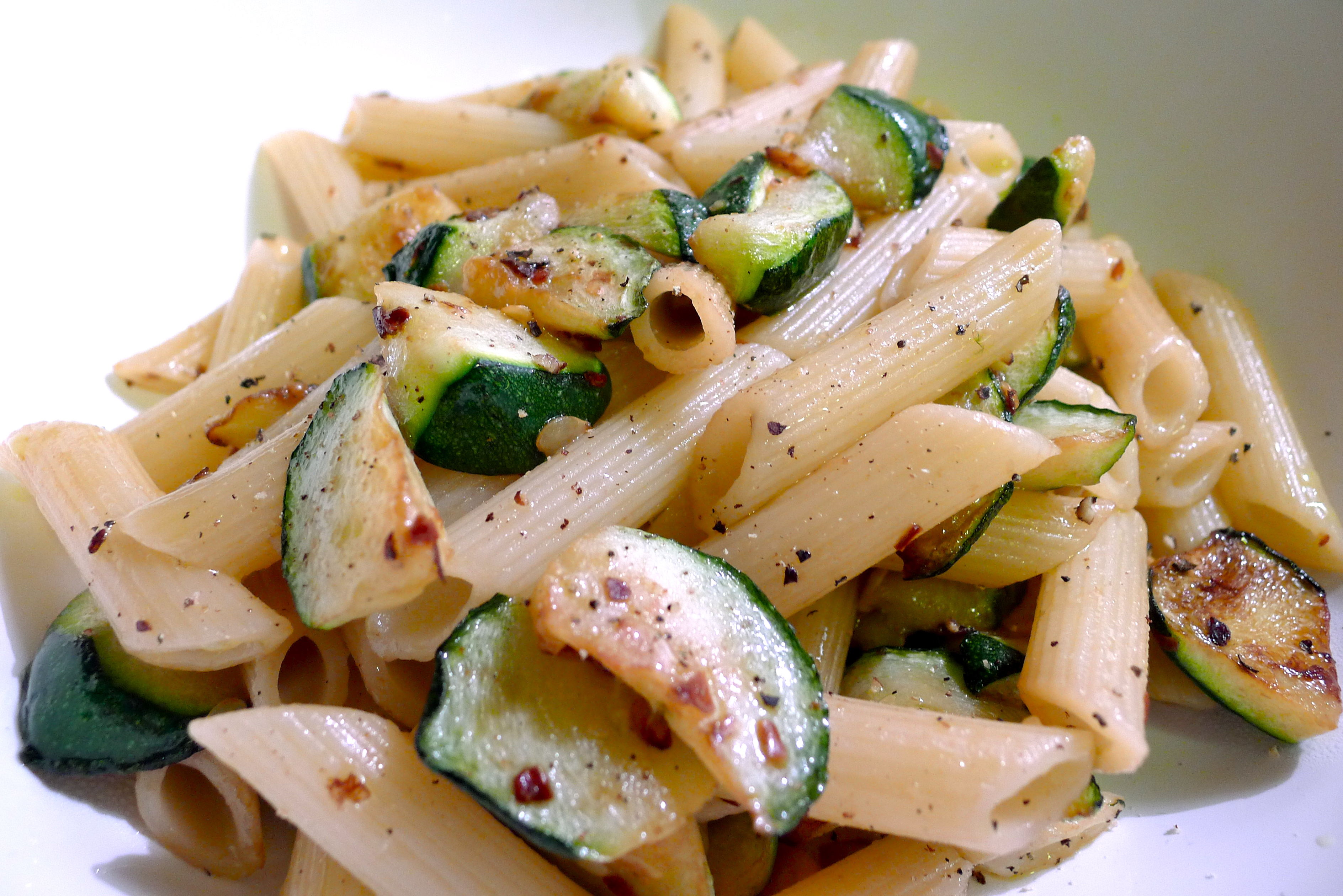
Penne with Pan-Roasted Zucchini and Red Chili Pepper Flakes


Have you ever polished off all the vegetables that you bought at the market with no waste and nothing thrown out? It rarely happen to me as I am an over-exuberant market shopper. I also forget that I sometimes go out, leaving the contents of my fridge and pantry to wait another day.

But I did it on Sunday! Polishing off 8 ears of corn, and the last of the zucchini in the bottom of the crisper! Go me!

Ingredients:

1/3 pound of penne

2 zucchini, cut into equal-sized irregular pieces

2 tablespoons of olive oil

Red chili pepper flakes

Salt and pepper

1 lemon, cut into halves

Freshly grated Pecorino Romano cheese

How to prepare:

1. Bring a pot of salted water to boil. When it starts to boil, add the penne. It should take about ten minutes to cook.

2. After you add the penne to the water, heat the olive oil over medium heat in a large skillet until it begins to shimmer. Add the zucchini. Cook it until it is browned and caramelized on all sides. Right before the penne is done, add as many red chili pepper flakes as you like.

3. Using a slotted spoon, scoop the penne directly into the skillet with the zucchini. Stir everything together to combine, scraping up the fond at the bottom of the pan. There should have been enough pasta water clinging to the penne that you don’t need to add anymore to the pan. If you find the pasta is looking a little dry, add some more pasta water from the pot. Adjust the seasoning, but be aware that the Pecorino will add saltiness as well.

4. Divide the pasta into two bowls. Squeeze one half of a lemon over each portion. Top with cheese and serve immediately.

Corn Pudding


When I first saw this recipe posted on Diner’s Journal, I swore up and down that it wouldn’t work.

Well, I was wrong — and deliciously so.

The recipe is ridiculously easy, and stunningly simple.

It is the purest expression of sweet summer corn.

With the addition of the lime juice and the cayenne, it is practically elote, but in pudding form. As it reminds me so much of Mexican grilled corn on a stick, you just have to add some cheese. Cotija if you have it, Parmigiano-Reggiano is you don’t, or Vella Dry Jack if you have that (I did).

If I make it again, I might add some mayonnaise, just to make it even creamier.

Ingredients:

8 ears of corn on the cob

2 tablespoons of butter

Cayenne pepper

The juice of two limes

Salt and pepper

1/2 to 1 cup of crumbled Cotija, grated Parmesan or Dry Jack

Special equipment:

A box grater

An apron

A cast-iron skillet

How to prepare:

1. Set your oven at 350°.

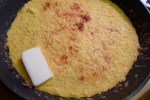
2. Put on your apron. Place the box grater in the cast iron skillet. Using the coarse side, thoroughly grate each ear of corn directly into the pan.

This will be messy. Very messy. But it will be worth it, so keep grating!

3. Evenly spread the milky, grated corn across the pan. Bake it in the oven for about 20-30 minutes, until the edges begin to brown. The top should be golden too. If it isn’t toasted on top, and you are worried about the pudding drying out, you can toss it under the broiler for a few minutes. Or you can just eat it . . . like I did.

4. Remove the pan from the oven. Dust the top with cayenne, about as much as you like. Add the butter. Combine everything together. Add the lime juice a little bit at a time until it suits your taste.  Adjust the seasoning and serve the corn pudding immediately, topped with cheese.

Sliced Andouille Sausage with Boiled Fingerling Potatoes


I can’t say that I would wholeheartedly recommend Elaine Sciolino‘s recently published La Séduction: How the French Play the Game of Life. It’s not that it isn’t interesting, or that the anecdotes that she includes don’t entertain — they do. Maybe it’s the tone. Or the fact that I can’t figure out whether it is meant to be some kind of non-scientific monograph on seduction,  or some kind of memoir.

I will say that if you are in frequent contact with a bunch of French people, it can be illuminating. Had her book been around earlier, it might have given me some insight as to how to have made my graduate-student life easier by not taking things so seriously.

That being said, you can sum up the book like this:

It ain’t fun if it ain’t charming. And if it ain’t charming, it’s probably American.

Maybe that’s why I don’t like the book: the author is clearly very cultured, intelligent, well-read, and well-traveled, but still manages to come off as a frustrating rube.

She’s been living in France since 2002.

In the end, Sciolino cannot help but be charmed over and over again by the French. But each of these “you-won-me-over” moments follows the exact same cycle: Journalist doesn’t understand why the French do X. Journalist seeks the help of the French intellectual crème de la crème to help explain it to her. She still doesn’t understand, and protests using the the biggest American clichés and cultural stereotypes at her disposal. She tries it out reluctantly. It works. She is now a converted.

There was one chapter that I very much enjoyed: the story about when Guy Savoy (Guy Savoy!) invited her to take a quick trip with him to his mother’s house to have lunch with his family.

It might almost be worth the book — or at least reading it in the bookstore, and then putting it back on the shelf.

Even when Savoy is chez maman, he can’t help being in control: Where is the cream! Where is the knife! No, the one that cuts! Smell this! Try this! Where are the glasses! Champagne!

And the meal is fabulous. Full of stick-it-to-your ribs country goodness: salad, andouille, butter, potatoes, côte de boeuf, petits pois, morels, vanilla and raspberry ice cream, more cream, white sugar, meringue, hazelnut biscuits, coffee, obligatory nap.

On their way back to Paris, Savoy admits that he had never brought an outsider to his mother before. Why, Sciolino asks, did he take her?

To which Savoy replies (and this is exquisite), “I didn’t do it for you, I didn’t do it for me. I did it for France.”

But of course.

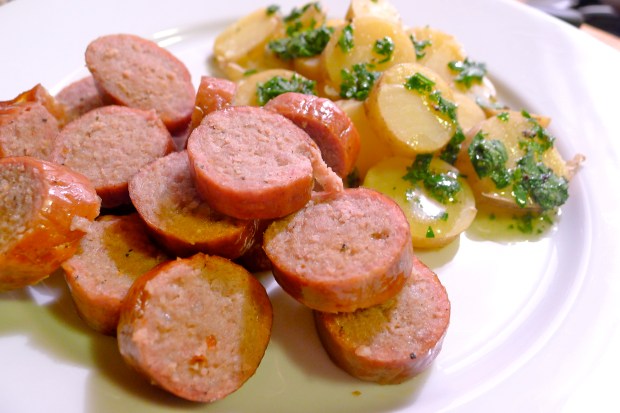
So of course after reading that, I had to have my own simple little country affair: just some excellent CSA andouille done in the oven, served with boiled local fingerling potatoes cut into coins. Melted butter and parsley.

Does that need a recipe?

Probably not, but I have found that there is a helpful order of preparation:

1. Set your oven to 350°.

2. In a large pot of salted water, boil the potatoes until you can easily pierce them with a paring knife. Drain them and set them aside to cool enough so you can handle them without burning your fingers.

3. Rub the andouille with olive oil, and pop it in the oven. It should cook for about 10-15 minutes. The andouille that I get from my CSA is pretty lean, so it might cook more quickly than yours. Check it after about 10 minutes for doneness, and leave it in the oven for longer if it needs more time.

4. In a small saucepan over low heat, melt about 4 tablespoons of butter with 1 teaspoon of salt and freshly ground black pepper. When the butter is melted, turn off the heat and add about a tablespoon of finely chopped parsley.

5. When the sausage is done, slice it into coins, along with the fingerling potatoes. Spoon the melted butter and parsley on top of the potatoes, and serve immediately.

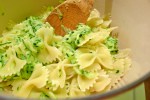
Farfalle with Yogurt and Zucchini


Okay, I’ll admit it: I’ve dabbled in Ayurvedic cooking.

I don’t remember exactly what drew me to it. I think I liked the idea of eating according to your mind-body type. There was something medieval about it, like eating to balance bodily humors but without the phlegm!

Ayurveda has three divisions called doshas which correspond to space and air (vata), fire and water (pitta), and water and earth (kapha). A balanced person is someone who has all three doshas in harmony, but most of us tend to have more of one or two, or less of one than another. By eating foods associated with the doshas that you are deficient in, you can work towards regaining balance.

Okay, that might be a ridiculous over-simplification of Ayurveda (and probably inaccurate as such), but that is also as far as I got. The only other things that I remember is that hing is a really smelly thing to have in the kitchen, and that I should eat a lot of yogurt.

This recipe from Food & Wine made me think of that. One might consider using yogurt as a savory sauce to be a little strange, but it is actually quite wonderful. Warm, the sauce is thick and creamy. Cooler, it becomes thicker, but it is still tasty.

I modified the recipe slightly. I also changed the proportions and cooking times from the original to keep the zucchini vividly green. It is also a good way to use all the nice zucchini that has been in the market lately.

This recipe will serve 2.

Ingredients:

1/3 pound of dried farfalle

1 medium zucchini, coarsely shredded

1 knob of butter

1 cup of whole-milk Greek yogurt

1/4 cup of grated Pecorino (optional)

Salt and pepper

Grated nutmeg

How to prepare:

1. Bring a pot of salted water to boil. Add the pasta.

2. While the pasta is cooking, prepare the sauce. In a small saucepan, melt the butter over medium-low heat. When it has melted completely, turn off the heat and add the yogurt. Stir the yogurt and the butter together until the sauce is nice and smooth. Add the Pecorino if you have it, along with a good grating of nutmeg. Grind some fresh pepper into the sauce, and adjust the seasoning if it needs more salt.

3. Just right before the pasta is al dente, add the grated zucchini to the pot. Cook the zucchini for 30 seconds before draining it very well. The zucchini will hold a lot of water, so make sure you give your colander a few good shakes before returning everything back to the pot. Add the sauce and toss well. Serve immediately.

High Point Farms: Fall CSA Membership Drive is on!


CSA sign-ups for the fall have begun!

The upcoming distribution cycle will run every other Thursday from September to November.

Pick-up dates are as follows:

• September 8
• September 22
• October 6
• October 20
• November 3
• November 17

Pick-up will run from 4:30 to 7:00PM.

There will be two pick-up sites this round:

Manhattan (with yours truly):

Jimmy’s 43 (43 East 7th Street, between First and Second Avenues)

Brooklyn (with awesome Sam):

CrossFit Virtuosity Williamsburg (221 North 8th St, between Driggs and Roebling)

Sign up to meet your meat here.

Cream of Golden Summer Squash

Didn’t I just make this soup?

Summer time vegetables are terrific to turn into soups which can be served both hot and cold. As you can see, the basic template for a puréed soup is pretty simple, and infinitely adaptable:

1. Sauté your alliums (onion, shallots, garlic, etc.) in butter and olive oil until soft and translucent.

2. Add your chopped vegetables to the pot, warming them in the oniony mixture.

3. Cover with water. Cook until tender.

4. Purée and adjust seasoning.

Golden summer squash is in season right now. And it makes a soup the color of sunshine.

Ingredients:

1 knob of butter

1 tablespoon of olive oil

1 small onion, chopped

2 golden summer squashes, cut into 1-inch pieces

2 tablespoons of crème fraîche

Water

Fresh basil

Special Equipment:

A hand-held immersion blender

How to prepare:

1. In a medium sauce-pan (about 2 quarts), heat the butter and the olive oil together over medium heat until it begins to foam. Add the chopped onion, and sauté it until it is translucent. When the onions begin to get a twinge of goldenness, add the squash. Toss and warm everything together for about another a minute or two. Make sure that the squash is well-coated with the onion mixture.

2. Cover the squash with about 1/2-inch of water. Add a few healthy pinches of salt, and simmer everything until the squash is nice and tender. When the squash is done, turn off the heat. Using an immersion blender, purée the vegetables in the pan (makes for easier clean-up). You want the texture to be smooth and creamy. If the soup seems a little thick, you can add some more water to thin it. Stir in the crème fraîche. Adjust the seasoning (I just use salt because I like to keep the vibrant color of the soup unmarred by little flecks of black pepper).

3. Top the soup with a chiffonade of basil, and serve it hot or cold. If you serve it cold, it will thicken upon standing.

Cream of Carrot Soup with Cumin and Honey

With puréed soups, sometimes I use water, not stock for the base. If the vegetables are lovely and in-season, I just want a pure taste with minimal distractions.

Carrots pair well with cumin, and the honey heightens their natural sweetness.

Ingredients:

1 knob of butter

1 tablespoon of olive oil

1 small onion, chopped

Ground cumin

1 bunch of carrots (about a pound), peeled, or well-scrubbed, and cut into 1/2 inch pieces

1-2 tablespoons of honey

Water

Salt to taste

Special Equipment:

A hand-held immersion blender

How to prepare:

1. In a medium sauce-pan (about 2 quarts), heat the butter and the olive oil together over medium heat until it begins to foam. Add the onions, and sauté them in the butter until they are translucent. When the onions begin to get a twinge of goldenness, sprinkle them lightly with cumin (a little goes a long way). Toss the onions and the cumin together for about 20 to 30 seconds. You want the ground spice to become a little fragrant and toasted, but not burnt. Add the carrots, and toss them with the onions.  Warm everything together for about a minute or two, making sure that the carrots are well-coated with the onion mixture.

2. Cover the carrots with about 1/2-inch of water. Add a few healthy pinches of salt, and simmer everything until the carrots are nice and tender. When the carrots are done, turn off the heat. Using an immersion blender, purée the vegetables in the pan (easier clean-up, no?). You want the texture to be smooth and creamy. If the soup seems a little thick, you can add some more water to thin it. Stir in the honey. Start with one tablespoon, and add another if you feel like the soup needs more sweetness. Adjust the seasoning (I only use salt because I like to keep the vibrant orange smoothness of the soup unmarred by little black flecks of pepper).

3. Top the soup with a dollop of crème fraîche, and serve it hot or cold. If you serve it cold, it will thicken upon standing.