Peanut Butter and Jelly Tart with Concord Grape Sauce


Fall is my favorite time of year.

I love the crisp air, and harvest time, and hayrides, and watching the leaves turn colors.

I love squash, and apples, and spice, and all those nice things that we start eating when the weather begins to get cooler. I love being able to turn on my oven again without turning my apartment into a sauna. I love roasted meats, and roasted vegetables. It is wonderful that is getting chilly enough to be able to eat cheesy, creamy sauces again. I love stew.

We are currently in the throes of Concord grape season — not for much longer, but long enough to partake in what must be the very essence of childhood. Concord grapes have that grapey grapiness that turns your tongue purple with nostalgia. The taste instantly transports me back to lunch in the third grade.

This tart is far from the PBJ’s that I ate as a child, but the flavors are still there — just in a more refined way.

The original recipe from Epicurious seemed a little too sweet to me, so I eliminated the extra brown sugar in the peanut butter topping. Also, the recipe calls for the Concord grapes to be halved and tossed with Concord grape jam as a topping. However, as Concord grapes are pretty fabulous on their own (commercial jam is usually too sweet anyway), I opted to get rid of the topping and make my own Concord grape sauce with local grapes.

Ingredients:

For the crust:

12 5×3-inch graham crackers, broken into pieces

1 cup of salted, roasted peanuts

1/8 teaspoon of allspice

1/2 cup of melted butter

For the filling:

4 ounces of cream cheese, softened

3 tablespoons of butter, softened

1/2 cup of smooth peanut butter

1 cup of heavy cream

1/2 teaspoon of vanilla

About 1/2 cup of Concord grape jam*

For the sauce:

1 pound of Concord grapes

1/2 cup of water

3/4 cup of sugar

A pinch of salt

The juice of 1 lemon

Special equipment:

1 11-inch fluted tart tin with a removable bottom

1 food processor

1 half-size sheet pan

1 strainer

1 fine-mesh strainer

1 hand immersion blender

How to prepare:

1. Set your oven to 350°.

2. While your oven is heating up, blend the graham crackers, the peanuts, and the allspice in your food processor until the nuts are evenly ground up. Add the melted butter, and pulse everything together until the crumbs are evenly moistened.

3. Turn the moistened crumbs out into the fluted tart tin. Using your fingers, firmly press the crumbs evenly into the bottom and up the sides of the tin.

4. Set the tart tin gently on a half-size sheet pan that is lined with parchment paper. Bake the crust in the oven for about 10 to 15 minutes. When the crust is lightly browned and “set,” remove it from the oven and let it cool.

5. While the tart crust is cooling, blend the peanut butter, the butter, and the cream cheese together with an electric mixer set at medium-high speed until the mixture is fluffy. In a separate bowl, whip the cream and the vanilla together until soft peaks form. Fold the whipped cream gently into the peanut butter mixture.

6. Very carefully spread the jam over the bottom of the cooled tart crust. If you have an offset spatula, this is a little easier to do, but it’s okay if you don’t (I do have one . . . something I realized only after the tart was done). Wipe off your spatula, and carefully smooth the peanut butter topping over the top of the jam. Chill the tart in the refrigerator until the tart is firm, about 3+ hours.

7. While the tart is chilling (tart be chillin’!), prepare the sauce. Over a small bowl, slip the skins off of all the Concord grapes (they should come off easily, and if you do this over a bowl, the bowl will catch all of the juices). Reserve the skins, and keep them in separate bowl.

8. Bring the pulp and 1/2 cup of water to a boil in a small saucepan. When the peeled grapes have turned opaque, pour them into a mesh sieve set over a medium-sized bowl. Using a spatula, push the pulp through the sieve. Discard the seeds.

9. Add the grape skins to the bowl of grape pulp. Using an immersion blender, purée the skins and the pulp together. Push the mixture through the fine-mesh sieve set over a bowl, pressing the remains of the grape skins with a spatula to extract all of the juice. Discard the grape skins.

10. In a small saucepan, combine the strained grapes with the sugar and the lemon juice. Set the pan over medium heat until it begins to boil. Skim any foam that you see off of the top. When it begins to boil, lower the temperature until the sauce is just barely at a simmer (be careful that it doesn’t boil over). Keep the sauce at barely a simmer until it has thickened and reduced to a syrupy consistency. When it gets to that point, turn off the heat and let the sauce cool.

11. When the tart has cooled and set, cut it into wedges. Make a pool of grape sauce in the middle of a dessert plate, and place one tart piece on top of the purple puddle. Serve immediately.

* My recipe actually makes quite a bit of sauce, and I imagine that if you prefer to not have any commercial jam in your tart at all, you could just cook the sauce down further — with the addition of a 1/4 cup more of sugar — until you have a thick syrup. Use this instead of the jam as a layer.
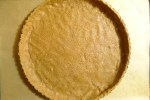
Ricotta-Topped Rigatoni with Tomato, Sausage, and Kale Sauce


I have a new love: Jersey Farms Crushed Tomatoes.

I can eat them straight out of the can. Seriously. They just taste so rich and, well, tomatoey.

All of the tomatoes come from just 6 cooperative farms in New Jersey. Once picked, they are canned within 24 hours with no added water or preservatives, only a little salt. The crushed tomatoes are thick, but not too thick. They are perfect. Just perfect. You almost don’t need any seasoning at all. You practically don’t even need to cook them.

But if you do cook with them, whoa golly, are you in for a treat. These tomatoes make the best pizza sauce. The best anything, really.

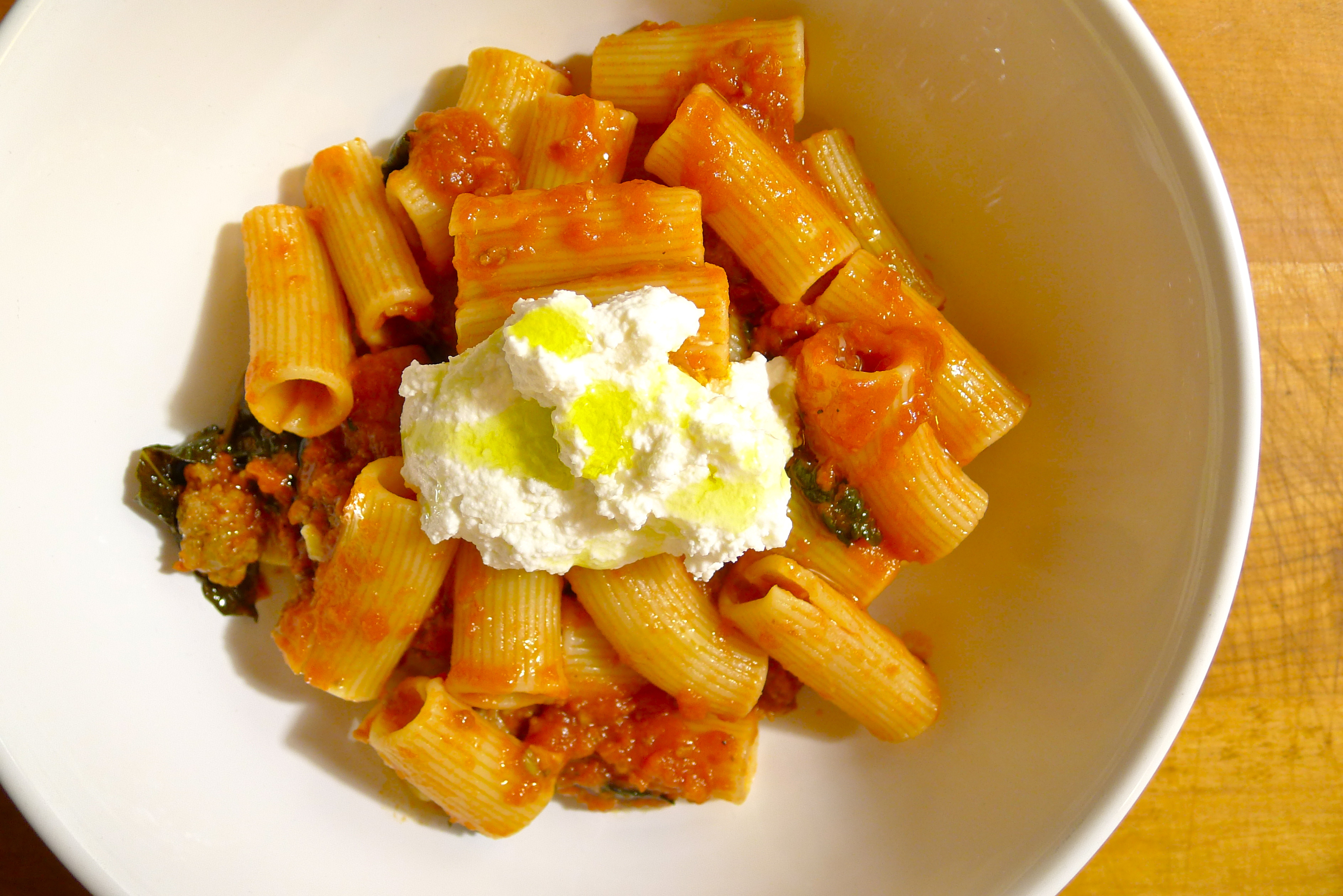
Using some mild beef sausage from my CSA, I made a quick sauce with just garlic, olive oil, and some extra kale I had in the fridge. After rolling some al dente rigatoni in it for a couple of minutes, I topped everything with a sloppy spoonful of creamy, locally-made ricotta. A little drizzle of olive oil to add an extra bit of luster.

And I tell you, it was delicious.

Ingredients:

2 cloves of garlic, finely minced

1 tablespoon of olive oil

1 pound mild Italian beef sausage, casings removed

Red pepper flakes to taste

1 28-ounce can of crushed tomatoes (preferably Jersey Farms Crushed Tomatoes)

2 cups of kale, chopped with the ribs removed

Salt and pepper

1 pound of rigatoni

Whole milk ricotta cheese

More olive oil for drizzling

How to prepare:

1. Heat the olive oil over medium heat in a large casserole, or Dutch oven. When the oil begins to shimmer, sauté the garlic in it until it is fragrant. The garlic should just begin to have a little bit of color, but not too much. Crumble the sausage into the oil, and cook it until it is evenly browned (be sure to break up larger pieces of sausage with the edge of your spoon as you cook). Add as many red pepper flakes as you like. Toss the red pepper flakes with the browned sausage for about a minute before adding the tomatoes.

2. Carefully pour in the crushed tomatoes. If the sauce seems too thick to you, you can add some water to thin it out a little bit. Stir everything together. Lower the heat, and let the sauce simmer for about 15-20 minutes before adding the kale.

3. In the meanwhile, bring a large pot of salted water to boil. When the water begins boiling, add the pasta and cook it until it is al dente.

4. Let the kale wilt in the sauce while the pasta cooks. Adjust the seasoning.

5. When the pasta is done, drain it well. You will add about a ladleful of sauce per 1/4 pound of pasta. Toss everything together, and then divide the pasta into warmed bowls.

6. Top each serving of pasta with a nice, fat dollop of ricotta cheese. Drizzle some olive oil on top of everything. Before eating, be sure to mix the ricotta into the pasta with your fork!

Black Bean Salad with Oven-Roasted Tomatoes, Corn, Almonds, and Lemon Zest


This is another great recipe adapted from Heidi Swanson’s Super Natural Every Day. Swanson, whose blog 101 Cookbooks is an amazing source of ideas and inspiration, makes food that is healthy, wholesome, a little quirky, always delicious, and never preachy.

The great thing about her vegetarian recipes is how amenable they are to your tastes. You can substitute chicken for tofu, or add shrimp, or beef, or pork, and the dishes will still be great.

For this recipe, I added local corn and the farfalle. Since Hurricane Irene, our farmers need all the help we can give them. Though NYC was mostly spared, many of the farmers and growers who bring the literal fruits of their labor every week to us were not. Almost no farm was left untouched by the flooding.

Support local and please make a donation here.

Ingredients:

1 pint of Sun Gold tomatoes (cherry or grape tomatoes work too), halved

Salt and pepper

Granulated cane sugar

Olive oil

3/4 cup of raw almonds, halved width-wise

1 cup of corn kernels (about two ears)

2 15-ounce cans of black beans, rinsed and drained

1/3 pound of farfalle, prepared according to package directions

The grated zest of one lemon

The juice of one lemon

1/4 pound of French feta, crumbled

How to prepare:

1. Preheat your oven to 350°.

2. Line a rimmed baking sheet with parchment paper. Spread the tomato halves over the sheet and sprinkle them liberally with salt and sugar. Drizzle the halves with olive oil. Toss everything together so that the tomatoes are evenly coated in the oil, salt, and sugar. Arrange the tomatoes cut-side up. Roast them until they have shrunken, and have begun to caramelize around their edges, about 45 minutes. Remove them from the oven, and when they are cool, scrape them into a large bowl along with all their caramelized juices.

3. Meanwhile, heat the almonds in a single layer in a large cast-iron skillet set over medium heat. Toss them around every couple of minutes until they are fragrant and toasty. Be sure to monitor the nuts closely; they can burn in a minute! When the almond halves are toasted, add them to the same large bowl as the tomatoes.

4. Wipe out the skillet and add about 1 tablespoon of olive oil. Heat the pan over medium-high heat until the oil begins to shimmer. Add the corn, and toss the kernels in the hot oil until they begin to brown. Add the corn to the same large bowl as the almonds and tomatoes.

5. Add the remaining ingredients to the bowl and drizzle everything with olive oil. Toss everything together well. Adjust the seasoning and serve.

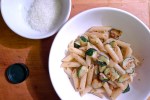
Penne al Pomodoro Crudo (Penne with Raw Tomato Sauce)


Indian summer, that strange spike in temperature and humidity that occurs following the first frost. Okay, so maybe we haven’t had a first frost yet, but the weather in the Mid-Atlantic has been so screwy lately that it makes me feel like anything goes.

I just know that it has been pretty warm out, warm enough to make me still crave food that minimally requires use of my stove.

Pomodoro crudo is the simplest of sauces, and an excellent way to savor the very last of this season’s tomatoes. I used a big, fat heirloom tomato, the jolie-laide of summer fruit. A little gnarly, very misshapen, but incredibly full, flavorful, and delicious.

And it goes without saying that the better your core ingredients, the better the sauce will be.

Ingredients:

About 1 to 1 1/2 pounds of very good, very ripe tomatoes

1 clove of garlic, lightly crushed

About 2 tablespoons of excellent extra-virgin olive oil

Salt and pepper

Fresh basil

About 1/3 pound of dried penne

How to prepare:

1. Bring a large pot of water to boil.

2. Set up a large ice water bath.

3. When the water begins to boil, score an X on the bottom of each tomato. Drop the tomatoes gently into the boiling water and leave them in for about 20-30 seconds, depending on how big your tomatoes are. Remove them carefully from the boiling water, and slip them into the ice water bath. You should now be able to easily remove the skin of each tomato.

4. Once all the tomatoes are peeled, cut them in half and remove the seeds. Chop each tomato, and transfer everything to a medium-sized bowl. Season the tomatoes with salt and pepper to taste (you can salt liberally). Add the olive oil and the crushed clove of garlic. Stir everything together, and let the sauce sit covered and undisturbed on the counter for about 30 minutes.

5. Bring a large pot of salted water to boil. Add the penne and cook it until it is just slightly under-al dente. Drain the pasta and add it to the sauce. Toss everything together, and remove the garlic clove.

The pasta should begin to absorb some of the excess liquid in the sauce.

Hand-tear a handful of basil and add it to pasta. Toss again, and serve.

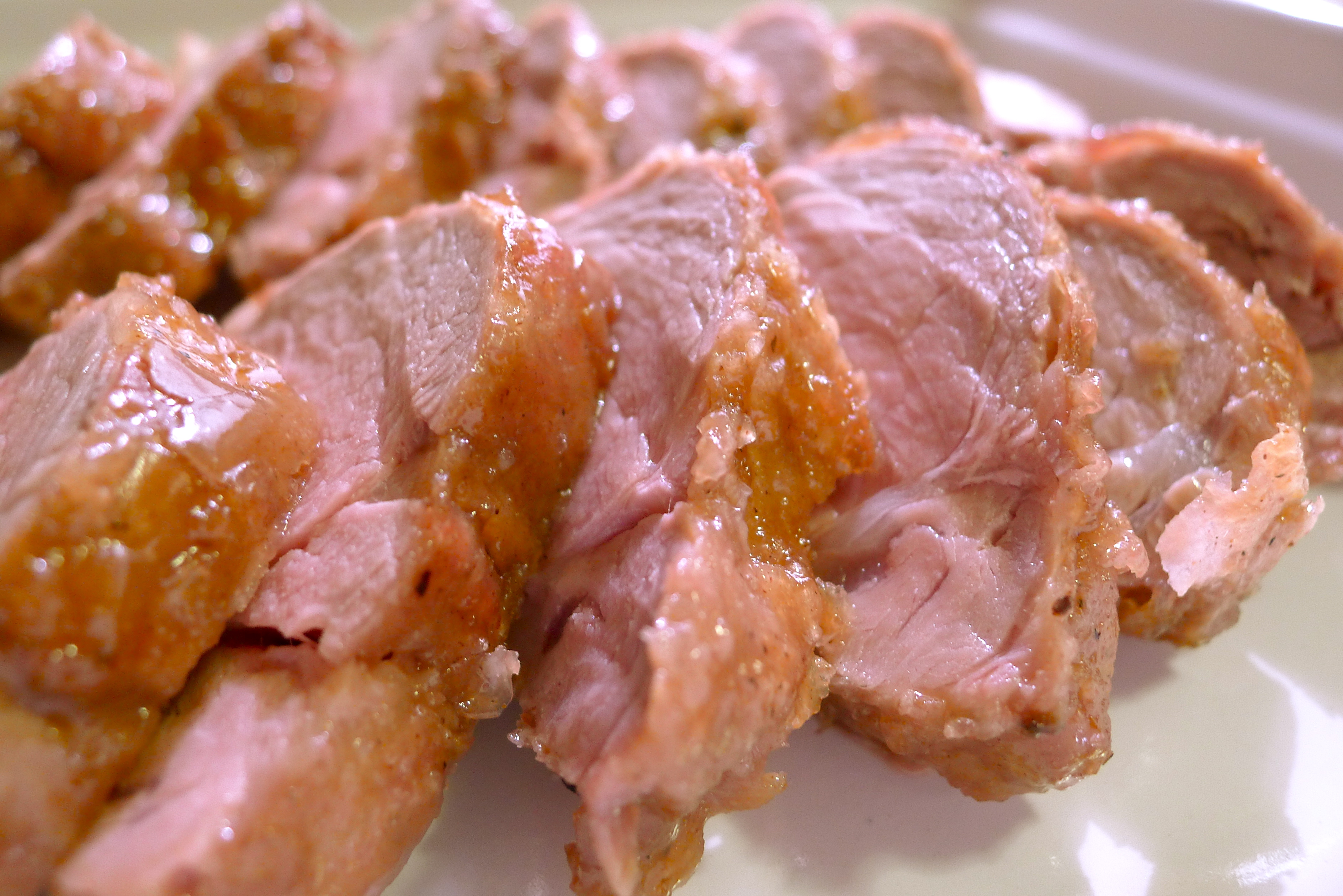
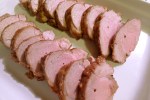
Maple-Bourbon Glazed Pork Tenderloin


Another freely-adapted recipe from Cook’s Illustrated. It takes a page from Korean fried chicken in terms of using corn starch to create a crispy, crackly exterior that the maple-bourbon glaze can adhere to.

The pastured pork tenderloin was also a birthday gift from dear Tina at High Point Farms. It went wonderfully with Bob’s Cabernet Franc!

Thank you, thank you, thank you!

More people should give meat for birthdays.

Ingredients:

1 pork tenderloin (about 1 1/4 to 1 1/2 pounds)

3/4 cup dark maple syrup (Grade B)

1/4 cup brown sugar, packed

2 tablespoons of bourbon

A pinch of ground cinnamon

A pinch ground cloves

Cayenne pepper to taste

Salt

1/4 cup of cornstarch

Kosher salt

Ground black pepper

2 tablespoons vegetable oil

Special equipment:

half-size sheet pan

wire rack to fit the sheet pan

leave-in meat thermometer

How to prepare:

1. Adjust the oven rack to the middle position, and heat the oven to 375°.

2. In a small bowl, combine the maple syrup, the bourbon, and the brown sugar together, stirring until you have an even slurry. Add the ground cinnamon, ground cloves, and cayenne pepper. Add a hefty pinch of salt. Set this aside to let the sugar dissolve a little bit.

Stir the cornstarch, salt, and black pepper together in another small bowl until well-combined. Feel free to increase or decrease the seasoning according to your personal taste. Transfer the cornstarch mixture to a rimmed baking sheet. Pat the tenderloin dry with paper towels, and then roll it in the cornstarch mixture until it is evenly coated on all sides.

Shake off the excess cornstarch mixture.

3. Heat the oil in a large cast-iron skillet over medium-high heat until it just begins to smoke. Reduce the heat to medium, and place the tenderloin in skillet. If the tenderloin is a little big for the pan, don’t worry; it will shrink a little bit while cooking. Brown the tenderloin well on all sides. Transfer it to a wire rack set in the rimmed baking sheet.

4. Pour off the excess fat from skillet, and return it to medium heat. Carefully add the sugar slurry to skillet. It might bubble a little violently depending on how hot your pan is, so take care to not stand too close. Scrape up the browned bits on the bottom of the pan with a wooden spoon. Cook the sauce until it has reduced to about ½ a cup, about 2 minutes.

Brush the tenderloin with approximately 1 tablespoon of glaze. Roast it until a thermometer inserted in thickest part of tenderloin registers 130 degrees. Brush it with another tablespoon of glaze, and continue to roast it until the thickest part of tenderloin reaches 135 to 140 degrees, about 2 minutes more.

Remove the tenderloin from oven, and brush it with the remaining glaze. Let it rest, uncovered, for about 10 minutes.

5. Transfer the meat to a cutting board, and slice it into thick pieces. Serve.

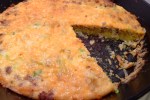
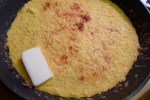
Breakfast Skillet


What a strange August we have been having! Temps in the low 80’s during the day, and cool breeziness at night. Maybe it’s not so strange after all. Maybe I have simply grown so accustomed to expecting oppressively hot and humid August weather over the years, that something nice and clement just blows my mind.

I would never have considered making a skillet breakfast last year, for instance, as it was too hot to make something that has to be baked in a cast-iron!

But this year, it didn’t feel out of place.  Plus, it was a great way to use the casing-less breakfast sausage from my CSA.

Ingredients:

1 to 1 1/2 pounds of Yukon Gold potatoes

1 pound of loose or bulk pork breakfast sausage

2-3 tablespoons of vegetable oil

8 eggs

2-3 tablespoons of green onions, chopped

Salt and pepper

1 cup of shredded Cheddar cheese

Special equipment:

A cast-iron skillet

A box grater

How to prepare:

1. Set your oven to 350°.

2. Bring a large pot of water to boil. Add the potatoes and parboil them for about 6 to 8 minutes, depending on how big they are. They shouldn’t totally raw, but the potatoes shouldn’t be completely cooked through either. Drain them, and set them aside until they are relatively cool enough to handle.

3. While the potatoes are boiling, brown the breakfast sausage in a large cast-iron skillet. Break up any lumps with a wooden spoon. When the sausage is done (you should no longer see any pink, and the meat should be browned in spots), remove it from the pan with a slotted spoon and set it aside.

4. Peel the potatoes. Using a box grater, coarsely shred each one.

5. Wipe out your cast-iron pan, and heat between 2-3 tablespoons of vegetable oil in it over medium heat. Add the potatoes. Season them with salt and pepper. Toss them in the oil until they are evenly coated. Press the shredded potatoes into an even cake against the bottom of the skillet. Let the potato cake brown slowly on the stove top.

6. Meanwhile, whisk together the 8 eggs with the green onions.

7. When the potato cake is starting to brown on the bottom, and the potato shreds are beginning to turn a little translucent, add the egg mixture to the pan. Scatter the shredded cheese on top of the eggs. Let the eggs set up for about a minute or two before putting the skillet in the oven. Bake it for about 15-20 minutes, until the top is golden and puffed. Let cool for about 10-15 minutes before slicing into wedges and serving.

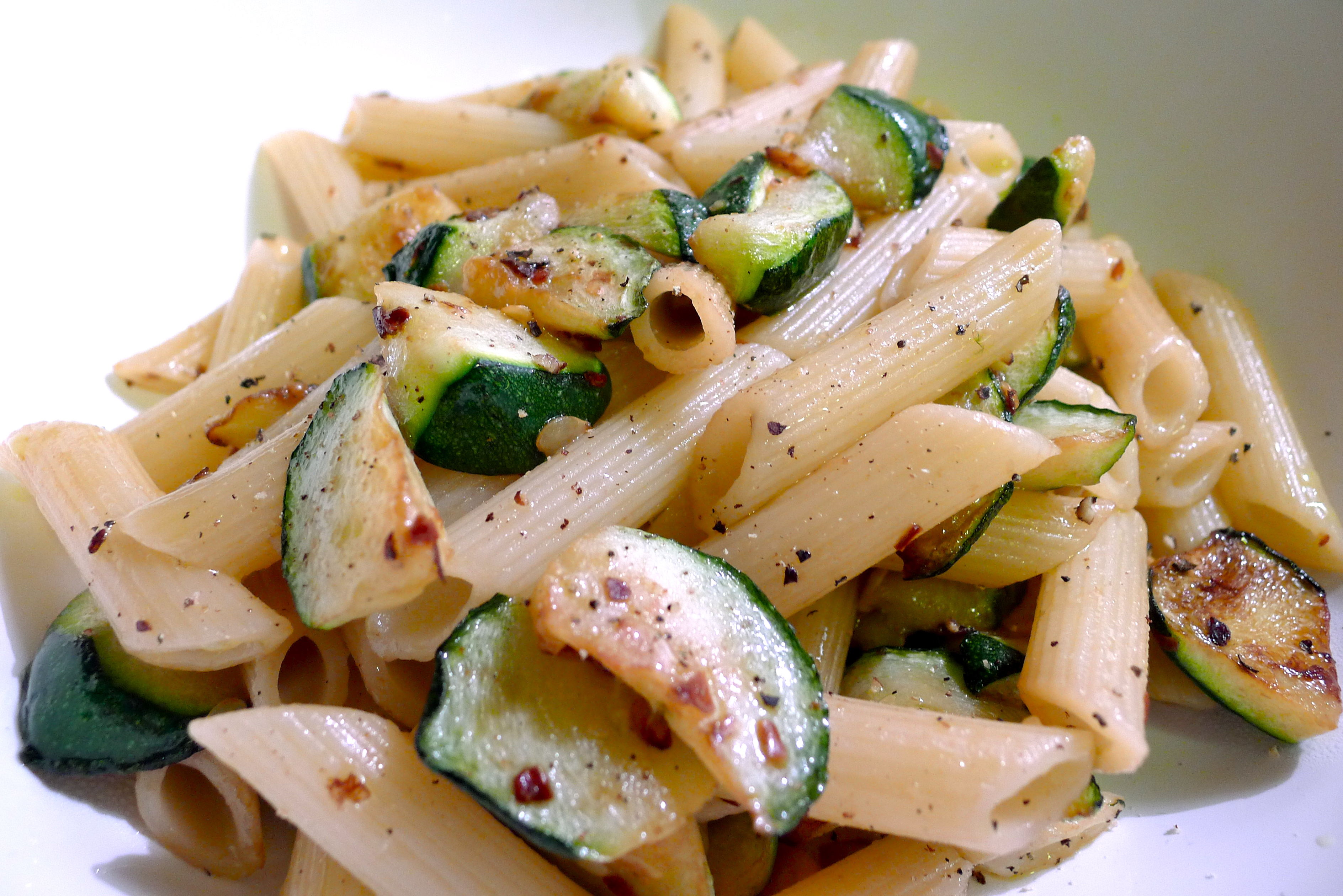
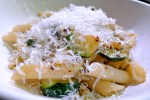
Penne with Pan-Roasted Zucchini and Red Chili Pepper Flakes


Have you ever polished off all the vegetables that you bought at the market with no waste and nothing thrown out? It rarely happen to me as I am an over-exuberant market shopper. I also forget that I sometimes go out, leaving the contents of my fridge and pantry to wait another day.

But I did it on Sunday! Polishing off 8 ears of corn, and the last of the zucchini in the bottom of the crisper! Go me!

Ingredients:

1/3 pound of penne

2 zucchini, cut into equal-sized irregular pieces

2 tablespoons of olive oil

Red chili pepper flakes

Salt and pepper

1 lemon, cut into halves

Freshly grated Pecorino Romano cheese

How to prepare:

1. Bring a pot of salted water to boil. When it starts to boil, add the penne. It should take about ten minutes to cook.

2. After you add the penne to the water, heat the olive oil over medium heat in a large skillet until it begins to shimmer. Add the zucchini. Cook it until it is browned and caramelized on all sides. Right before the penne is done, add as many red chili pepper flakes as you like.

3. Using a slotted spoon, scoop the penne directly into the skillet with the zucchini. Stir everything together to combine, scraping up the fond at the bottom of the pan. There should have been enough pasta water clinging to the penne that you don’t need to add anymore to the pan. If you find the pasta is looking a little dry, add some more pasta water from the pot. Adjust the seasoning, but be aware that the Pecorino will add saltiness as well.

4. Divide the pasta into two bowls. Squeeze one half of a lemon over each portion. Top with cheese and serve immediately.

Corn Pudding


When I first saw this recipe posted on Diner’s Journal, I swore up and down that it wouldn’t work.

Well, I was wrong — and deliciously so.

The recipe is ridiculously easy, and stunningly simple.

It is the purest expression of sweet summer corn.

With the addition of the lime juice and the cayenne, it is practically elote, but in pudding form. As it reminds me so much of Mexican grilled corn on a stick, you just have to add some cheese. Cotija if you have it, Parmigiano-Reggiano is you don’t, or Vella Dry Jack if you have that (I did).

If I make it again, I might add some mayonnaise, just to make it even creamier.

Ingredients:

8 ears of corn on the cob

2 tablespoons of butter

Cayenne pepper

The juice of two limes

Salt and pepper

1/2 to 1 cup of crumbled Cotija, grated Parmesan or Dry Jack

Special equipment:

A box grater

An apron

A cast-iron skillet

How to prepare:

1. Set your oven at 350°.

2. Put on your apron. Place the box grater in the cast iron skillet. Using the coarse side, thoroughly grate each ear of corn directly into the pan.

This will be messy. Very messy. But it will be worth it, so keep grating!

3. Evenly spread the milky, grated corn across the pan. Bake it in the oven for about 20-30 minutes, until the edges begin to brown. The top should be golden too. If it isn’t toasted on top, and you are worried about the pudding drying out, you can toss it under the broiler for a few minutes. Or you can just eat it . . . like I did.

4. Remove the pan from the oven. Dust the top with cayenne, about as much as you like. Add the butter. Combine everything together. Add the lime juice a little bit at a time until it suits your taste.  Adjust the seasoning and serve the corn pudding immediately, topped with cheese.

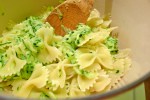
Farfalle with Yogurt and Zucchini


Okay, I’ll admit it: I’ve dabbled in Ayurvedic cooking.

I don’t remember exactly what drew me to it. I think I liked the idea of eating according to your mind-body type. There was something medieval about it, like eating to balance bodily humors but without the phlegm!

Ayurveda has three divisions called doshas which correspond to space and air (vata), fire and water (pitta), and water and earth (kapha). A balanced person is someone who has all three doshas in harmony, but most of us tend to have more of one or two, or less of one than another. By eating foods associated with the doshas that you are deficient in, you can work towards regaining balance.

Okay, that might be a ridiculous over-simplification of Ayurveda (and probably inaccurate as such), but that is also as far as I got. The only other things that I remember is that hing is a really smelly thing to have in the kitchen, and that I should eat a lot of yogurt.

This recipe from Food & Wine made me think of that. One might consider using yogurt as a savory sauce to be a little strange, but it is actually quite wonderful. Warm, the sauce is thick and creamy. Cooler, it becomes thicker, but it is still tasty.

I modified the recipe slightly. I also changed the proportions and cooking times from the original to keep the zucchini vividly green. It is also a good way to use all the nice zucchini that has been in the market lately.

This recipe will serve 2.

Ingredients:

1/3 pound of dried farfalle

1 medium zucchini, coarsely shredded

1 knob of butter

1 cup of whole-milk Greek yogurt

1/4 cup of grated Pecorino (optional)

Salt and pepper

Grated nutmeg

How to prepare:

1. Bring a pot of salted water to boil. Add the pasta.

2. While the pasta is cooking, prepare the sauce. In a small saucepan, melt the butter over medium-low heat. When it has melted completely, turn off the heat and add the yogurt. Stir the yogurt and the butter together until the sauce is nice and smooth. Add the Pecorino if you have it, along with a good grating of nutmeg. Grind some fresh pepper into the sauce, and adjust the seasoning if it needs more salt.

3. Just right before the pasta is al dente, add the grated zucchini to the pot. Cook the zucchini for 30 seconds before draining it very well. The zucchini will hold a lot of water, so make sure you give your colander a few good shakes before returning everything back to the pot. Add the sauce and toss well. Serve immediately.

Cream of Golden Summer Squash

Didn’t I just make this soup?

Summer time vegetables are terrific to turn into soups which can be served both hot and cold. As you can see, the basic template for a puréed soup is pretty simple, and infinitely adaptable:

1. Sauté your alliums (onion, shallots, garlic, etc.) in butter and olive oil until soft and translucent.

2. Add your chopped vegetables to the pot, warming them in the oniony mixture.

3. Cover with water. Cook until tender.

4. Purée and adjust seasoning.

Golden summer squash is in season right now. And it makes a soup the color of sunshine.

Ingredients:

1 knob of butter

1 tablespoon of olive oil

1 small onion, chopped

2 golden summer squashes, cut into 1-inch pieces

2 tablespoons of crème fraîche

Water

Fresh basil

Special Equipment:

A hand-held immersion blender

How to prepare:

1. In a medium sauce-pan (about 2 quarts), heat the butter and the olive oil together over medium heat until it begins to foam. Add the chopped onion, and sauté it until it is translucent. When the onions begin to get a twinge of goldenness, add the squash. Toss and warm everything together for about another a minute or two. Make sure that the squash is well-coated with the onion mixture.

2. Cover the squash with about 1/2-inch of water. Add a few healthy pinches of salt, and simmer everything until the squash is nice and tender. When the squash is done, turn off the heat. Using an immersion blender, purée the vegetables in the pan (makes for easier clean-up). You want the texture to be smooth and creamy. If the soup seems a little thick, you can add some more water to thin it. Stir in the crème fraîche. Adjust the seasoning (I just use salt because I like to keep the vibrant color of the soup unmarred by little flecks of black pepper).

3. Top the soup with a chiffonade of basil, and serve it hot or cold. If you serve it cold, it will thicken upon standing.