Oven-Roasted Baby Back Ribs, Part II

Baby got back.
A couple of months ago, Edna at expatedna.com published a post about some of the strange search terms that have led to her blog. Some of the weirdest that she cited were: “German army uniform 2012,” “watered down biracial baby with mongolian spot,” and “if i’m part asian does it still make me racist?”

If only I were so lucky! In the entire time that I have maintained this blog, I have not had one strange search lead to me. Not. One. Single. Weird. Search.

You know what that means?

It means I’m boring.

To be more interesting, maybe I should have a plushie chase me across a Croatian nudist beach covered with technicolor Rastafarian Jesus squirrels wearing sequin pasties and rubber panties!

No, I’m not actually going to do that πŸ™‚ I just wanted to up the chances of a strange search ending up here πŸ™‚

Anyway, among the pedestrian search terms that led people to my blog were: “french breakfast radish recipe,” “juicy pork chops,” and “quick oven baked baby back ribs.”

I know. Very exciting.

Seriously though, this post on oven-roasted baby back ribs remains one of the most popular posts that I have ever done. However, for the number of times that it gets viewed, it has very few comments. I attribute this to one of two things: either my recipe is terrible, or the lead-up to the recipe is misleading.

The recipe is terrific, but the lead-up to the recipe is misleading because it is my mother’s recipe and she lied to me.

See, my mother told me that these ribs would take a mere 30 minutes in the oven. What she neglected to add was that they take about 30 minutes after the first hour

So I’m here to redress this wrong: oven-roasted ribs will take at least 1 hour and 30 minutes to cook. An hour and 30 minutes. You cannot cook ribs faster than that because there is too much connective tissue and collagen to break down. You just can’t. But you should still make these ribs because they are delicious, just plan accordingly.

I had intended to make these ribs for a special occasion, but given the soaring temperatures last week, I was spurred to cook them ahead of time and meet my friends in a nice, air-conditioned restaurant instead. In my haste, I forgot to mix the seasoning with soft brown sugar. I simply rubbed them down with one of Lior Lev Sercarz‘s beautiful spice blends (Pierre Poivre No.7, if you’re interested), and threw them into a 350Β° oven for an hour and a half.

Done and delicious.

Ingredients:

1 or 2 racks of baby back pork ribs

1 heaping tablespoon of steak seasoning or rib rub per rack of ribs

Kosher salt

Special equipment:

One half-size sheet pan

One wire rack to fit the sheet pan

How to prepare:

1. Pre-heat the oven to 350Β°.

2. First remove the membrane on the back of the pork ribs. It’s super easy to do and allows your ribs to cook nice and flat, without curling up. It also makes them much nicer to eat. To do this, flip the ribs bone-side up. Using the flat handle of a spoon or a dull butter knife, loosen the membrane on one end of the rack of ribs. Grasp the loosened end with a paper towel and pull the membrane slowly in the direction of the opposite end. It should come off in one piece. If it doesn’t, you can just grab the torn end and continue. To help visualize, here is a how-to clip from BBQTalk.

3. After drying the ribs with paper towels, rub the seasoning mix into both sides of the rack. Sprinkle both sides with salt and arrange them on the wire rack.

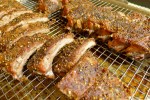
4. Set the racks of ribs in the oven. Carefully pour about 2 1/2 to 3 cups of water into the bottom of the sheet pan. The water should not touch the bottom of the wire rack. Roast the ribs in the oven at 350Β° for an hour to an hour and a half until the ribs are tender and buttery. Remove the pan carefully from the oven. Let the ribs rest for 5 to 10 minutes before slicing and serving.


\

I Made the Ratatouille from Ratatouille for My Students

RΓ©my's ratatouille!
Another semester has come and gone. At the end of each one, regardless what happens during the term, I am always overcome with wanting to hug each of my students and send them out into the world with a macaron. Maybe two.

This class was no exception. Despite a rough and rocky start, I finally learned to relax around them after Spring Break. The change was very welcome. I started spending less time freaking out planning my lessons and more time enjoying talking about some of the topics that interest me the most: history and process, food and memory, taste and identity, sustainability and individual responsibility,  inspiration and experimentation.

The first time that I taught a class on French food, it was the summer that the movie Ratatouille came out. I saw the movie by myself before accompanying two separate groups of students to the theater. Maybe it was the summer heat, or maybe my brain was addled from having seen the movie three times in a row, but I remember standing on the subway platform and cooing at a big, fat rat. “Oooooooh!!!” I squealed, “Look at the cutie pie! He’s got a . . . Subway sandwich!!!! Awwwwwww!!!”

Is it surprising to hear that people moved away from me?

For those of you who haven’t seen it, Ratatouille is a marvel of a movie, a treasure trove of tidbits that you can use to teach French food and culture. Want to explain a brigade by showing a kitchen hierarchy? Want to show the importance of technique and apprentissage? Want to begin a discussion about whether or not cuisine is an art form? Want to perfectly represent archetypal figures of French gastronomy like the stubborn chef, the restaurant critic, or the gastronome? Want to kick off a conversation about Proust? Want it in French and English?

Ratatouille is the movie for you!

As some of you might know, Thomas Keller was the consulting chef for the film. His reinterpretation of the classic ratatouille was also a re-imagining of a popular Turkish dish called Δ°mam bayΔ±ldΔ±, which literally means “the imam fainted (because it was so darn good).” Keller’s ratatouille was first published in The French Laundry Cookbook as an accompaniment to guinea fowl. This “crΓͺpinette de byaldi” subsequently morphed into the confit byaldi featured in the film.

Unlike the traditional ratatouille for which all the vegetables are either stewed together or layered in the same pot and simmered until soft, Keller’s version has you make a simple pipΓ©rade over which you artfully layer very thin slices of eggplant, yellow squash, zucchini, and tomato. It takes a little bit more work, but the result is something much more elegant.

I deviated from the original recipe in order to keep the dish’s preparation more in line with the one seen in the movie. The recipe from The French Laundry Cookbook has you cover the confit with aluminum foil and tightly crimp it around the dish. However, I didn’t want a watery ratatouille, so I cut parchment paper to fit and laid it on top of the confit β€”  just like RΓ©my.

This single dish probably has the greatest carbon-footprint out of any that I have made this year. None of the vegetables are in season. All of them were grown in Peru, with the exception of the tomatoes which came from Holland. However, I wanted to serve my students something that they have been seeing and talking about all semester.

Unfortunately, they polished it off before I could even get a taste of the finished product. I assume it was good, but I have also seen students eat all kinds of weird stuff! In any case, I look forward to revisiting this recipe later in the summer when local eggplants, tomatoes, peppers, and squash are around.

Ingredients:

For the pipΓ©rade

Olive oil

1 large white onion, chopped

1 yellow bell pepper, cored, seeded and diced

1 orange bell pepper, cored, seeded and diced

1 herb sachet made from a sprig of fresh parsley, a sprig of fresh thyme, a sprig of rosemary, and a bay leaf tied up in a cheesecloth bundle.

Salt and freshly-ground white pepper

To assemble the final dish

4 Roma tomatoes, thinly-sliced

1 small eggplant, thinly-sliced

1 yellow squash, thinly-sliced into rounds

1 zucchini, thinly-sliced into rounds

3-4 cloves of garlic, finely minced

1 teaspoon of fresh thyme, minced

2-3 tablespoons of olive oil

Salt and freshly-ground white pepper

How to prepare:

1. Pre-heat the oven to 325Β°.

2. To prepare the pipΓ©rade, heat about 1-2 tablespoons of olive oil in a medium-sized sautΓ© pan over medium heat. When the oil is hot, add the onions. SautΓ© them until they just begin to soften. Add the diced yellow bell peppers and the herb sachet. Continue to cook the vegetables until they are soft, but not browned. Remove and discard the sachet. Adjust the seasoning.

3. Spread the pipΓ©rade in an even layer in the bottom of an oven-proof baking dish. Begin arranging the sliced vegetables over it. You can either do this in rows like I did, or you can create a circular pattern by starting at the edges of the dish and moving towards the center. In any case, you want to alternate and overlap the vegetable slices so that they create a pleasing design.

4. Mix together the garlic, thyme, olive oil, and salt and pepper to taste in a small dish. sprinkle this mixture over the vegetables.

5. Cut a piece of parchment paper to lay on top of the confit. Press it down gently to adhere. Roast the confit until the vegetables have cooked through (the eggplant will take the longest). This should take between 45 minutes to an hour. It might even take over an hour. In all honesty, I can’t really remember since I was a couple of beers in by then. Just start checking it around the 45 minute mark!

6. Remove from the oven and let it cool. The confit can be served hot, warm, or cold.

Mother’s Day Giveaway Winner

Courtesy of Brie :-)
The winner is . . .

The Perfumed Dandy

Congratulations, dear M. Dandy! Kindly contact us with your details via the contact form on this page.

Many thanks to Brie for the lovely guest post, the generous draw, and the wonderful and warm replies to everyone’s comments.

And thank you to everyone who commented!

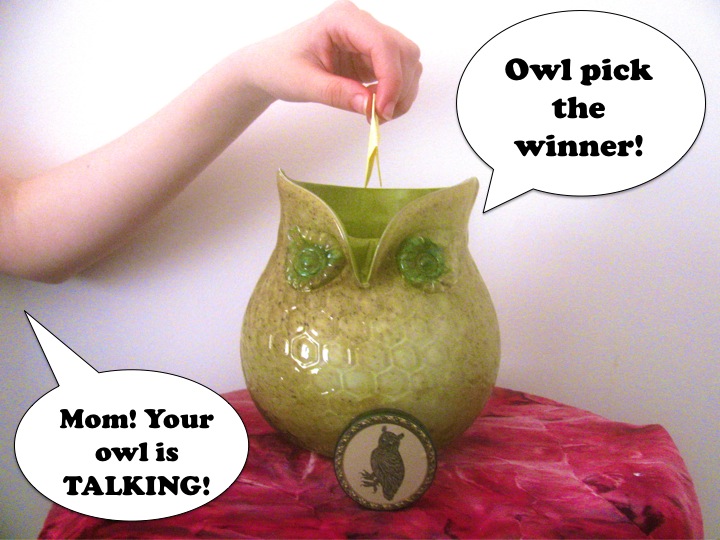
Photo courtesy of Brie and her daughters. Corny captions by yours truly πŸ™‚

Reminder: Last Chance to Enter to Win Mother’s Day Giveaway

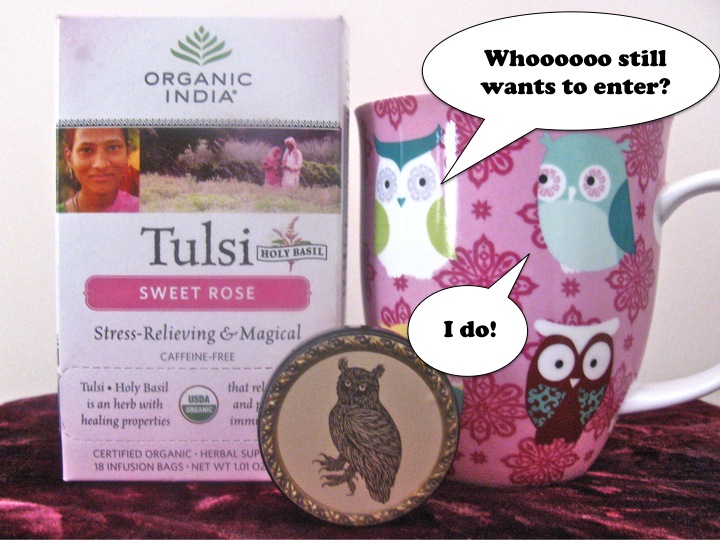
Whooo wants to win?
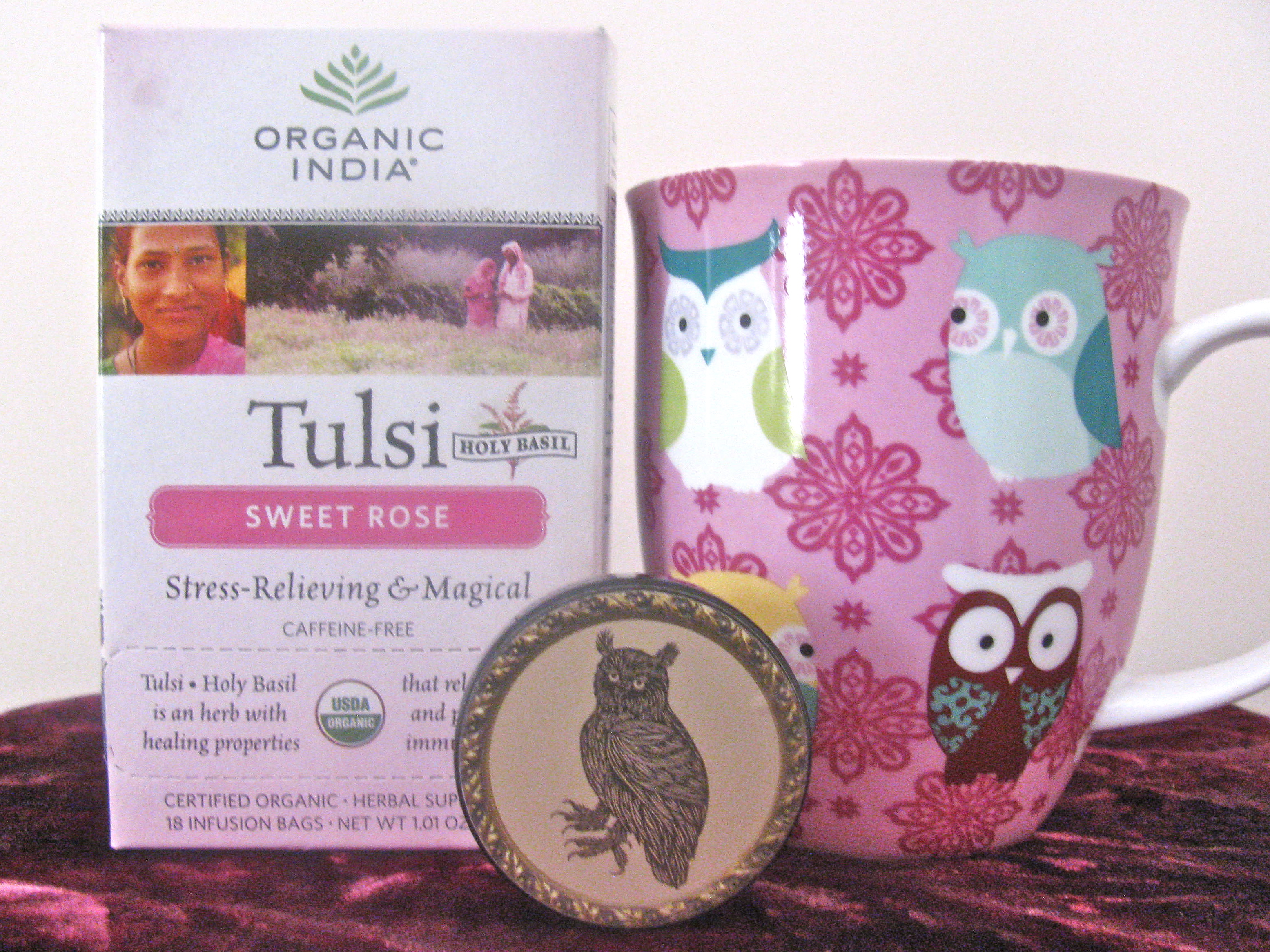
Last chance for one lucky commenter to enter for the chance to win a tea sampler including Organic India’s Tulsi Sweet Rose Tea and a small sample of Soap and Paper Factory’s Owl solid perfume, courtesy of Brie.

To enter, leave a comment below or on the original post and tell us about a special mother or motherly figure in your life.

This drawing will close Sunday, May 19, at midnight EST. Anyone in the US or overseas can enter. The winner will be drawn by Brie and her children from her special ceramic owl. We will announce the winner on this blog in a separate post and also make the announcement on Twitter.

The winner will have one week to contact us with a mailing address. In the case that the winner does not get in touch with us, we will draw again for a runner-up.

Good luck, Everyone!

Guest Post from Brie: A Mother’s Day Story and A Special Perfume Pairing + Giveaway

Sweet roses and tea for mom.
A note from Daisy: After the warm and wonderful reception to Brie’s last Perfume Pairings Guest Post, I have asked her to contribute another one in honor of Mother’s Day.

In about a week, I will finally wrap up a grueling semester of teaching. I very much look forward to getting back to the kitchen and back to my dear Readers. In the meanwhile, I am pleased to hand the reins over to Brie again for this beautiful tribute to her friend’s mother and to all mothers. Enjoy!

Wisdom comes with age, but sometimes age arrives alone, unaccompanied.
Woon Tai Ho, Riot Green

by Brie

Christine is my oldest childhood friend. We have known each other for 42 years. When we met, she lived one flight down from me in an apartment in NYC. Her mother, Catherine, was a bubbly woman of Greek descent who lived life to the fullest. She had an infectious laugh and the ability to always see the glass half full instead of half empty.

One Christmas, Catherine invited all of her daughter’s friends over to present us with gifts that she had chosen quite carefully for each of us. What was revealed after we tore off the wrapping paper were handcrafted ornaments of various animals. I was secretly hoping for the cat (my favorite animal) and was dismayed to see that she had given me an owl instead. Sensing my disappointment, she pulled me aside and quietly whispered, β€œDo you know what the owl represents? Intuitive wisdom. Never forget that you are an owl, not a cat.”

At the time, being four months shy of becoming a teenager, all I cared about was getting what I did not think I had: popularity and attractiveness. Intuition and wisdom were the very last attributes I wanted to cultivate. Sadly, Christine lost her mother to breast cancer a few years later.

Flash forward to ten years ago when I asked my parents to retrieve all of my Christmas ornaments from the common storage room in their apartment building. To my horror, all of my collectibles from Hallmark had been stolen. The only decorations left behind were worthless stragglers, including that owl from Catherine. Despite my first reaction to it all those years ago, I took it back with me. When I hung it on my Christmas tree that year, I thought of Catherine. Her words haunted me and every year following that one, I placed that owl on my tree.

Whoo likes owls now? I do!

Slowly but surely, the owl became my animal, and eventually my three children heard the story of how I came to love them through the Catherine’s wise words.

It should come as no surprise that when I saw Soap and Paper Factory’s Owl solid perfume, I bought it un-sniffed. Luckily for me, it smells fantastic! Owl is a bright, rosy geranium on top of a dry down of sandalwood, tobacco, and vetiver. For a solid and natural perfume, it lasts an incredibly long time. The tea I love to pair it with is Organic India’s Tulsi Tea – Sweet Rose. Tulsi, or holy basil, is an herb renowned in India for its healing properties: it relieves stress and protects the immune system. That beautiful Sweet Rose tea melds so nicely with the Soap and Paper Factory’s Owl perfume.

Three years ago, I included a letter with my yearly holiday card to my friend Christine. I wrote about the exchange between her mother and me. I also included a picture of my owl hanging on the Christmas tree. Last year, she confided that she keeps my letter in a special place and reads it from time to time. I hope that it serves as a reminder that her mother’s memory lives on in the heart of a woman who hopes for wisdom to accompany her into middle age.

Now that I am a mother myself, as challenging as it has been to raise children in a world that isn’t always so wonderful, I can say that motherhood is an experience that I would not have wanted to miss.

Mother’s Day isn’t necessarily about biological mothers, as far as I am concerned. We can get love and that motherly connection from our closest friends. I know because I have! For that reason, I think that is an important to stress that many of us are already “mothers” to others without even knowing it.

This story is dedicated to all mothers: past, present and future.

Happy Mother’s Day to you all!

Thanks to Brie, we also have a special Mother’s Day Giveaway: A tea sampler including Organic India’s Tulsi Sweet Rose Tea, and a small sample of Soap and Paper Factory’s Owl solid perfume. To enter, leave a comment below and tell us who is the “mother” you would like to dedicate this post to.

This drawing will close at midnight EST on May 19. Anyone in the US or overseas can enter. The winner will be drawn by Brie and her children from her special ceramic owl. We will announce the winner on this blog in a separate post and also make the announcement on Twitter.

The winner will have one week to contact us with a mailing address. In the case that the winner does not get in touch with us, we will draw again for a runner-up.

Good luck, Everyone!

Happy Mother’s Day

All the girls in the family.
I don’t have much from my family in terms photos or stories. My mother’s side of the family lost everything during the Cultural Revolution. They left China with almost nothing and made it to the United States in stages.

My grandmother, my mom, and her sisters were the first. Followed almost twenty years later by the boys, my two uncles. This photo is one of the few images that I have of my grandmother and her daughters together.

I think this was taken in Hong Kong in 1964.

We’re kind of a strange family on my mother’s side, bucking almost every Asian stereotype and defying just about every cultural tradition. Everyone in my family is bad at math. No one is lactose-intolerant and those of us who drink, can drink like fishes. Most bizarrely for an Asian family? Girls are favored more than boys β€” much to the consternation of my uncles, brothers, and male cousins who complain that they received zero attention growing up.

My grandmother was a athlete, the star-player on her high school basketball team. She was strong-willed, cultured, and always smelled like Chanel No. 5.

My mom is equally as awesome. She listens to Chinese opera at deafening volumes in the car, proudly has Priscilla Presley’s autobiography on her bookshelf next to Shakespeare’s tragedies, has never missed an episode of Keeping up with the Kardashians, and makes no apologies.

The woman can sass the heck out of you.

I love her so much.

Happy Mother’s Day to my dearest mom and also to all you mothers out there!

(Can you guess who my mom is in the photo? I’ll give you a hint: we both have a penchant for cat’s eye glasses)

From Hanna at Inherit the Spoon: I wasn’t ever hungry as a child

A note from Daisy:

As many of you know, I am a big fan of Hannah’s blog, Inherit the Spoon.

When she recently published this post on poverty and food insecurity, I thought it was so poignant, personal, and well-done that I asked her if I could share it with you.

Thank you, Hannah for bringing my attention back to an issue that I have long been aware of, but haven’t devoted enough time and energy to.

Sichuanese Pork Wontons in Chili-Soy Sauce

Plump dumplings rule!
I have inherited a lot from my mother. In addition to her dry sense of humor, her sarcasm, and her sly potty mouth, I am also the beneficiary of her glossy hair and poreless, flawless skin β€” which she reminds me, while comparing the four zits that I have had in my entire life to her NONE EVER, is actually less flawless than her own.

What I did not get from my mother was my taste for fiery, hot spice, gamy meat, and my willingness to put my overly-trusting ethnically Chinese-self in the hands of white people.

“Who is Fuchsia Dunlop?” my mother asked, “Is she Chinese?”

“Um, no. She’s British.”

“Like British-Chinese?”

“No . . . um, just British.”

Silence.

Asian-child fail!

But it’s really not my fault! My mother is an amazing cook, who has basically decided that she will be taking all her secrets to her grave so I will miss her more when she’s gone. In her kitchen, I am not even sous chef. I am relegated to the status of line-cook. Or bus-person.

Basically she lets me wrap things like egg rolls, dumplings, or leftovers with cling film.

These dumplings are not anything my mother would ever cook. First of all, they are spicy as heck! Secondly, the root of their spice comes from a nice, thick, orange slick of delicious grease! Finally, the recipe is from a white person.

But. They. Are. Delicious.

To the unintiated, Fuchsia Dunlop (who never seems to be known as just Fuchsia or just Dunlop) is a Chinese food phenomenon. Author of the best-selling Shark’s Fin and Sichuan Pepper: A Sweet-Sour Memoir of Eating in China, the book outlines her deep love for Chinese cookery which began as a student at Cambridge, culminated in a move to Chengdu and enrollment in a professional chef’s training course at the Sichuan Institute of Higher Cuisine β€” the first Westerner to ever do so.

Friends, both Asian and not, swear by her books and her recipes, both of which translate Sichuanese and Hunanese cuisine into something effortless, accessible, and authentic-feeling.

I adapted this recipe from one that appeared on Epicurious from Every Grain of Rice: Simple Chinese Home Cooking. I didn’t change parts of it because I had any kind of personal reference β€” apart from eating similar dumplings in restaurants, I don’t. Instead, I altered the recipe because I am apparently lazier than your average Chinese home cook πŸ™‚

However, the results are still divine. Heritage schmeritage! These dumplings tick every single box in terms of a deeply soul-satisfying food experience. Did I mention that they are ridiculously easy to make too? πŸ™‚

Ingredients:

For the sauce

3-4 tablespoons of dark Chinese soy sauce

1 1/2 teaspoons of sugar

3 cloves of garlic, finely minced

3 scallions, finely chopped

3 tablespoons of sesame chili oil with sediment

For the dumplings

1 knob of fresh ginger

1 pound of ground pork

1 egg, beaten

2 teaspoons of Shaoxing wine (a useful buying guide can be found here)

1 teaspoon of toasted sesame oil

3 scallions, finely chopped

Freshly ground white pepper

1 package of wonton wrappers

For garnish

2 tablespoons of roasted peanuts, chopped (Fuchsia Dunlop’s recipe does not call for them, but I think they would be an terrific addition. I would have added if I had them on hand!)

How to prepare:

1. First, prepare the sauce. In a small bowl, whisk together the soy sauce and the sugar. Let the mixture sit for about 5 minutes until all the sugar crystals have dissolved. Once the sugar has dissolved, add the finely minced garlic, the chili oil with sediment, and the finely chopped scallions.

2. Using a rolling pin or the bottom of a heavy coffee mug, crush the knob of unpeeled ginger. Place it in a small dish and cover it with about 2 tablespoons of water.

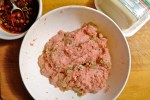
3. In a large bowl, combine the pork with one beaten egg, 2 teaspoons of Shaoxing wine, 1 teaspoon of roasted sesame oil, and 3 teaspoons of the ginger water. Mix well with your hands. Add the scallions and season the meat with white pepper to taste.

As the sauce is relatively salty, I opted to not salt the meat, but you can do so if you prefer.

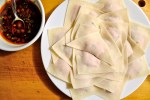
4. Fill a small dish with cold water. Take one wonton wrapper and lay it on a flat surface. Place about a teaspoon of pork filling into the center of the wrapper. Dip a finger in the cold water and run it around the edges. Fold the wrapper in half diagonally and continue until all the pork filling is gone. You should use up about half of the package of wrappers, which you can save and freeze for another time. Lay the wontons out on a large cookie sheet to avoid crowding them onto a plate like I did.

5. While you are wrapping, set a large pot of water to boil. When the water has reached a rolling boil, salt it as if you would for pasta (wontons are essentially ravioli after all). Carefully drop the wontons in one-at-a-time. I only cooked 8-10 at once to ensure that they wouldn’t stick together. When the water has come back up to a boil, add another cup of cold water to the pot. When the water has come up to a boil again, gently scoop up each wonton with a slotted spoon and drain each well. Divide the wontons among however many bowls you want and generously spoon over the chili-soy sauce.

Sprinkle with crushed peanuts, put on a bib, and dive in.

Guest Perfume Post: Jordan River Presents Us a Scented Tale + Spikenard Oil Giveaway

A note from Daisy: This post is courtesy of Jordan River, also known around these parts as The Fragrant Man. As I have been inundated with work these past few weeks, I am quite grateful to place you in his capable hands for a little bit of a departure from our regularly scheduled programming πŸ™‚

Since this post went up yesterday, there has been a little bit of confusion created about the religious nature of it. I would just like to say that I am not a religious person. I did not choose to publish Jordan’s post in order to impose any kind of ideology. What I did like was the idea of being able to travel back in time through scent.

Sometimes when I smell something, I feel instantly transported to another time and space. Those memories need not always be personal and yesterday’s post is an opportunity to reach back and feel a small sliver of what the past might have been like.

Now without further ado, Jordan will take us on a journey to a faraway land filled with mysterious women, men, and precious oils . . .

Alabaster Box

by Jordan River

Are you spending too much on perfume? Here is a scented tale for you.

The Oil in the Alabaster Box

There are many faiths in this world. There are also many myths and legends. It’s up to you to find the truth on your fragrant journey. Let’s travel to the east this Easter to visit a woman living on the boundaries of her culture.

She has recently met a man. She believes him to be her spiritual guide. He is surrounded by men at a dinner party. She is uninvited and has to make her way past the guests in order to be able to offer her teacher a scented gift.

The gift is spikenard oil, an expensive perfume ingredient which at this volume β€” a Roman litra* β€” is the equivalent of spending a year’s salary on a scent. The scent so potent that the home where this story takes place becomes filled with fragrant air.

image

The room grew still
As she made her way to Jesus
She stumbles through the tears that made her blind

She felt such pain
Some spoke in anger
Heard folks whisper
There’s no place here for her kind

Still on she came
Through the shame that flushed her face
Until at last, she knelt before his feet
And though she spoke no words
Everything she said was heard
As she poured her love for the Master
From her box of alabaster

Don’t be angry if I wash his feet with my tears
And I dry them with my hair
You weren’t there the night He found me
You did not feel what I felt
When he wrapped his love all around me and
You don’t know the cost of the oil
In my alabaster box

– lyrics: Janice Sjostran
for chanteuse Cece Winans
– an interpretation of Mark 14:3-9

Judas the accountant thought this money would have been better spent as food for the poor. Nevertheless the teacher accepted this gift from a woman’s heart.

Jesus looked at her with a smile “Your deed will never be forgotten. Your story will be told throughout all the lands, for all time, and in ways you have never even dreamed of.”

Never could she have imagined that one day the story of her alabaster box would be told on the World Wide Web.

* A Roman litra ~ 327 grams

Album Version – Cece Winans – The Alabaster Box
A more melodic version.

Easter Giveaway: Spikenard Foot Oil

We also have a gift to give away. Brie in New York has made some spikenard foot oil especially for this post. If you would like to encounter this scent and look after your own or your loved one’s feet, please leave a comment below or follow Daisy and/or Jordan on Twitter.

The gift recipient will be announced on Easter Sunday and your package will be lovingly mailed to you on Tuesday.

Spikenard or nard originates in India and Nepal, high in the Himalayas. The root of the plant is the source for one of the rarest and most precious oils.

Brie would like to say that she is not a professional perfumer. This is an interest for her. She blends with the best of intentions, carefully choosing oils for their healing properties as well as for their scent. Brie says that spikenard is quite tenacious and challenging to work with. In her experience, it can easily take over the blend (as tea tree oil similarly does).

This giveaway is appearing on multiple platforms. Please visit the other participating blogs for more chances to win. You can enter more than once!

Australian Perfume Junkies

Scents Memory

The Perfume Dandy

All I Am – A Redhead

Jonathan Benno’s Pasta e Fagioli

Don't be a fool, eat yo' pasta fazool!
Nigella does what?!”

Steve from Gourmandistan shook his head incredulously and made a face.

She tells you to put all the fresh herbs in the foot of a nylon stocking and to leave the whole thing in simmering stock for an hour!

“Doesn’t it melt?!”

“Yeah. You would think!”

“That is disgusting.”

Agreed.

A few weeks ago, Steve was in town for the Roger Smith Cookbook Conference and we were talking “food blogger shop” at Roberta’s over craft beer and aioli-coated fried sweetbreads.

Shop that night included pasta e fagioli,

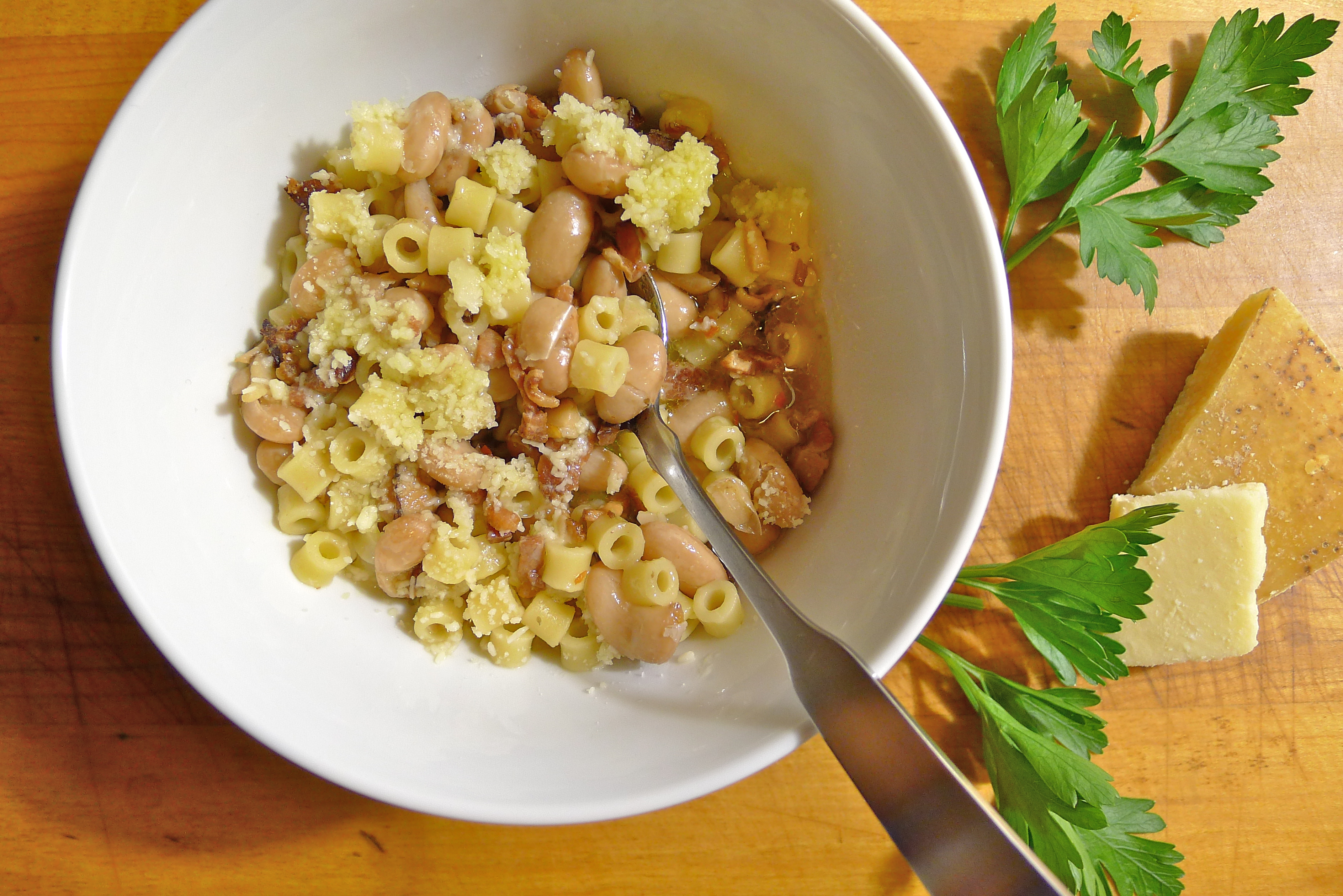
I love pasta e fagioli, affectionately known on these close-to-Jersey shores as pasta fazool. Translated simply as pasta and beans, the name of this humble Italian dish belies its power to soothe and satisfy. Pure alchemy occurs when the nuttiness of the beans Vulcan mind-melds with the pasta in rich rosemary and bay-scented broth. It is warm, wonderful comfort in a bowl and in these waning days of winter, it is the perfect dish.

My current favorite version of pasta e fagioli is from Mario Batali, who starts off his recipe by asking you to mash up a wad of fatback with the back of a spoon until you have a nice and smooth porky paste. Very Italian.

The subject of our mutual alarm was from British celebrity chef Nigella Lawson β€” not Italian at all. Although I like her writing, her recipes leave me cold . . . and extremely skeptical. Like this one for pasta e fagioli in which she asks you to use a “popsock” β€” also known as a knee-high nylon stocking β€” as a herb sachet instead of good, old-fashioned, food-safe, heat-resistant, and dependable cheesecloth.

Now I see the utility of bundling the aromatics used to perfume pasta e fagioli in a sachet; it makes it much easier to remove the spent herbs from the soup if you have them together. It saves you from the futilely fishing around for the gray and bitter spindles of rosemary leaves. However, I draw the line at rooting around in my sock drawer for kitchen essentials. Furthermore, Nigella includes the following sentence in her recipe: “Chuck out the corpsed popsock and its contents [after the beans are tender].”

Not yummy-sounding at all.

I am always on the lookout for a new variation on pasta e fagioli. Recently, New York Magazine published one from Jonathan Benno in which he solves the fresh-herb-removal problem by infusing the stock with Parmesan rinds and aromatics and then straining them all out before use. 

Brilliant!

Benno recommends soaking the dried beans for two days in the refrigerator instead of just one day on the countertop. I’m not sure if the additional day of soaking affects the taste, but I did notice that the beans cooked faster and more evenly. The beans were also creamier.

Heirloom beans are best, but regular old beans work just as well. Traditionally, borlotti beans β€” also called cranberry beans β€” are used in pasta e fagioli, but cannellini beans are a good substitute.

To Benno’s recipe, I have added bacon. Because I can never resist adding bacon to everything πŸ™‚ You can omit it and the soup will still be delicious.

Ingredients:

2 cups of dried beans (preferably heirloom beans like borlotti beans or cannellini beans)

2 quarts of chicken stock (about 8 cups)

1 cup of Parmesan rinds

2 sprigs of fresh rosemary

2 sprigs of fresh thyme

2 sprigs of fresh sage

5 fresh or dried bay leaves

1 pound of bacon ends, chopped (optional)

1 teaspoon of dried oregano

1 teaspoon of crushed red pepper flakes

Salt and pepper to taste

1 1/2 cups of dried ditalini or another kind of small tubular pasta like macaroni

Extra-virgin olive oil

Freshly grated Parmesan

How to prepare:

This soup is not difficult to prepare. However, it does require some advanced planning. Be sure to read the recipe closely before beginning.

1. In a bowl large enough to fit the beans comfortably, cover them with about two inches of cold water. Soak the beans in the refrigerator for two days.

2. When the beans are done soaking, drain them.

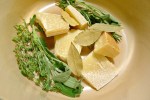
3. Combine the chicken stock, the Parmesan rinds, the fresh herbs, and the bay leaves in a large pot. Simmer everything together for about an hour. Do not the let stock boil. Strain the stock and discard the Parmesan rinds and herbs.

4a. If using, brown the chopped bacon ends in a large skillet until most of the fat has rendered. Drain the bacon bits on paper towels.

4b. Add the soaked and drained beans, the bacon if desired, the dried oregano, and the crushed red pepper flakes to the strained stock. Gently simmer the beans for between 1-2 hours. When the beans are done, they will be creamy in the center. Do not let the liquid come to a boil or the skins can burst. Skim the surface of the soup if and when necessary. Adjust the seasoning.

5. When the beans are tender, add the dried pasta to them. You may need to add more stock or water if the level of the liquid in the pot is too low. When the pasta is al dente, turn off the heat.

To serve, heap a generous spoonful of freshly grated Parmesan on top and finish the soup with a drizzle of good extra-virgin olive oil.