Maple-Bourbon Glazed Pork Tenderloin


Another freely-adapted recipe from Cook’s Illustrated. It takes a page from Korean fried chicken in terms of using corn starch to create a crispy, crackly exterior that the maple-bourbon glaze can adhere to.

The pastured pork tenderloin was also a birthday gift from dear Tina at High Point Farms. It went wonderfully with Bob’s Cabernet Franc!

Thank you, thank you, thank you!

More people should give meat for birthdays.

Ingredients:

1 pork tenderloin (about 1 1/4 to 1 1/2 pounds)

3/4 cup dark maple syrup (Grade B)

1/4 cup brown sugar, packed

2 tablespoons of bourbon

A pinch of ground cinnamon

A pinch ground cloves

Cayenne pepper to taste

Salt

1/4 cup of cornstarch

Kosher salt

Ground black pepper

2 tablespoons vegetable oil

Special equipment:

half-size sheet pan

wire rack to fit the sheet pan

leave-in meat thermometer

How to prepare:

1. Adjust the oven rack to the middle position, and heat the oven to 375°.

2. In a small bowl, combine the maple syrup, the bourbon, and the brown sugar together, stirring until you have an even slurry. Add the ground cinnamon, ground cloves, and cayenne pepper. Add a hefty pinch of salt. Set this aside to let the sugar dissolve a little bit.

Stir the cornstarch, salt, and black pepper together in another small bowl until well-combined. Feel free to increase or decrease the seasoning according to your personal taste. Transfer the cornstarch mixture to a rimmed baking sheet. Pat the tenderloin dry with paper towels, and then roll it in the cornstarch mixture until it is evenly coated on all sides.

Shake off the excess cornstarch mixture.

3. Heat the oil in a large cast-iron skillet over medium-high heat until it just begins to smoke. Reduce the heat to medium, and place the tenderloin in skillet. If the tenderloin is a little big for the pan, don’t worry; it will shrink a little bit while cooking. Brown the tenderloin well on all sides. Transfer it to a wire rack set in the rimmed baking sheet.

4. Pour off the excess fat from skillet, and return it to medium heat. Carefully add the sugar slurry to skillet. It might bubble a little violently depending on how hot your pan is, so take care to not stand too close. Scrape up the browned bits on the bottom of the pan with a wooden spoon. Cook the sauce until it has reduced to about ½ a cup, about 2 minutes.

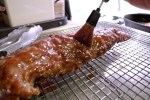
Brush the tenderloin with approximately 1 tablespoon of glaze. Roast it until a thermometer inserted in thickest part of tenderloin registers 130 degrees. Brush it with another tablespoon of glaze, and continue to roast it until the thickest part of tenderloin reaches 135 to 140 degrees, about 2 minutes more.

Remove the tenderloin from oven, and brush it with the remaining glaze. Let it rest, uncovered, for about 10 minutes.

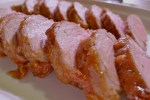
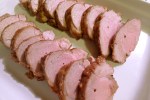
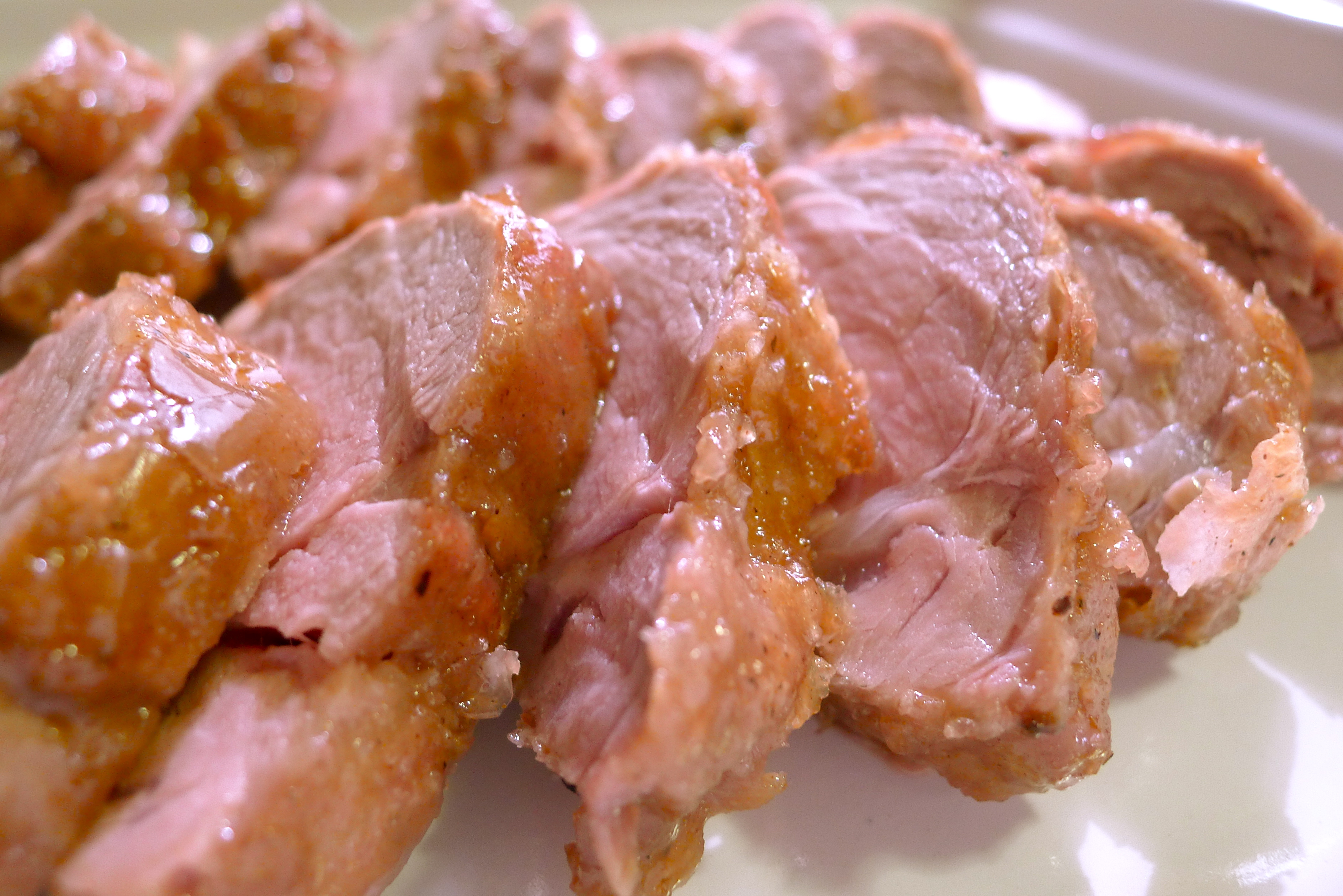
5. Transfer the meat to a cutting board, and slice it into thick pieces. Serve.
Breakfast Skillet


What a strange August we have been having! Temps in the low 80’s during the day, and cool breeziness at night. Maybe it’s not so strange after all. Maybe I have simply grown so accustomed to expecting oppressively hot and humid August weather over the years, that something nice and clement just blows my mind.

I would never have considered making a skillet breakfast last year, for instance, as it was too hot to make something that has to be baked in a cast-iron!

But this year, it didn’t feel out of place.  Plus, it was a great way to use the casing-less breakfast sausage from my CSA.

Ingredients:

1 to 1 1/2 pounds of Yukon Gold potatoes

1 pound of loose or bulk pork breakfast sausage

2-3 tablespoons of vegetable oil

8 eggs

2-3 tablespoons of green onions, chopped

Salt and pepper

1 cup of shredded Cheddar cheese

Special equipment:

A cast-iron skillet

A box grater

How to prepare:

1. Set your oven to 350°.

2. Bring a large pot of water to boil. Add the potatoes and parboil them for about 6 to 8 minutes, depending on how big they are. They shouldn’t totally raw, but the potatoes shouldn’t be completely cooked through either. Drain them, and set them aside until they are relatively cool enough to handle.

3. While the potatoes are boiling, brown the breakfast sausage in a large cast-iron skillet. Break up any lumps with a wooden spoon. When the sausage is done (you should no longer see any pink, and the meat should be browned in spots), remove it from the pan with a slotted spoon and set it aside.

4. Peel the potatoes. Using a box grater, coarsely shred each one.

5. Wipe out your cast-iron pan, and heat between 2-3 tablespoons of vegetable oil in it over medium heat. Add the potatoes. Season them with salt and pepper. Toss them in the oil until they are evenly coated. Press the shredded potatoes into an even cake against the bottom of the skillet. Let the potato cake brown slowly on the stove top.

6. Meanwhile, whisk together the 8 eggs with the green onions.

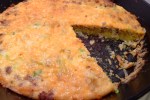
7. When the potato cake is starting to brown on the bottom, and the potato shreds are beginning to turn a little translucent, add the egg mixture to the pan. Scatter the shredded cheese on top of the eggs. Let the eggs set up for about a minute or two before putting the skillet in the oven. Bake it for about 15-20 minutes, until the top is golden and puffed. Let cool for about 10-15 minutes before slicing into wedges and serving.

Sliced Andouille Sausage with Boiled Fingerling Potatoes


I can’t say that I would wholeheartedly recommend Elaine Sciolino‘s recently published La Séduction: How the French Play the Game of Life. It’s not that it isn’t interesting, or that the anecdotes that she includes don’t entertain — they do. Maybe it’s the tone. Or the fact that I can’t figure out whether it is meant to be some kind of non-scientific monograph on seduction,  or some kind of memoir.

I will say that if you are in frequent contact with a bunch of French people, it can be illuminating. Had her book been around earlier, it might have given me some insight as to how to have made my graduate-student life easier by not taking things so seriously.

That being said, you can sum up the book like this:

It ain’t fun if it ain’t charming. And if it ain’t charming, it’s probably American.

Maybe that’s why I don’t like the book: the author is clearly very cultured, intelligent, well-read, and well-traveled, but still manages to come off as a frustrating rube.

She’s been living in France since 2002.

In the end, Sciolino cannot help but be charmed over and over again by the French. But each of these “you-won-me-over” moments follows the exact same cycle: Journalist doesn’t understand why the French do X. Journalist seeks the help of the French intellectual crème de la crème to help explain it to her. She still doesn’t understand, and protests using the the biggest American clichés and cultural stereotypes at her disposal. She tries it out reluctantly. It works. She is now a converted.

There was one chapter that I very much enjoyed: the story about when Guy Savoy (Guy Savoy!) invited her to take a quick trip with him to his mother’s house to have lunch with his family.

It might almost be worth the book — or at least reading it in the bookstore, and then putting it back on the shelf.

Even when Savoy is chez maman, he can’t help being in control: Where is the cream! Where is the knife! No, the one that cuts! Smell this! Try this! Where are the glasses! Champagne!

And the meal is fabulous. Full of stick-it-to-your ribs country goodness: salad, andouille, butter, potatoes, côte de boeuf, petits pois, morels, vanilla and raspberry ice cream, more cream, white sugar, meringue, hazelnut biscuits, coffee, obligatory nap.

On their way back to Paris, Savoy admits that he had never brought an outsider to his mother before. Why, Sciolino asks, did he take her?

To which Savoy replies (and this is exquisite), “I didn’t do it for you, I didn’t do it for me. I did it for France.”

But of course.

So of course after reading that, I had to have my own simple little country affair: just some excellent CSA andouille done in the oven, served with boiled local fingerling potatoes cut into coins. Melted butter and parsley.

Does that need a recipe?

Probably not, but I have found that there is a helpful order of preparation:

1. Set your oven to 350°.

2. In a large pot of salted water, boil the potatoes until you can easily pierce them with a paring knife. Drain them and set them aside to cool enough so you can handle them without burning your fingers.

3. Rub the andouille with olive oil, and pop it in the oven. It should cook for about 10-15 minutes. The andouille that I get from my CSA is pretty lean, so it might cook more quickly than yours. Check it after about 10 minutes for doneness, and leave it in the oven for longer if it needs more time.

4. In a small saucepan over low heat, melt about 4 tablespoons of butter with 1 teaspoon of salt and freshly ground black pepper. When the butter is melted, turn off the heat and add about a tablespoon of finely chopped parsley.

5. When the sausage is done, slice it into coins, along with the fingerling potatoes. Spoon the melted butter and parsley on top of the potatoes, and serve immediately.

High Point Farms: Fall CSA Membership Drive is on!


CSA sign-ups for the fall have begun!

The upcoming distribution cycle will run every other Thursday from September to November.

Pick-up dates are as follows:

• September 8
• September 22
• October 6
• October 20
• November 3
• November 17

Pick-up will run from 4:30 to 7:00PM.

There will be two pick-up sites this round:

Manhattan (with yours truly):

Jimmy’s 43 (43 East 7th Street, between First and Second Avenues)

Brooklyn (with awesome Sam):

CrossFit Virtuosity Williamsburg (221 North 8th St, between Driggs and Roebling)

Sign up to meet your meat here.

Andouille Pigs-In-A-Blanket


What’s cuter? Pigs-in-a-blanket, the name “pigs-in-a-blanket,” or real pigs in blankets?

Regardless, whoever came up with pigs-in-a-blanket is a complete genius!

Pigs-in-a-blanket can go upscale. You could use nice puff pastry, and nestle your “pigs” in flaky baskets of buttery goodness. But is that going too fancy?

When I think of pigs-in-a-blanket, what I want good ol’ uncomplicated nostalgia . . . okay, nostalgia with a twist.

So use that commercial tube of pop-out crescent rolls! Preheat your oven to 375°. Take about half a pound of excellent CSA andouille, and cut it into 1 1/2 to 2-inch sections. Cut each section into quarters. Separate the crescent roll dough into its pre-cut triangles. You will need to split each triangle kind of “in half.”

Wrap a triangle of crescent roll dough around each andouille sausage quarter. Spread them out evenly on a baking sheet lined with parchment paper. Bake your andouille pigs-in-blankets for about 12-15 minutes, or until golden and flaky. 

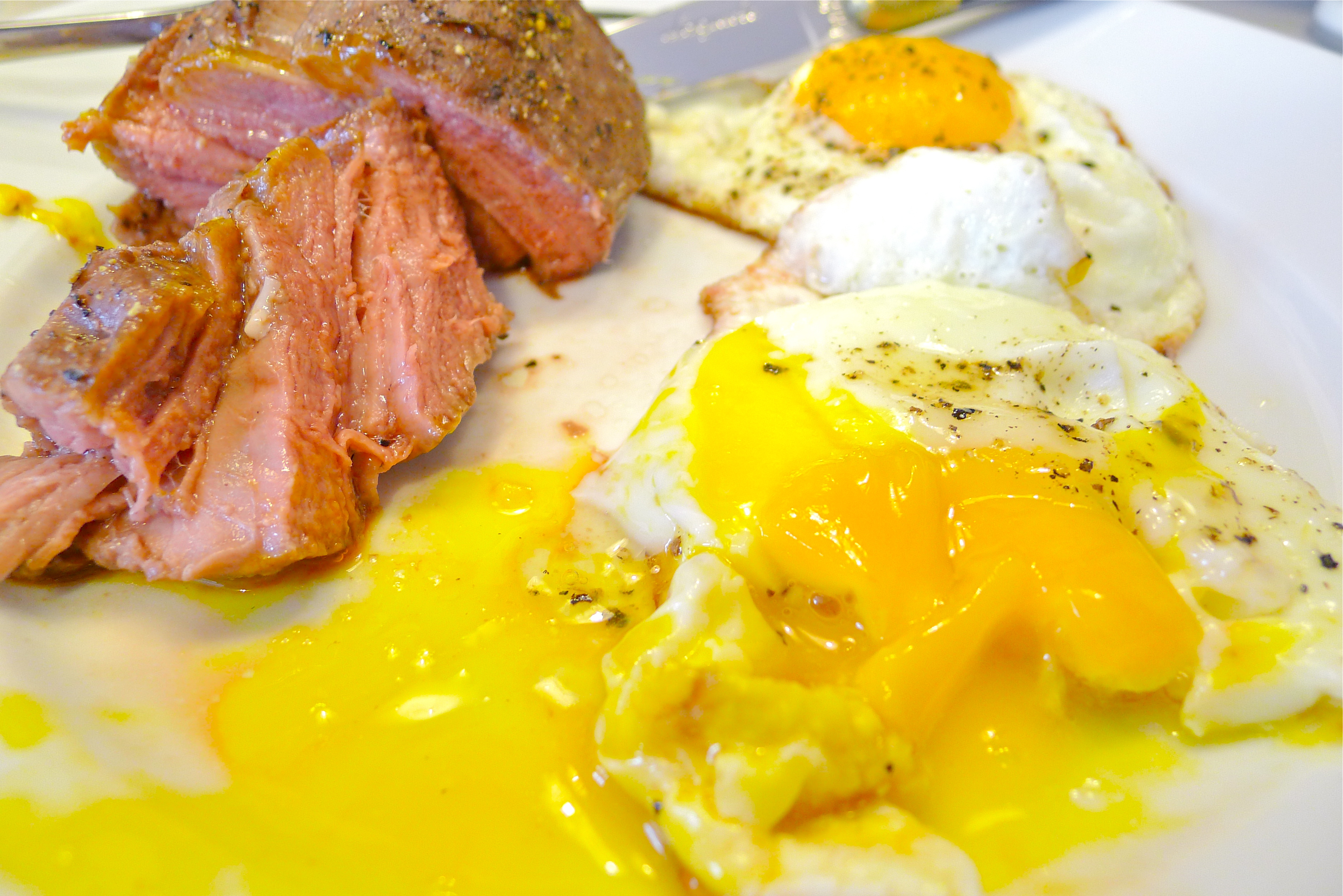
Steak and Eggs

Do you really need a recipe for steak and eggs? The title pretty much says it all. However, I did manage to distill the instructions into three easy steps . . . and in haiku too!

How to prepare:

1.

Room temperature.
Season with salt and pepper.
Heat oil till smoking.

2.

Sear steak on both sides.
Will have a very nice crust.
Let it rest a bit.

3.

Fry up your two eggs.
Sunny-side up is my thing.
Please keep yolks runny

4.

Sometimes toast is nice.
It is not necessary,
But it is tasty.

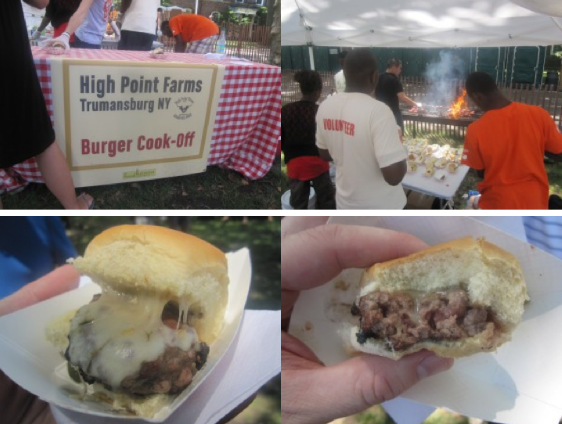
High Point Farms takes Best Burger at Cook Out NYC on Governor’s Island

Photos courtesy of the Reverend at burgerconquest.com.

Happy cows make delicious burgers! Congratulations to High Point Farms for taking the Best Burger award at last weekend’s Burger Cook-Off on Governor’s Island! Go CSA!

Read about the event here.

And see more pictures of the event here!

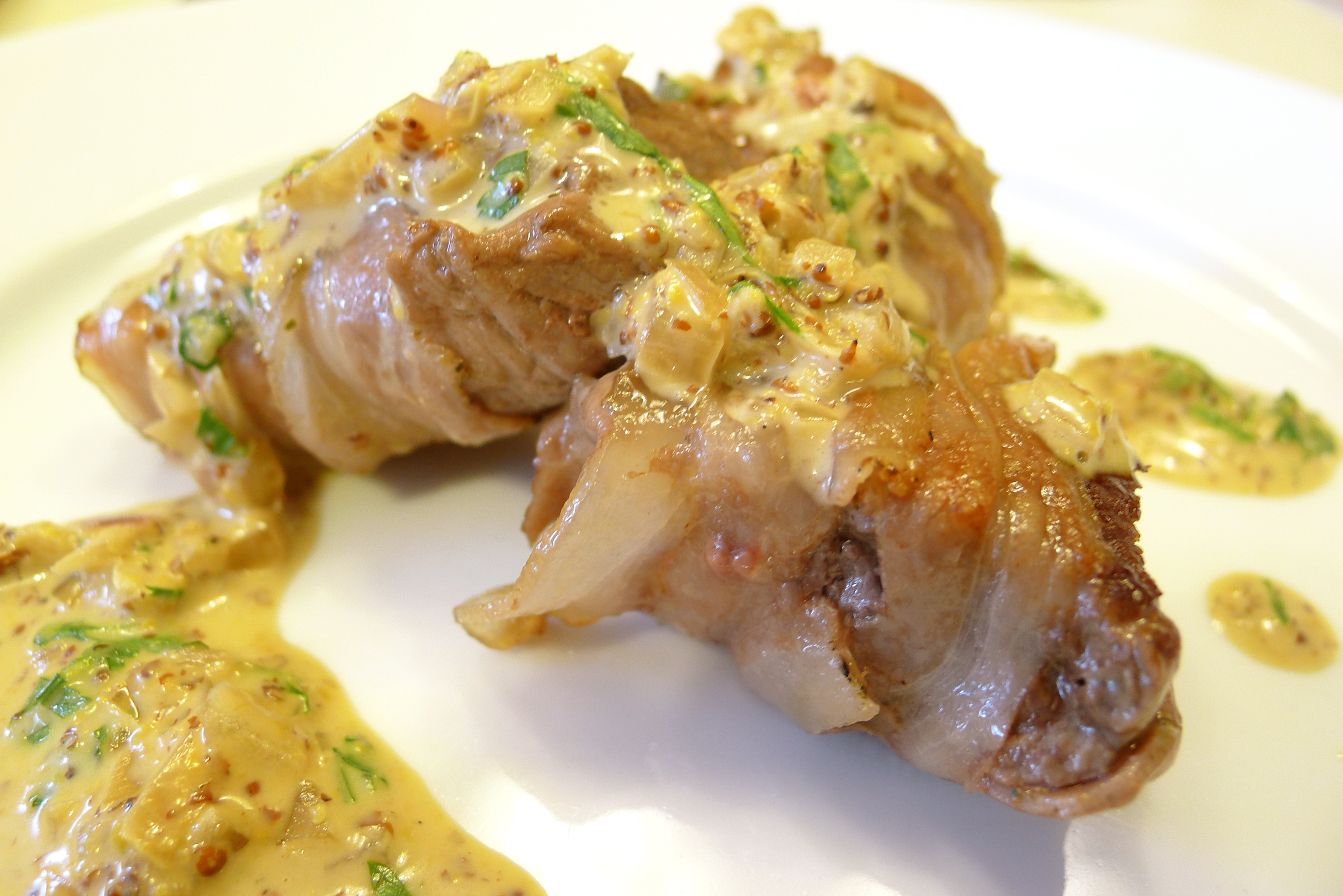
Pancetta-Wrapped Beef with Mustard Cream Sauce


When looking for a recipe to try, I find myself repeatedly drawn to certain things. In general, I prefer natural food pairings: peas and mint, asparagus and parmesan, brussels sprouts and bacon. Even though I like flavor combinations to be on the conventional side, I do want food to be inspired, but never forced. I don’t like tortured dishes made from overly complicated recipes — meaning the ones with too many things going on.

I look for balance. I want harmony. The plate has to “work.” Most importantly, it has to let the ingredients shine. The emphasis should be on letting food taste like what it is supposed to taste like. I’m not that keen on hiding the flavors with a bunch of heavy spices, nor do I look fondly on over-worked preparation.

Simplicity is best. Simplicity is not boring, it’s elegant.

That is what I like about this recipe. It’s just enough work to be interesting, but not so much that it is a chore. I have tweaked it a bit from its original, but it makes a terrific little meal when you don’t have a lot of time, but want a lot of style.

Ingredients:

1 pound of tender cut beef, cut into 2-inch cubes (you should have about 12 cubes total)

About 12 thin slices of pancetta or proscuitto, one per beef cube

2 tablespoons of canola oil

1 shallot, finely minced

1/4 cup of Bourbon

1/4 cup of water

1 tablespoon coarse Dijon mustard

1/4 cup of heavy cream

2 tablespoons of parsley, finely chopped

How to prepare:

1. Pat the beef cubes dry with paper towel. Wrap each cube with a slice of pancetta or a slice of proscuitto, making sure to cover as much of the cube as possible. If you have rolled pancetta, you can unroll it and then wrap it around each cube.

2. In a large cast-iron skillet, heat the oil over medium-high heat until it starts to shimmer. Place the wrapped cubes seam-side down in the pan. Sear the cubes evenly on all sides, about a minute or two per side. You want the beef to stay medium rare, but the pancetta to crisp a little bit.

Remove the beef cubes to a paper towel-lined plate while you finish the sauce.

3. Reduce the heat to medium, and add the shallots to the same skillet. Sauté the shallots until they begin to get translucent, scraping up the browned bits from the bottom of the pan as you go. Carefully add the bourbon and the water to the pan. Dissolve the browned bits in the added liquid. Once most of the alcohol has cooked away, add the mustard and the heavy cream. Stir everything together. Continue to simmer the sauce until it has thickened. Turn off the heat, and add the parsley to the sauce.

4. To serve, top the beef cubes with the sauce and eat.

Chicken Fried Rice


Comfort food brings up all kinds of dishes: macaroni and cheese, meat loaf, casserole, matzo ball soup. French fries, ice cream, chocolate. These foods are comforting for lots of people. But comfort food is so subjective. What comforts someone, might be strange and unappetizing for someone else.

What makes food comfortable and familiar is oftentimes a complex interplay between memory, taste, nostalgia, personal history, ethnicity, and emotion. There is no existing formula to make things comforting; they either are or they aren’t.

Despite the subjectivity of comfort food, I do think that in order to be comforting, there are certain qualities that must be present:

1. The dish is usually warm. Sno-cones, for example,  evoke nostalgia. You can crave a Sno-Cone. Do you want a Sno-Cone to comfort you when you have had a disaster day at work? Probably not.

Ice cream maybe, but ice cream has enough fat to have a luxurious mouthfeel, negating the fact that it is cold.

2. It’s usually filling. True comfort should relax you. It should be full of soft middles and rounded edges. It should warm you from your core, and make you feel full and satisfied. It should make you feel safe, cosseted in familiar smells and textures.

3. It’s usually full of salt and fat, or fat and sugar. Despite efforts to negate our very human attraction to calories, millions of years of biology and evolution have made us creatures who crave fattening foods simply because they are fattening.

4. Comfort food should above all taste good. It should hit all the sweet spots, and tick all of the boxes.

If you had to say something about comfort food, it makes you happy to eat it. It takes your stress away. It transports you to a simpler, less complicated time. Recently, there was a NYT article about Filipino cruise ship workers who pull into Red Hook when their luxury liners dock in New York City. It’s really a great little story about how food can connect you, and make you feel closer to home.

And that is precisely what fried rice does for me. My mom would make fried rice for me after school, after long speech meets, after coming home too late, after long hours at summer jobs, after exhausting semesters at college, after months abroad. She would use leftover rice, and whatever else was in the fridge. It didn’t matter if it was some extra pork, or beef, shrimp, or chicken from the night before. Sometimes she had some broccoli, some carrots, some peas. Sometimes she just had some scallions, which — let’s be honest — she always has.

Left with some extra soy-poached chicken and steamed rice myself after dinner with Tomoko, I decided to do the same.

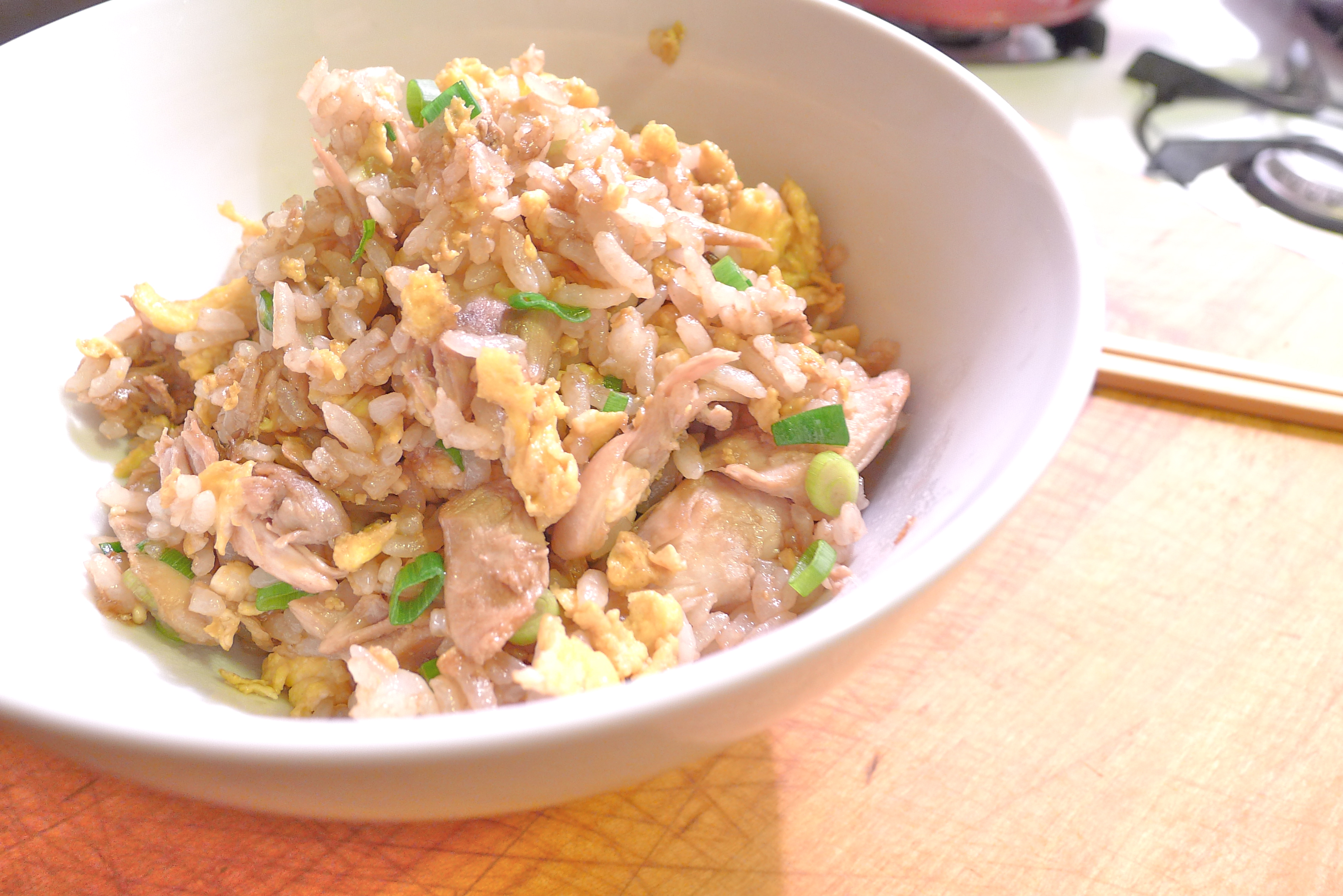
Fried rice has no recipe. What I do when I am just making it just for myself is I scramble two eggs in a skillet, breaking up the curds into smaller bits. When they are done, I remove them from the skillet and set them aside. I add about a tablespoon of vegetable oil to the same pan, and set it over medium-high heat. When the oil starts to shimmer, I add the rice, the chicken, and the eggs. I let the everything begin to brown and sizzle, stirring and tossing the ingredients together all the while. I add a few splashes of good soy sauce, continuing to move all the ingredients around with a spatula. Once most of the liquid has evaporated, I add a handful of chopped scallions. I toss everything together so that the scallions are evenly distributed throughout the rice. Then I eat, and think of home.

Sliced Filet Mignon with Fava Beans and Radishes


This is another recipe is from Epicurious. It is terrific for spring. I’ve modified the recipe a little bit, but kept the primary components.

I like to do steak in a pan the Tom Colicchio-way, basting the meat in butter as it cooks. Factor in about one steak per person.

I prefer my radishes crunchy, so I wouldn’t recommend letting them sit in the dressing for as long as the original recipe states.

I love fava beans. Get them fresh while you can (now is the season). They are extremely labor intensive to shuck and peel, but it is worth it. Here is a handy video clip to show you how if you have never cooked with fava beans before. Just ignore the cooking times that the cook in the clip recommends.

I never really measure out my oil or vinegar for the vinaigrette . . . If pressed, I would suggest that 3:1 ratio of oil to vinegar.

Ingredients:

About a 1/4 cup of extra-virgin olive oil

A splash of apple cider vinegar

Dijon mustard to taste (I use about a teaspoon and a half)

About 1/3 cup of fresh fava beans (from about 6-7 pods)

2 radishes, thinly sliced

2 filet mignon steaks, about 5-7 ounces each

Canola oil

Butter

Salt and pepper

About a tablespoon of chopped chives

Crumbled, soft goat cheese, or chèvre

How to prepare:

1. In a medium bowl, whisk together the vinegar, oil, and mustard until they form an emulsion. Adjust the seasoning to your taste.

If using fresh favas, you will first need to shuck the beans from the pods. Discard the empty pods, and blanch the beans in boiling water for about 2 minutes — any longer than that, and they will be mushy. Have an ice bath ready to shock the beans. By submerging the beans in ice water after draining them, you will retain their beautiful green color. When the beans are cool, you will need to remove the waxy outer-covering of each one. If you nick the end of a bean with your finger nail, you can easily squeeze the bean out of its peel.

Toss the fava beans and the radishes in the vinaigrette. You want them evenly-coated with the dressing.

2. Pat the steaks dry with paper towels, and season them liberally with kosher salt and pepper. In a heavy pan, heat the canola oil over high heat until it is almost smoking. You’ll be able to see when the oil is up to temperature when its surface begins to shimmer. Sear the meat on both sides, about 2 minutes per side. Reduce the heat to medium-low. You must reduce the heat to prevent the butter from burning on contact with the pan. Add a good knob of butter to the pan. Tilt the pan and, using a spoon, baste the steaks continually with the melted butter and oil mixture, flipping them halfway through cooking. Continue to cook the steaks until you have achieved your desired level of doneness.

Transfer the steaks to a cutting board. Let them rest a few minutes before slicing them.
Bear in mind that the steaks will continue to cook a little bit while resting, so you may want to keep this in mind and remove them from the pan when they are a little bit rarer than how you want to eat them.

3. Toss the fava beans and the radishes with the chives. Divide the fava bean and radish mixture between two plates. Top each portion with one of the sliced filet mignons. Drizzle some of the vinaigrette, and sprinkle on some of the crumbled chèvre over each steak. Serve immediately.