Pan-Seared Pork Chops with Sautéed Brandied Apples

Is it too cliché to mention that old adage that necessity is the mother of invention?

Maybe it should be added that necessity is good, but extreme cold and laziness is a better motivator!

This was where I found myself the other chilly night, looking at the contents of my fridge and pantry and wondering what I could make for dinner without having to go out and get anything else. Pork chops and apples was what came naturally to mind as I had a pair of juicy pork chops from the CSA, and some shrivelly apples. The apples were a little past being able to be enjoyed raw, but they were still perfectly good to cook.

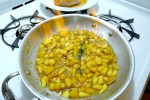
And then I looked up at my nice collection of booze, and thought, “Not just any apples tonight, but flambéed apples!”

Okay, I’m not being 100% truthful. My actual thought was, “Fire! Fire! Fire!”

In any case, the results were fast, easy, delicious, and perfect for an early winter supper.

Ingredients:

2 thick-cut boneless pork chops

Olive oil

2 apples, peeled, cored, and cut into small pieces

1 shallot, finely minced

1/4 cup of apple cider

1 branch of fresh thyme

1/4 cup of brandy

Salt and pepper

Special items:

Matches

How to prepare:

1. Heat some olive oil in a pan over medium-high heat. When the oil begins to shimmer, add the pork chops. Sear the pork chops for about 3-4 minutes. They should have a nice golden crust when you flip them. Lower the heat to medium after you turn the pork chops. Continue to cook them until they are done (you’re looking for a nice rosy pink). A meat thermometer inserted in the center of each chop should register between 140-145°. Remove the chops to a plate while you finish the dish.

2. Spoon off most of the fat in the pan, leaving only about two teaspoons. Set the pan back on stove over medium-high heat. Add the apples and shallots. Toss them together in the pan, being sure to scrape up any tasty brown bits stuck to the bottom of it. Cook them until the shallots gain a little color and begin to turn translucent.

3. Reduce the heat to medium. Add the apple cider and the thyme to the pan. Cook the apples and the shallots in the apple cider until the sauce has thickened.

4. Take the pan away from its heat source, and carefully pour the brandy over the apples. Return the pan to the heat. Let the brandy warm for a just a few seconds before igniting it with a match. Stand back and let the alcohol burn off completely. To help you visualize this, here is a nice Youtube clip from the Food Network (the flambé-ing occurs around the 2:55 mark).

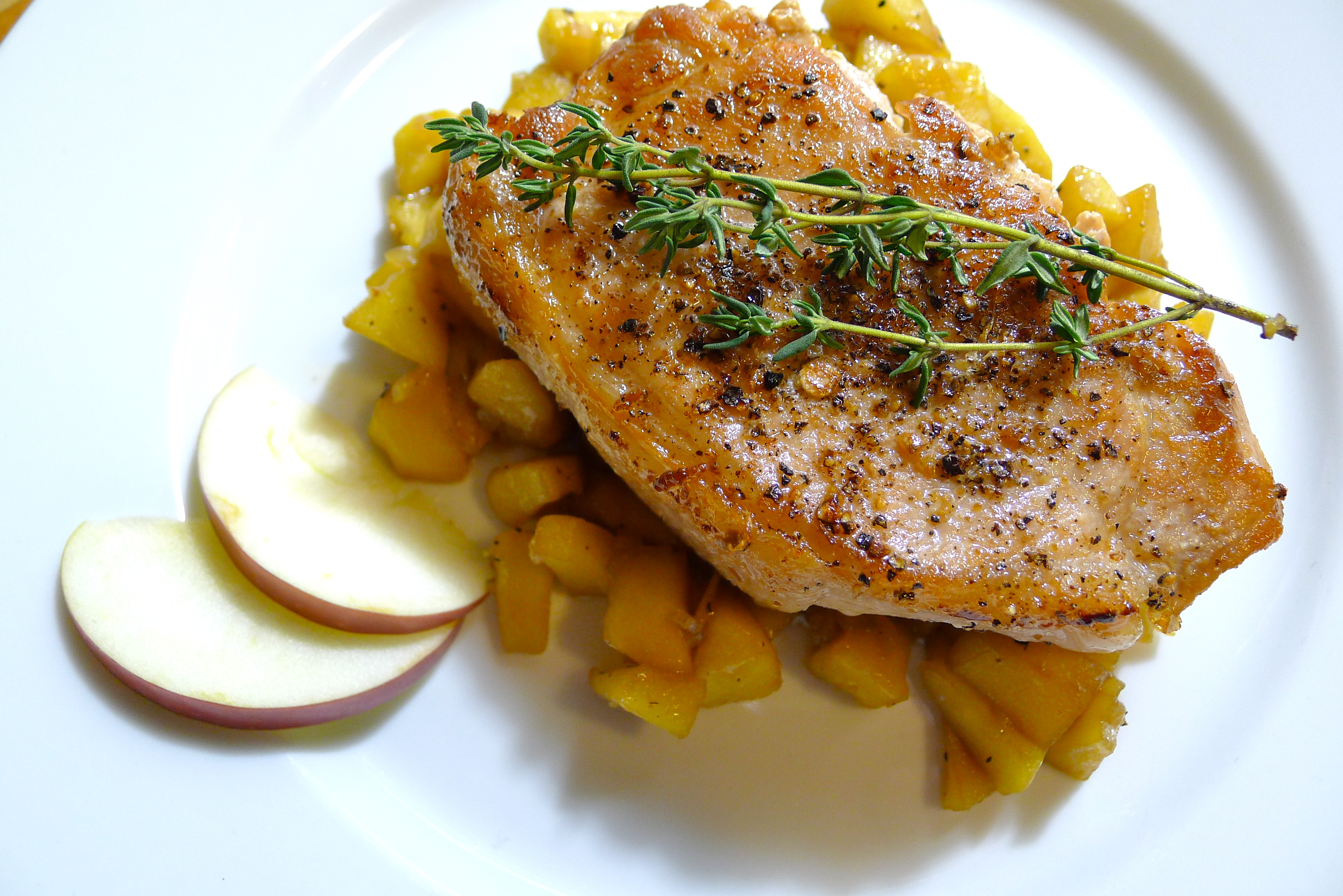
5. Add any juices that have accumulated in the plate where the pork chops are resting to the pan. Continue to cook the apples until the liquid has some reduced more. Remove the thyme branch, and adjust the seasoning. Set the pork chops on top of a good mound of apples and serve.
Prosciutto e melone (Prosciutto and Melon)


One of my favorite things to eat in late summer is prosciutto e melone.

The silky saltiness of the paper-thin ham delicately draped over sweet, heady melon is truly irresistible this time of year.

How’s that for a extra-hefty dose of hyperbole?

But seriously, it’s hard not to wax poetically about it. If the melons are ripe and fragrant (melons have been in the market for a few weeks now), and the prosciutto is the finest San Daniele you can get your hands on, you should.

There is no recipe for prosciutto and melon, because it is exactly just that: prosciutto and melon.

I feel very strongly, though, that as there are only 2 ingredients, there should be some clear guidelines:

1. If you do not have ripe melons, do not make prosciutto e melone.

2. Some people think honeydew is an acceptable melon. It is not.

Cantaloupe or nothing, people.

3. Do not use domestic prosciutto, which is fine for cooking, but it too salty for salad. You want the good stuff: the golden pinky-hued San Daniele. The best you can buy. You don’t need too much of it. About a quarter pound is more than enough for two people.

Buy the best. It is worth it.

4. Just slice your melon. You can do wedges or melon balls, however you want it. Drape the ham seductively across it. You want sexy ham folds, ribbons of air-dried pork tufted like satin pig-sheets over your musky melon. That’s what you want.

Do not:

1. . . . wrap your prosciutto around your melon like this.

2. . . . wrap your prosciutto around your melon, and impale it on a skewer with a freakin’ cherry tomato like this.

3.  . . . drizzle it with olive oil. Do not add pepper. It does not need salt. It doesn’t.

4.  . . . add a ball of mozzarella cheese, a glop of pesto, a shred of basil, dusting of dried herbs, or a bed of greens. Don’t sauce it. Don’t even have a sauce near it. Just don’t.

It is truly best as it is!

Nigel Slater’s Blueberry-Pear Cake


One of my favorite books is Nigel Slater’s The Kitchen Diaries. Part cookbook, part, well, diary, longtime Observer columnist Slater takes you through a year in his life food-wise. He doesn’t give an entry for every day (and some days he doesn’t even cook at all), but each one is a beautiful little snippet of real life lived well.

I love Slater’s writing voice, which seems to be a reflection of his cooking: honest and personal. He has had some training, but is not a chef per se (neither was Julia). That doesn’t mean that his food suffers; Slater is a good eater who appreciates food, and loves to share generously. Who can’t respect that?

His recipes are dead-simple, but they are made with the assumption that you know your way around the kitchen. Sometimes, they are a little skimpy on details, but they do all work (at least the ones that I have tried).

His tastes are also very, very British, which — forgive me — might be construed as a somewhat dumb statement to make, given that he is British. That being said, there are some things to note:

1. The Brits eat a lot of gooseberries, and drink a lot of things flavo(u)red with elderflower.
2. They like desserts named “fool” and “mess,” and collectively dessert is referred to as “pudding.”
3. There is a lot of smoked fish.
4. Chili is spelled with two l’s.
5. Curry powder is common.
6. Parsley sometimes seems bizarrely interchangeable with cilantro.
7. Cilantro is called “coriander.”
8. “Medium-rare” can infuriatingly mean “medium-done.”

As for Mr. Slater himself, he has:

1. A kick-ass garden.
2. A beautiful wooden-plank farm-house table.
3. A lot of chipped dishes.
4. A kick-ass neighborhood deli.

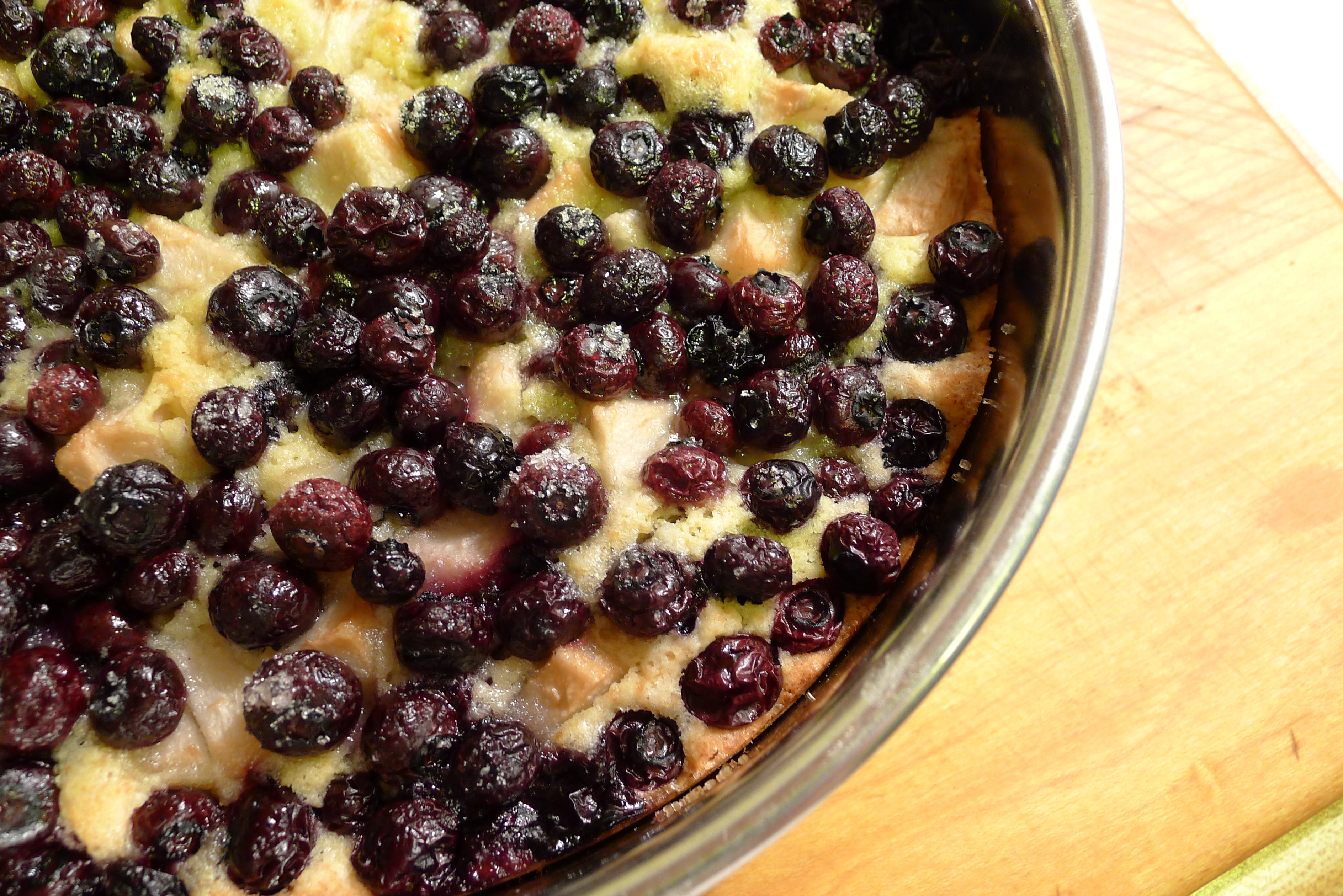
This recipe adapted from Slater’s is a terrific way to take advantage of the blueberries currently in the market. It comes together quickly, and looks beautiful. Though Slater makes no mention of it in his Diary, my dining companion did suggest that a little jug of crème anglaise on the side would be a nice addition.

Ingredients:

1 1/4 cups of flour

A pinch of salt

1 teaspoon of baking powder

1/2 cup of good butter, softened

1/2 cup of sugar

2 eggs, beaten

1-2 ripe pears, peeled, cored, and cut into small pieces

1 large pint of blueberries

About 2 more tablespoons of sugar

Special equipment:

A spring-form pan

How to prepare:

1. Preheat the oven to 350°. Butter the bottom and sides of the spring-form pan. Line just the bottom with a circle of parchment paper.

2. Sift or stir together the flour, salt, and baking powder.

3. In a separate large bowl, beat the butter and sugar together until the mixture is pale and fluffy. Add the beaten eggs slowly to the butter/sugar mixture. While continuing to beat everything together, add the dry ingredients a little bit at a time until they are fully incorporated. The resulting batter will be a little thick.

4. Pour (or spread) the batter out in an even layer over the lined bottom of the spring-form pan. Scatter the pear pieces and the blueberries evenly across the top of the batter. Sprinkle the fruit with the remaining 2 tablespoons of sugar.

5. Bake for about 55 minutes to an hour. The top should be golden, and a skewer or knife inserted into the center of the cake should come out clean when it is done. Let cool before removing the spring-form pan’s outer ring.

Strawberries Dipped in Chocolate Caramel Sauce


Chocolate-covered strawberries get a bad rap. It’s perhaps not so surprising: the majority of ones in this country are sold in February, when strawberries are completely out-of-season.

Now I have nothing against partaking in enrobed fruit for Valentine’s Day, but strawberries bought in the middle of winter are usually shipped from South America, freakishly oversized, and stunningly tasteless despite their glossy red exteriors.

The chocolate sarcophagus they come in isn’t always very appetizing either.

But it is finally springtime — officially the start of strawberry season. Now is the time to see that chocolate-covered strawberries done right can be a sinfully sloppy mess.

How can you tell if a strawberry is ripe?

Smell it. Does it smell like a strawberry? No? Put it down. Walk away. Yes? Is it a full-on, luscious, musky strawberry-smell? Buy. Now. Buy buckets of them.

This sauce is fantastic. So easy and so versatile. Dredge fruit in it, or even better, drizzle warm gobs of it over vanilla-bean gelato. Or just eat it out of the pot. It’s fabulous.

Ingredients:

1 pint of ripe strawberries, washed and gently patted dry

1/4 cup of sugar

1/2 cup of heavy cream

2 ounces of semi-sweet chocolate (no more than 70% cacao), broken into smaller pieces

1/8 teaspoon of sea salt

How to prepare:

1. Cook the sugar in a small dry saucepan over moderately high heat, undisturbed, until it begins to melt, about 2 minutes. Continue to cook, tipping the pan from one side to the other, until the sugar has melted into a deep golden caramel, about 1 to 2 minutes. To help visualize this, here is a handy profanity-free video with Gordon Ramsay.

2. Remove the caramel from the heat and carefully pour in the cream. The cream will steam and bubble vigorously. Once the bubbles begin to subside, return pan to moderately low heat and cook, stirring or whisking constantly, until the caramel has dissolved. If the caramel does not seem to dissolve completely, add 1 to 2 teaspoons of water at a time, stirring, until it has dissolved.

3. Turn off the heat and continue to stir or whisk the caramel to cool it down a little bit. Add the chocolate and the salt. Stir or whisk the chocolate into the caramel. The sauce should be thick and glossy when you are finished.

4. Dip the strawberries in the sauce and arrange them on a plate. Serve them to someone you want to make happy.

Parchment Paper-Wrapped Salmon with Sliced Mango and Calamansi Juice


“Why,” my friend asked, “Are you taking such a huge bag with you to San Francisco when you are only going for three days?”

She has a point, I thought, but she doesn’t understand what’s in sunny California: lemons. Big, shiny, juicy, fabulous lemons. Meaty, fragrant, unsprayed suckers growing like weeds in everyone’s backyard.

Oh, and I guess my new godson is in California too 😉

Living on the East Coast, we get wonderful apples, but zero good citrus. Limes from Chile arrive bright green on the outside, and dry as popcorn on the inside. Lemons smell vaguely like styrofoam and are mouth-puckeringly tart — not in a good way. Even the Meyer lemons we get are a little overripe and slightly smushy.

So was I going to miss out on my golden (state) opportunity to bring back some excellent fruit? No way!

Thankfully, my best friend and her warm, welcoming family were more happy to accommodate. Her parents raided her uncle’s lemon trees and came out with a great big bag of fat fruit. Hooray! I must have been quite the sight at the baptism running around with a fresh lemon stuck under my nose.

And as I was packing to head back to the frigid northeast, my friend’s mother palmed a handful of super tiny, but ultra-perfumed orbs into my hand.

Calamondin, or calamansi, are used a lot in Filipino cooking. I wasn’t sure what to do with them, but I certainly was not about to let that stop me from finding out!

This recipe is from a terrific cooking blog called Coconut & Lime. Instead of wrapping the salmon in aluminum foil, I opted for my preferred parchment paper. Salmon en papillote, southeast Asian-style.

I’m also testing out a brand new camera!

Ingredients:

2 individual portions of center-cut salmon, bones and skin removed

1 small onion or shallot, very thinly sliced

1 small ripe mango, cut into thin strips

1-2 small Bird’s Eye Chiles, thinly sliced

1 1/2 teaspoons of coconut vinegar

The juice from a handful of calamansi oranges

Olive oil

Salt to taste

Special Equipment:

Parchment paper

Baking Sheet

How to prepare:

1. Preheat the oven to 350°.

2. Place the salmon portions in the center of a large sheet of parchment paper. Arrange the sliced onions evenly on top of the salmon, followed by the mango slices, and finally the sliced chiles. Sprinkle the salmon with the coconut vinegar and the calamansi juice. Drizzle olive oil over everything. Season with a shower of kosher salt to taste.

3. Pull the edges of the parchment paper up lengthwise. Roll the edges down together, making several folds as you go along. The paper should be snug against the salmon, but not too tight. Twist, or tie with butcher’s twine, the ends of each side so that you end up with a nice, neat packet.

4. Place the packet on your baking sheet seam-side up. Bake the salmon for 20 minutes. The fish should be fully cooked. When opening the packet, be careful to not burn yourself with the steam. Serve with steamed white rice.

Holiday Ham with Pomegranate Molasses, Black Pepper and Bourbon Glaze


There was a special treat in the CSA basket last week: a beautiful ham.

Growing up, hams in my household were always honey-baked affairs, spiral-cut and gifted by friends and relatives who came to the house bearing boxes of See’s Candies. I don’t think I ever remember my parents baking a ham themselves, so this was a new experience for me.

What to do with a lovely ham? When Tina from High Point Farms suggested a glaze, something in clicked in my mind that I had filed away in my mental “To Cook” folder: pomegranate.

I have been seeing crates of pomegranates lately in the market. ‘Tis the season!

Though native to ancient Persia, the pomegranate figures prominently in the Greek myth of Persephone. Dear Persephone, minding her own business in a field, is abducted by her uncle Hades and spirited away to the underworld to be his bride. Overwrought with sorrow, her mother Demeter, Goddess of the Harvest, plunges the Earth into brutal winter. With nothing growing, Zeus sends Hermes to demand that Hades return her daughter to her. But not without caveats : Persephone can only return if nothing — no food nor drink — from the Underworld has passed her lips. Good Persephone had indeed been denying herself both, but when presented with a gorgeous pomegranate, she is unable to resist and swallows six ruby-red seeds. For this, she is allowed to be reunited with her mother for 6 months out of the year — 6 glorious months filled with sunshine and green, growing things — before returning to Hades, leaving her mother’s sadness to expand over the cold and frigid earth.

Such a story! To be seduced by a pomegranate! Certainly something to think about as the ham bakes, filling the apartment with warm, cuddly smells of sweet spice and exotic fruit. Maybe, I wondered as I basted another candy-colored layer onto the ham, it was worth it after all?

This recipe is from the terrific food blog, Food 52. It calls for pomegranate molasses, which I assume is easily available in most ethnic and specialty food markets. Actually, I wouldn’t know because I found it even easier to just make my own. You can too. The recipe is super easy and doesn’t require much attention, leaving you free to mind other things.

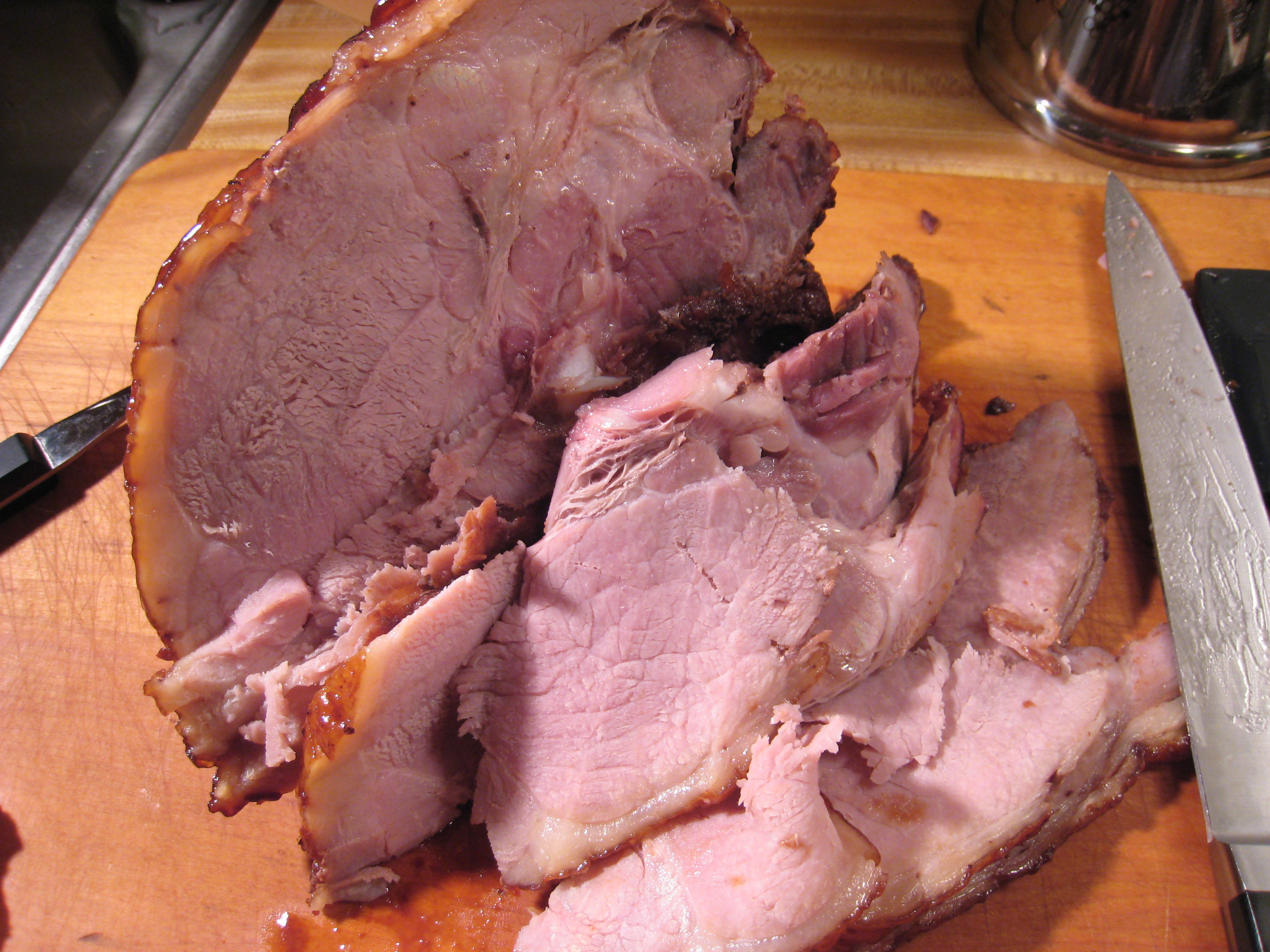
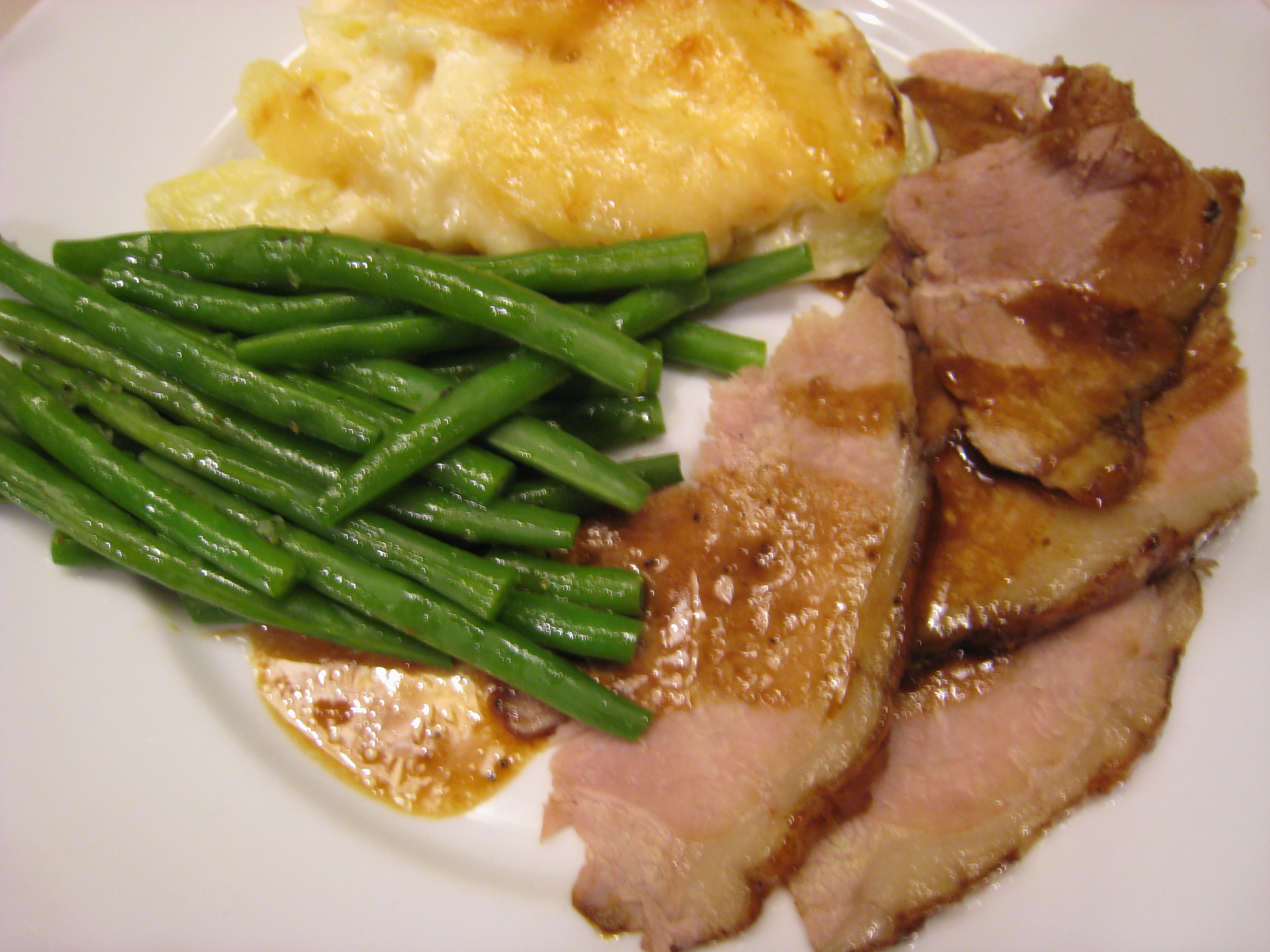
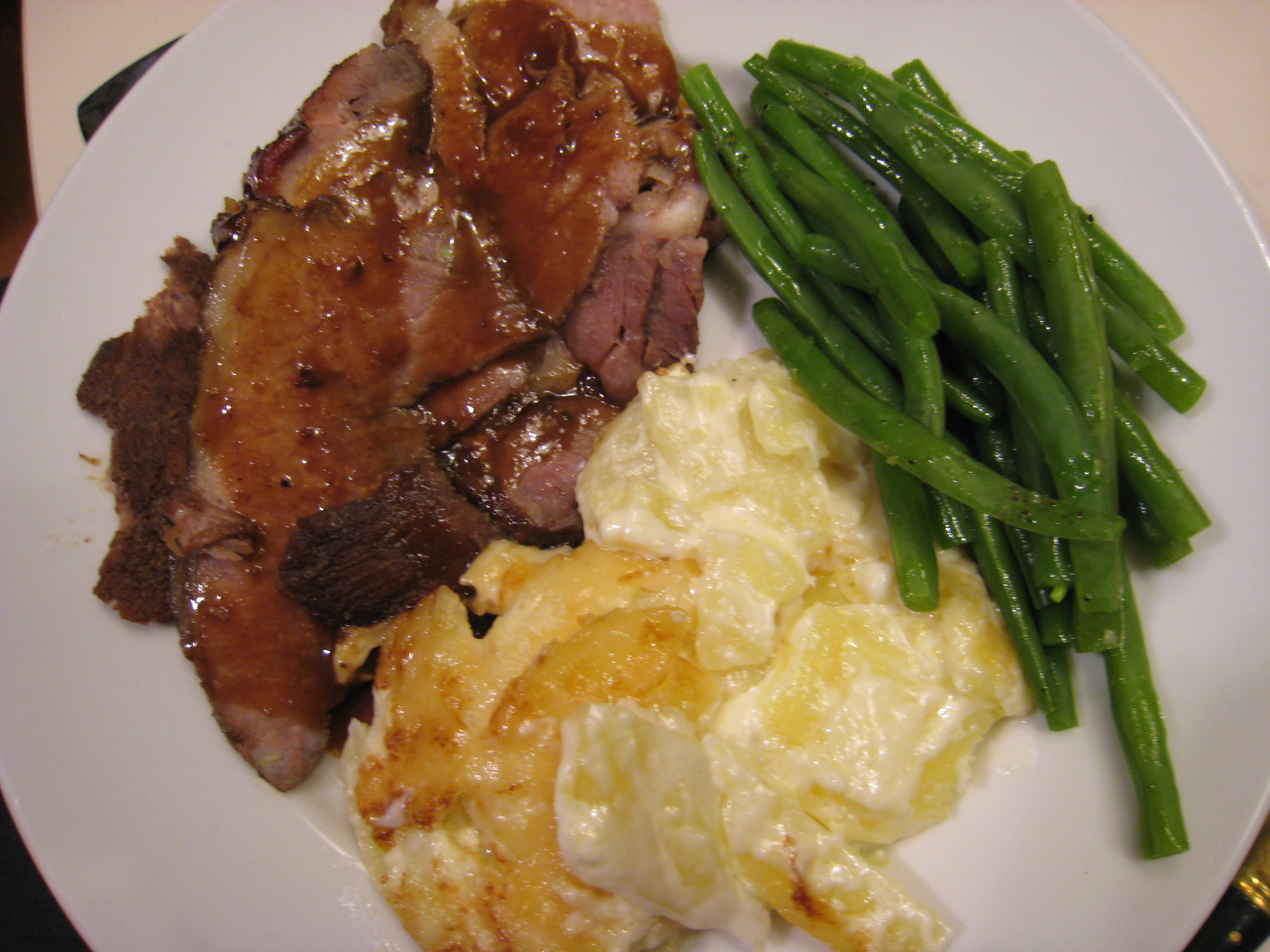
The glaze is spectacular. So interesting, it is tart, tangy, sweet and smoky all at once. Don’t skip reducing whatever remains into a quick pan sauce and drizzling it with abandon on top of your pearly pink slices of ham. We served it with a golden potato gratin and some blanched green beans.

Ingredients:

1 bone-in ham roast, about 3 lbs.

3/4 cups of pomegranate molasses*

1/4 cup of Dijon mustard

2 tablespoons of bourbon

1 tablespoon of freshly ground whole black pepper

1 teaspoon of ground allspice (optional)

1 teaspoon of kosher salt

How to prepare:

1. Let the ham come up to room temperature. Plan on about an hour before cooking.

2. Preheat the oven to 325 F.

3. To make the glaze, combine the pomegranate molasses, Dijon mustard, bourbon, pepper, allspice and salt in a bowl and whisk until well-blended.

4. Place the ham, fat side up, in a roasting pan. Score the fat in a cross-hatch pattern without incising the meat. Generously baste the ham with the glaze. Bake it in the oven, basting occasionally, until the internal temperature of the ham is 120°. The ham should be a deep golden brown and crusty at this time. If not, increase the heat to 450° and continue to bake for a few minutes longer, keeping an eye on it so it doesn’t burn. Remove the ham from the oven and transfer it to a cutting board. Let it rest 20 minutes before carving.

5. Transfer the remaining basting sauce to a small saucepan along with the skimmed pan juices. Simmer everything briefly to thicken it and burn off the alcohol. Slice the ham and serve with the sauce drizzled on top.

Note:

To make you own pomegranate molasses, combine 4 cups of 100% pomegranate juice (it can be from concentrate, just be sure to look at the label closely to make sure that the juice is not a blend), 1/2 a cup of sugar, and the juice of one lemon in a saucepan. Stir the mixture to dissolve the sugar and bring it to a boil. Lower the heat to medium-low and cook until everything has reduced to about a cup of liquid. You don’t really need to stir it at all. This should take about 60-70 minutes and you should end up with a thick syrup. Let the molasses rest for about 30 minutes. It should thicken a little more as it cools. Transfer the molasses to a covered container. It should keep in the fridge for about 6 months.

Cranberry Sauce with Grand Marnier and Candied Orange Peel


Cranberry sauce from scratch is so easy to make, and tastes so much better, that I have always wondered why anyone bothers with the sauce out of a can.

People do love the canned stuff though.

Shopping for Thanksgiving dinner with my boyfriend became an exercise in Abbott & Costello-esque absurdity as he kept putting a can of jellied cranberry sauce in the cart, and I kept removing it and putting it back.

“But it has rings that show you where to slice it!” he whined as I removed the can one last time.

Now, I must admit a fondness for tubular food: sausages, Boston Brown Bread, cannolis. Even the occasional Twinkie finds its way down my gullet about once a year.

But if you have ever had whole berry, home-made cranberry sauce, you know how really wonderful this condiment can be. No longer an afterthought plopped out of metal cylinder, real cranberry sauce can bring just the right hit of acid to the richness of the assembled dinner plate. Done right, it smells like the holidays: candied citrus, cloves, cinnamon. All warmth, sugar, spice, and everything nice.

The very basic recipe involves just three ingredients: cranberries, water, and sugar. It is essentially jam, which sounds intimidating to make but really isn’t.

To that, there are nearly endless variations. Feel free to play with it. No Grand Marnier? How about some rum? Or brandy? Try O.J. No orange peel? Got a lemon? Nope? No problems. Apples? Why not! Raisins? Throw in a handful for fun. Just feel your way through it. It will taste marvelous, I assure you.

And the other beauty? It can be made days before dinner, leaving you free to worry about something else. Even better, as the flavors meld together, it will be much yummier on day 3 than day 1.

Ingredients:

12 ounces of fresh cranberries

1 cup of water

1 cup of sugar

The zest from 1 untreated, organic orange*

1/4 cup of Grand Marnier or Cointreau, plus 1 tablespoon

3-4 whole cloves

1 cinnamon stick

A pinch of salt

Special equipment:

A citrus zester

How to prepare:

1. In a medium saucepan over medium-high heat, combine all the ingredients. Bring everything to a boil, stirring continuously to dissolve the sugar. Once the mixture begins to boil, reduce the heat so that it is at a slow, constant simmer. Continue to stir so that it doesn’t burn. As the sauce comes together, you might notice some foam or scum that appears on the surface. Don’t worry about skimming it off as it will dissipate as the sauce thickens.

2. Continue to simmer and stir until the mixture begins to jell. If you are slightly unsure what this means, you can put a small plate in the fridge and periodically test the thickness of your sauce by putting a dime-sized drop on the cold plate. If you drag your finger through it and the sauce doesn’t run back into the void you have created, it has nicely jelled and you are done. This whole process can take up to ten minutes or so.

3. Pour the sauce into a container, cover, and place it in the fridge. It will become more solid as it cools. Before serving, stir in 1 tablespoon of whatever alcohol you used if you would like extra boozy sauce — and who doesn’t?

Note:

Most citrus fruits (oranges, tangerines, grapefruit, lemons) are coated in a food-grade wax to preserve and protect the fruit. It also makes them really shiny. If you are cooking with the rind or peel of any citrus, try to look for fruit that has not be spray-treated with wax. Most fruit labeled “organic” should be untreated. How can you tell for sure?  Just scratch the surface of the fruit. If you see some clear wax on your finger nail, move on.

Banana Bread


An admission must be made: I am not the best baker on the planet. Though I am a crack tart maker and meringue master, I have been known to produce more than my share of lopsided cakes and leaden brownies.

Maybe it’s because I lack the precision that good baking requires. Roasting, sauces, stews and such seem so much more forgiving since you can tweak everything up until the moment you serve. Baking on the other hand seems like an alchemical reaction: if you blend all these things together in the right amounts at the right temperature and in the right sequence, something altogether different emerges from the oven after all that toil and trouble.

Sometimes I do get bitten by the baking bug. Motivated to do something with a bunch of bananas ripening too quickly in my fruit bowl, I decided to make banana bread. However, lacking the two loaf pans that the recipe asked, I halved all the amounts, guesstimating what a 1/6 or a 2/7 might be. To my surprise, it turned out beautifully. Moist crumbs, not too sweet, a little tangy, and very delicious.

Ingredients:

1 1/8 cups all-purpose flour

1 teaspoon baking soda

1/4 teaspoon cinnamon

1/4 teaspoon salt

2 large eggs at room temperature

1 1/6 cups sugar

1/2 cup vegetable oil

1 1/2 cups coarsely mashed very ripe bananas (3 large)

1/8 cup crème fraîche

1 teaspoon vanilla

1 cup walnut pieces (4 ounces)

How to prepare:

1. Preheat oven to 350°F. Butter and line 1 (9- by 5- by 3-inch) metal loaf pan with parchment paper.

2. Stir together the flour, baking soda, cinnamon, and salt in a bowl.

3. Beat together the eggs and sugar with an electric mixer at medium-high speed until very thick and pale. The mixture should form a ribbon when the beater is lifted, about 10 minutes. Reduce the speed to low and add the oil in a slow stream. Mix in the bananas, crème fraîche, and vanilla for about a minute. Fold the flour mixture and walnuts gently, but thoroughly, into the batter.

4. Pour the batter into the loaf pan, spreading evenly. Bake in the middle of the oven until golden brown and a wooden pick or skewer comes out relatively clean, about 1 to 1 1/4 hours. Cool the loaf in the pan for about 10 minutes before turning it out onto a rack. Turn the loaf right side up and cool completely.