Classic Southern Fried Chicken


This recipe is not for the faint-of-heart.

Your mission, should you choose to undertake it, will require Crisco. Lots of it. More, probably, than you have ever felt comfortable using. Gobs. Of. Crisco.

But the payoff is huge: the crispiest fried chicken you could possibly imagine. Chicken so shatteringly good, it explodes and leaves a healthy dribble of juice running down your chin.

Prior to this endeavor, I had never fried with Crisco. Previous experiences with hydrogenated soybean oil were either a scant quarter cup here and there while baking, or a light smear to periodically re-season my cast-iron pans.

That was before getting James Villas‘ amazing cookbook, The Glory of Southern Cooking, in which he makes a very cogent and convincing argument for Southern Cooking being one of the great regional cuisines of the world.

The book is a wonderful introduction to Southern charm and Southern hospitality, portraying the American South as a world of genteel manners and local thrift where casseroles are always given, silver chafing dishes abound, and Crisco is used liberally.

Very liberally.

This is not meant to diminish the value nor underestimate the diversity of Southern cooking, but simply to point out that at its heart, the bottom-line is that good food has nothing to do with calorie-counts or percentages of saturated fats. Good food is food that tastes good, like light and fluffy cakes, gooey and melty macaroni and cheese, and Crisco-fried chicken.

Villas’ recipe is less a recipe and more a series of guidelines to perfect frying. To attain perfection, you must:

1. Cut up your own bird (on High Point Farms’ website, there is a link to a Gourmet Youtube clip that must be the best one I have seen for teaching you how to do this).

2. Use cast-iron.

3. Use Crisco.

4. Never crowd the skillet.

5. Maintain the heat of the fat, except when the chicken is obviously burning (in which case, turn down the heat).

6. Never, never, never cover fried chicken after it is drained, unless you want soggy chicken.

And though frying an all-natural, pasture-raised chicken in fully-hydrogenated fat may outwardly appear to negate all the health benefits of eating free-range in the first place, at least you have the comfort of knowing that your chickens lived very happy lives before becoming crazy good and super delicious fried chickens.

Ingredients:

1 whole chicken, cut into pieces

Buttermilk

2 cups of flour

1 teaspoon of salt

Freshly ground black pepper to taste

Crisco

1 tablespoon  of bacon fat

How to prepare:

1. Place the chicken pieces in a large bowl, and add enough buttermilk to just cover them. Let the pieces soak for about 30 minutes.

2. In a heavy brown bag, or a large Zip-loc bag, combine the flour, the salt, and the pepper together. Add the chicken pieces to the bag, one or two at a time depending on the size of your bag, and shake the bag vigorously so that all the pieces are evenly-coated with flour. Tap the excess flour off of each piece, and stack the pieces on a large plate.

3. Place a large cast-iron skillet over moderate heat. Melt together the bacon fat and a huge amount of Crisco. You want the skillet to be about half-full of melted fat. Continue to heat the oil until it comes up to temperature, about 350-375°, or when a drop of water flicked into the pan sputters loudly.

4. Start frying the dark meat pieces first. Arrange them in a single layer, making sure not to overcrowd the pan. Fry them until they are golden brown and crisp, about 15 minutes per side. You should turn the pieces only once. Drain the pieces on paper towels, and fry the white meat pieces last.

5. Transfer the pieces to a large serving platter (how Southern!). Do not cover the chicken pieces at all. Serve them warm, or at room temperature.
Roasted Miso-Curry Delicata Squash with Pork

Yet another recipe adapted from Heidi Swanson’s Super Natural Every Day. This dish is a marvelous mixture of flavors and textures. It also shows off some of the first of Fall’s bounty: the gorgeous Delicata squash.

Oblong and streaked with golden yellow, forest green, and ivory, Delicata squash have a thin and delectable skin that does not need to be peeled. It cooks quickly, and yields a sweet, pure taste.

Though Swanson’s original recipe, like all of her recipes, is vegetarian, I find that the addition of thinly sliced pork goes well with the miso-curry sauce.

Ingredients:

A scant 1/4 cup of white miso

A scant 1 tablespoon of Thai red curry paste

Olive oil

1 Delicata squash

About 1 pound of small red potatoes, quartered or cut into even chunks

1 boneless pork chop (about 1/2 a pound), cut into 1/4 inch-thick slices

1-2 handfuls of shelled pepitas

Half a bunch of roughly chopped lacinato kale, stems removed

2/3 cup cilantro, roughly chopped

The juice of 1 limes (2 if the limes are small)

How to prepare:

1. Heat your oven to 400°.

2. In a small bowl, whisk together the white miso, the red Thai curry paste, and about a 1/4 cup of olive oil with a fork. Add more oil to loosen up the mixture if it seems too thick.

3. Trim both ends of the Delicata squash. Cut it in half lengthwise. Scoop out all of the seeds and discard them. Cut each half into 1/2-inch half moons.

4. In a medium bowl, combine the squash and the potatoes with about half of the miso-curry mixture. Toss the vegetables together with your hands until they are evenly coated. Turn the vegetables out onto a parchment paper-lined rimmed baking sheet. Spread them out in a single layer, and bake them for about 20 minutes.

5. In a small bowl, toss the pork with half of the remaining sauce. After the potatoes and the squash have roasted for about 20 minutes, evenly scatter the pork and the pepitas over the tops of them. Continue to roast everything until the pork is cooked and the potatoes are done, about 15 minutes more.

6. In a large bowl, combine the kale, the cilantro, the remaining miso-curry, and the lime juice. Add the roasted pork and vegetables to them. Toss everything gently together. Serve and enjoy.

Black Bean Salad with Oven-Roasted Tomatoes, Corn, Almonds, and Lemon Zest


This is another great recipe adapted from Heidi Swanson’s Super Natural Every Day. Swanson, whose blog 101 Cookbooks is an amazing source of ideas and inspiration, makes food that is healthy, wholesome, a little quirky, always delicious, and never preachy.

The great thing about her vegetarian recipes is how amenable they are to your tastes. You can substitute chicken for tofu, or add shrimp, or beef, or pork, and the dishes will still be great.

For this recipe, I added local corn and the farfalle. Since Hurricane Irene, our farmers need all the help we can give them. Though NYC was mostly spared, many of the farmers and growers who bring the literal fruits of their labor every week to us were not. Almost no farm was left untouched by the flooding.

Support local and please make a donation here.

Ingredients:

1 pint of Sun Gold tomatoes (cherry or grape tomatoes work too), halved

Salt and pepper

Granulated cane sugar

Olive oil

3/4 cup of raw almonds, halved width-wise

1 cup of corn kernels (about two ears)

2 15-ounce cans of black beans, rinsed and drained

1/3 pound of farfalle, prepared according to package directions

The grated zest of one lemon

The juice of one lemon

1/4 pound of French feta, crumbled

How to prepare:

1. Preheat your oven to 350°.

2. Line a rimmed baking sheet with parchment paper. Spread the tomato halves over the sheet and sprinkle them liberally with salt and sugar. Drizzle the halves with olive oil. Toss everything together so that the tomatoes are evenly coated in the oil, salt, and sugar. Arrange the tomatoes cut-side up. Roast them until they have shrunken, and have begun to caramelize around their edges, about 45 minutes. Remove them from the oven, and when they are cool, scrape them into a large bowl along with all their caramelized juices.

3. Meanwhile, heat the almonds in a single layer in a large cast-iron skillet set over medium heat. Toss them around every couple of minutes until they are fragrant and toasty. Be sure to monitor the nuts closely; they can burn in a minute! When the almond halves are toasted, add them to the same large bowl as the tomatoes.

4. Wipe out the skillet and add about 1 tablespoon of olive oil. Heat the pan over medium-high heat until the oil begins to shimmer. Add the corn, and toss the kernels in the hot oil until they begin to brown. Add the corn to the same large bowl as the almonds and tomatoes.

5. Add the remaining ingredients to the bowl and drizzle everything with olive oil. Toss everything together well. Adjust the seasoning and serve.

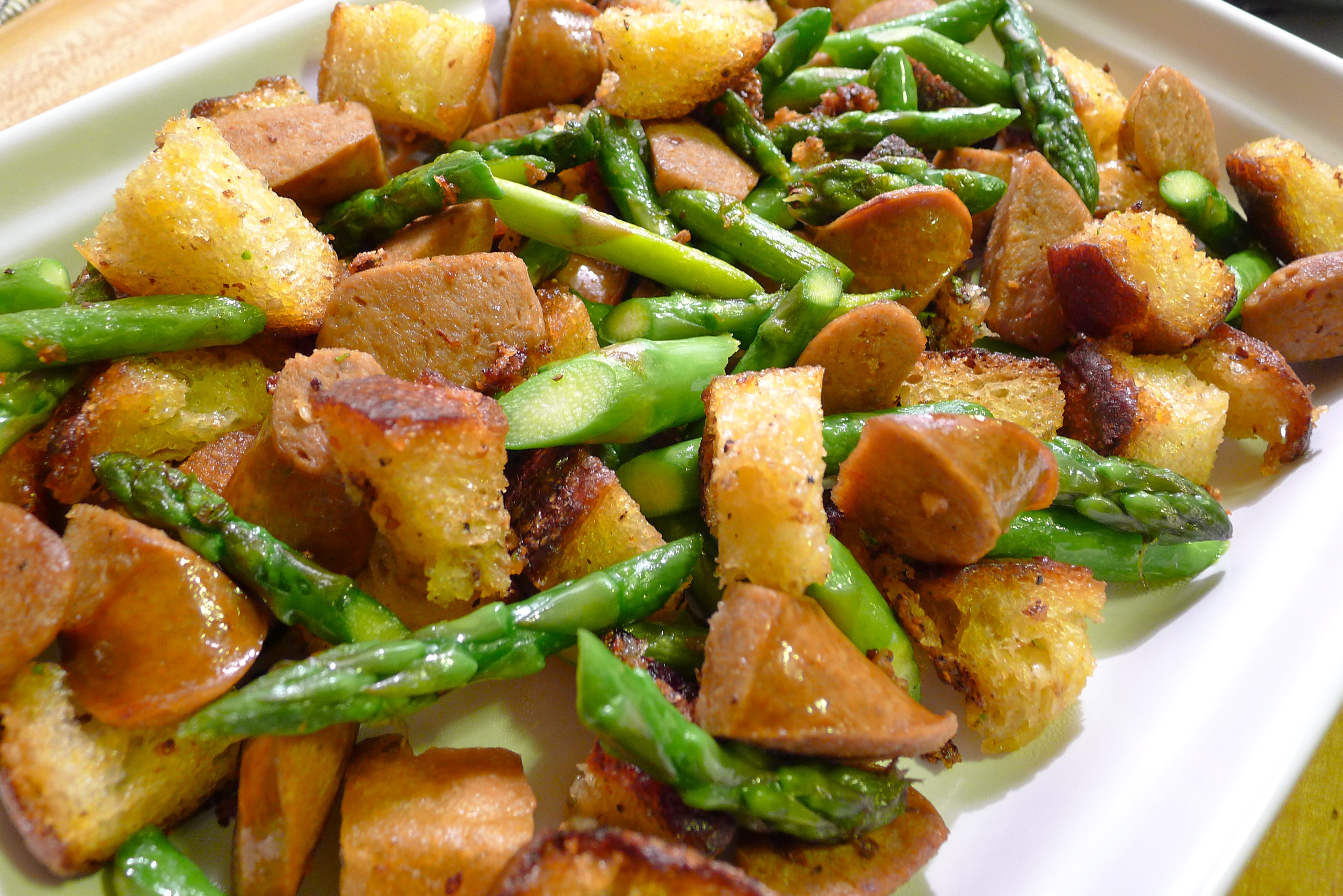
Asparagus with Chorizo and Croutons


Have you ever made something from memory, and then gone back to the original recipe to find that you mixed it all up?

That’s what happened here, but that is not to say that the results are not still delicious.

This is sort of one of Jacques Pépin’s Fast Food recipes. I’m sure that his is better, but the basic combination of chorizo, asparagus, and croutons is delicious — with or without the almonds.

I adore Jacques Pépin. If I had to pick anyone living or dead to have a meal with, it would be him. Famously frugal, I saw him once on PBS make adorable garnish mice out of basically garbage. He can do that and I would eat it because he’s Jacques Pépin. Unbelievably awesome.

The man is a walking legend.

Ingredients:

1/2 pound of chorizo, cut into 3/4-inch pieces

1/2 pound of asparagus, trimmed and cut into pieces

2 cups of day old bread, cubed

1/2 cup of Parmesan cheese, grated

Salt and pepper

Olive oil

How to prepare:

1. Place the cubes of bread in a large bowl. Drizzle them with olive oil, and season them with salt and pepper. Sprinkle them with the Parmesan and toss everything together again until the bread cubes are evenly coated.

2. Heat about 1 to 2 tablespoons of olive oil in a large skillet set over medium-high heat until it begins to shimmer. Add the chorizo, the asparagus, and the bread to the skillet. Toss and stir everything together for about 5 to 6 minutes. You want the chorizo to brown, the bread to toast, and the asparagus to cook through.

Adjust the seasoning and serve immediately.

Sliced Andouille Sausage with Boiled Fingerling Potatoes


I can’t say that I would wholeheartedly recommend Elaine Sciolino‘s recently published La Séduction: How the French Play the Game of Life. It’s not that it isn’t interesting, or that the anecdotes that she includes don’t entertain — they do. Maybe it’s the tone. Or the fact that I can’t figure out whether it is meant to be some kind of non-scientific monograph on seduction,  or some kind of memoir.

I will say that if you are in frequent contact with a bunch of French people, it can be illuminating. Had her book been around earlier, it might have given me some insight as to how to have made my graduate-student life easier by not taking things so seriously.

That being said, you can sum up the book like this:

It ain’t fun if it ain’t charming. And if it ain’t charming, it’s probably American.

Maybe that’s why I don’t like the book: the author is clearly very cultured, intelligent, well-read, and well-traveled, but still manages to come off as a frustrating rube.

She’s been living in France since 2002.

In the end, Sciolino cannot help but be charmed over and over again by the French. But each of these “you-won-me-over” moments follows the exact same cycle: Journalist doesn’t understand why the French do X. Journalist seeks the help of the French intellectual crème de la crème to help explain it to her. She still doesn’t understand, and protests using the the biggest American clichés and cultural stereotypes at her disposal. She tries it out reluctantly. It works. She is now a converted.

There was one chapter that I very much enjoyed: the story about when Guy Savoy (Guy Savoy!) invited her to take a quick trip with him to his mother’s house to have lunch with his family.

It might almost be worth the book — or at least reading it in the bookstore, and then putting it back on the shelf.

Even when Savoy is chez maman, he can’t help being in control: Where is the cream! Where is the knife! No, the one that cuts! Smell this! Try this! Where are the glasses! Champagne!

And the meal is fabulous. Full of stick-it-to-your ribs country goodness: salad, andouille, butter, potatoes, côte de boeuf, petits pois, morels, vanilla and raspberry ice cream, more cream, white sugar, meringue, hazelnut biscuits, coffee, obligatory nap.

On their way back to Paris, Savoy admits that he had never brought an outsider to his mother before. Why, Sciolino asks, did he take her?

To which Savoy replies (and this is exquisite), “I didn’t do it for you, I didn’t do it for me. I did it for France.”

But of course.

So of course after reading that, I had to have my own simple little country affair: just some excellent CSA andouille done in the oven, served with boiled local fingerling potatoes cut into coins. Melted butter and parsley.

Does that need a recipe?

Probably not, but I have found that there is a helpful order of preparation:

1. Set your oven to 350°.

2. In a large pot of salted water, boil the potatoes until you can easily pierce them with a paring knife. Drain them and set them aside to cool enough so you can handle them without burning your fingers.

3. Rub the andouille with olive oil, and pop it in the oven. It should cook for about 10-15 minutes. The andouille that I get from my CSA is pretty lean, so it might cook more quickly than yours. Check it after about 10 minutes for doneness, and leave it in the oven for longer if it needs more time.

4. In a small saucepan over low heat, melt about 4 tablespoons of butter with 1 teaspoon of salt and freshly ground black pepper. When the butter is melted, turn off the heat and add about a tablespoon of finely chopped parsley.

5. When the sausage is done, slice it into coins, along with the fingerling potatoes. Spoon the melted butter and parsley on top of the potatoes, and serve immediately.

Nigel Slater’s Blueberry-Pear Cake


One of my favorite books is Nigel Slater’s The Kitchen Diaries. Part cookbook, part, well, diary, longtime Observer columnist Slater takes you through a year in his life food-wise. He doesn’t give an entry for every day (and some days he doesn’t even cook at all), but each one is a beautiful little snippet of real life lived well.

I love Slater’s writing voice, which seems to be a reflection of his cooking: honest and personal. He has had some training, but is not a chef per se (neither was Julia). That doesn’t mean that his food suffers; Slater is a good eater who appreciates food, and loves to share generously. Who can’t respect that?

His recipes are dead-simple, but they are made with the assumption that you know your way around the kitchen. Sometimes, they are a little skimpy on details, but they do all work (at least the ones that I have tried).

His tastes are also very, very British, which — forgive me — might be construed as a somewhat dumb statement to make, given that he is British. That being said, there are some things to note:

1. The Brits eat a lot of gooseberries, and drink a lot of things flavo(u)red with elderflower.
2. They like desserts named “fool” and “mess,” and collectively dessert is referred to as “pudding.”
3. There is a lot of smoked fish.
4. Chili is spelled with two l’s.
5. Curry powder is common.
6. Parsley sometimes seems bizarrely interchangeable with cilantro.
7. Cilantro is called “coriander.”
8. “Medium-rare” can infuriatingly mean “medium-done.”

As for Mr. Slater himself, he has:

1. A kick-ass garden.
2. A beautiful wooden-plank farm-house table.
3. A lot of chipped dishes.
4. A kick-ass neighborhood deli.

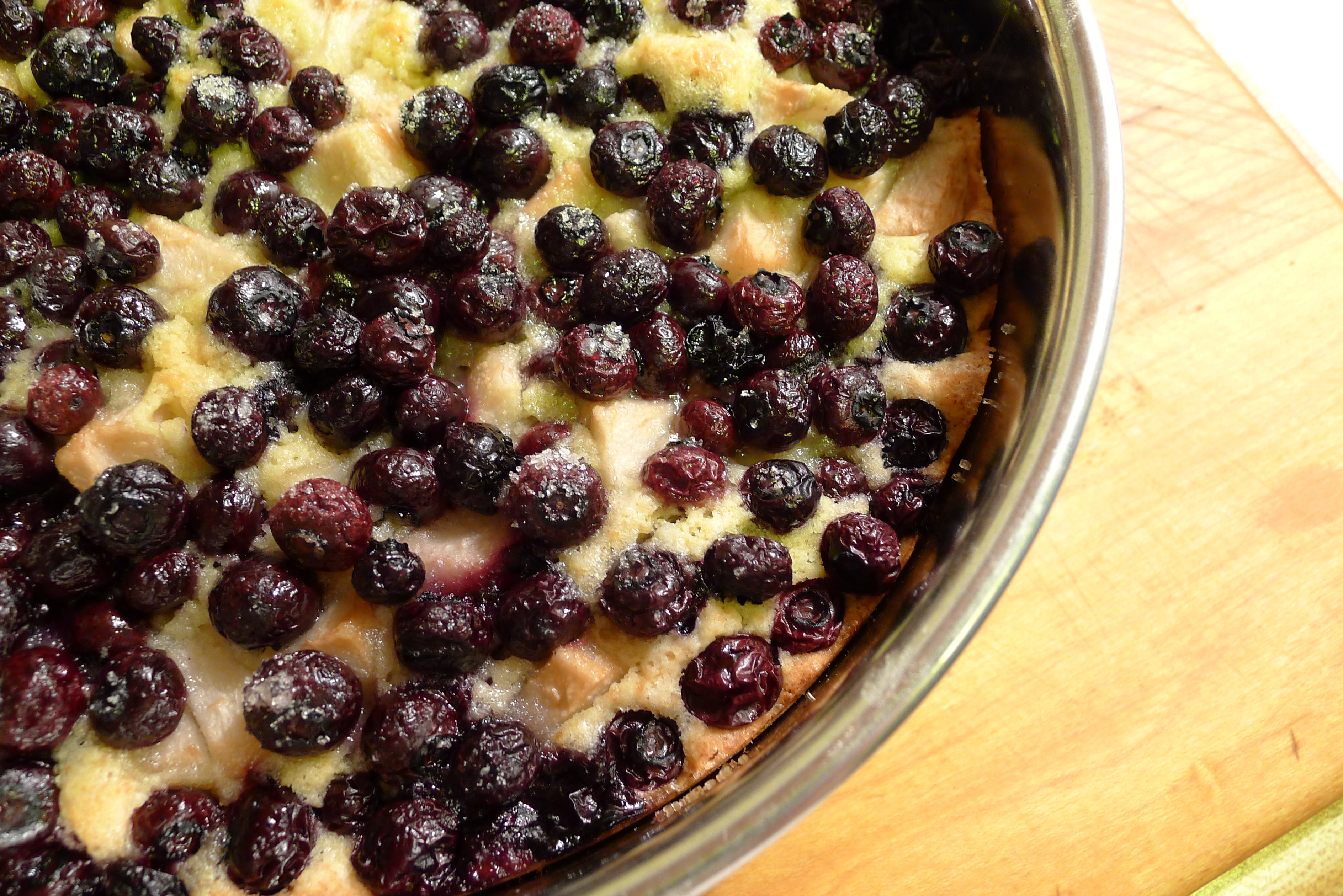
This recipe adapted from Slater’s is a terrific way to take advantage of the blueberries currently in the market. It comes together quickly, and looks beautiful. Though Slater makes no mention of it in his Diary, my dining companion did suggest that a little jug of crème anglaise on the side would be a nice addition.

Ingredients:

1 1/4 cups of flour

A pinch of salt

1 teaspoon of baking powder

1/2 cup of good butter, softened

1/2 cup of sugar

2 eggs, beaten

1-2 ripe pears, peeled, cored, and cut into small pieces

1 large pint of blueberries

About 2 more tablespoons of sugar

Special equipment:

A spring-form pan

How to prepare:

1. Preheat the oven to 350°. Butter the bottom and sides of the spring-form pan. Line just the bottom with a circle of parchment paper.

2. Sift or stir together the flour, salt, and baking powder.

3. In a separate large bowl, beat the butter and sugar together until the mixture is pale and fluffy. Add the beaten eggs slowly to the butter/sugar mixture. While continuing to beat everything together, add the dry ingredients a little bit at a time until they are fully incorporated. The resulting batter will be a little thick.

4. Pour (or spread) the batter out in an even layer over the lined bottom of the spring-form pan. Scatter the pear pieces and the blueberries evenly across the top of the batter. Sprinkle the fruit with the remaining 2 tablespoons of sugar.

5. Bake for about 55 minutes to an hour. The top should be golden, and a skewer or knife inserted into the center of the cake should come out clean when it is done. Let cool before removing the spring-form pan’s outer ring.

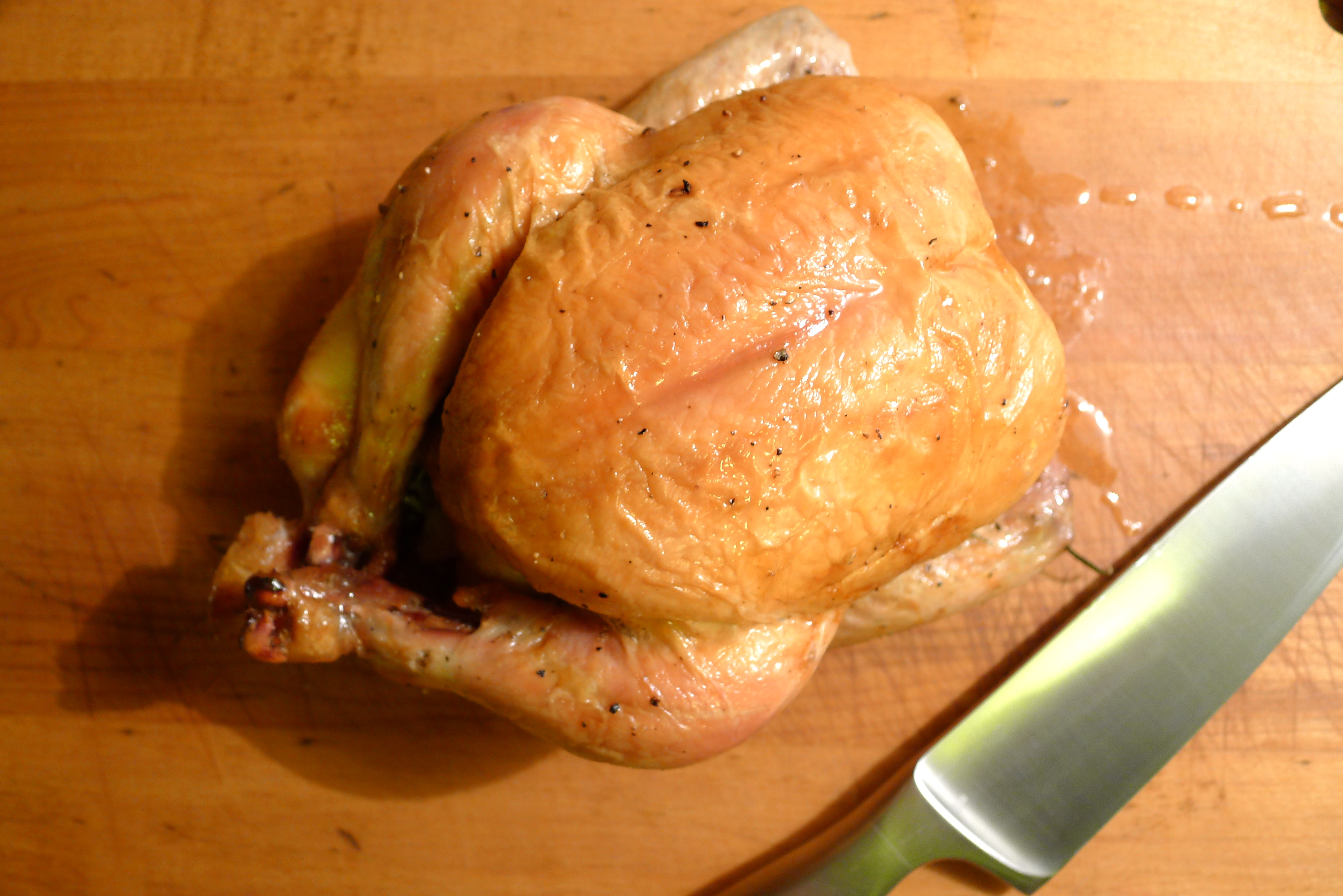
Anna Boiardi’s Apple Cider-Vinegar Roasted Chicken with Rosemary


The mercury hit over 80° today. So, of course, I would roast a chicken.

What possessed me? Shouldn’t I be eating sushi? Shouldn’t I be sitting under a tree chewing on raw snow peas? Yes, but I had planned this meal on a cold day, thinking that the chilly spring that we have been having would continue to the end of the week.

I wrong, but I decided to go for it anyway. I had a chicken. I have a surfeit of apple cider vinegar. I have to eat, so why not?

This recipe comes from a new cookbook that recently hit the market by the great-niece Chef Boyardee.

What? Chef Boyardee? The Chef Boyardee? From the can? The ravioli in a can?

Yes, that can. He was a real person.

I couldn’t believe it either.

Ettore “Hector” Boiardi immigrated to America with his family around the turn of the century. They settled in Cleveland and like many immigrants, started a restaurant. In response to demand, Boiardi’s started sending customers home with Italian food kits so they could reproduce what they made in the restaurant at home. It was such a success that Hector, along with his brothers Mario and Paul, began jarring their sauces and selling them under the name Chef Boyardee in 1928.

At the time, they became the largest importer of Parmesan cheese and olive oil in the country.

I know.

They moved their canning factory to Milton, Pennsylvania, where they convinced local farmers to grow the right kind of tomatoes that they needed for their sauces. They also grew and picked their own mushrooms at the plant.

I know.

So what happened?! How did they go from that to Beeferoni?! Well, after the WWII, the family sold their company — which had been supplying the troops during wartime — to a larger conglomerate.

And so it goes that . . .

. . . their descendent would be hot, live in a TriBeCa loft, and run Italian cooking classes for a living.

Of course, she would.

Anna Boiardi cooks real food. Real Italian food. And this recipe for Apple Cider-Roasted Chicken with Rosemary is really good.

Ingredients:

1 chicken (about 2.5 to 3 pounds)

1 cup of apple cider vinegar

Salt and pepper

1 clove of garlic, peeled and smashed

1/2 lemon

1 sprigs of rosemary

2 tablespoons of olive oil, plus more for drizzling

4 medium carrots, peeled

4 stalks of celery, peeled

1 onion, peeled and quartered

How to prepare:

1. Preheat your oven to 425°.

2. Place the chicken in a deep pot. The pot should be large enough to hold the chicken comfortably, with enough room on the top to spare. If you don’t have a pot large enough, you can improvise with some Zip-loc bags, doubled up. Add the vinegar and enough water to cover the chicken completely. Let the chicken soak for 30 minutes. After 30 minutes, remove the chicken and rinse it well under cold water. Pat it completely dry on the inside and out. At this point, your oven should be at the right temperature.

2. Put the chicken in a large cast-iron pan. Sprinkle the cavity liberally with salt and pepper. Place the garlic, the lemon, and one of the rosemary sprigs in the cavity. Truss your bird tightly. If you haven’t trussed a bird before, here is a handy video to help you.

3. Turn the chicken on its back, and massage about a teaspoon and a half of salt and about a quarter teaspoon of pepper into the skin. Be sure to get all the nooks and crannies. You want to work the salt in until it begins to dissolve. Massage in one of the two tablespoons of olive oil. Flip the chicken breast-side up, and repeat what you did to the back of the chicken. Work in another one and a half teaspoons of salt and quarter teaspoon of pepper. When the salt has dissolved,  massage in the remaining tablespoon of olive oil.

4. Arrange the aromatics (the carrots, celery, the remaining rosemary sprig, and onions) around the chicken. Drizzle them with olive oil.

5. Roast the chicken for about until it reaches an internal temperature of 165°. At that point, the juices should run clear when you pierce the deepest part of the thigh with a paring knife or a skewer. About halfway through cooking, you can also drop the temperature to 375°, and continue to roast it until it hits the target temperature. I’ve done it both ways depending on my mood. You can turn the vegetables halfway through the cooking time too so that they don’t dry out, and that they get well-coated by the drippings.
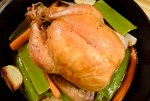
6. Let the chicken rest for about 20 minutes before carving. Serve with some of the juices spooned over the top.

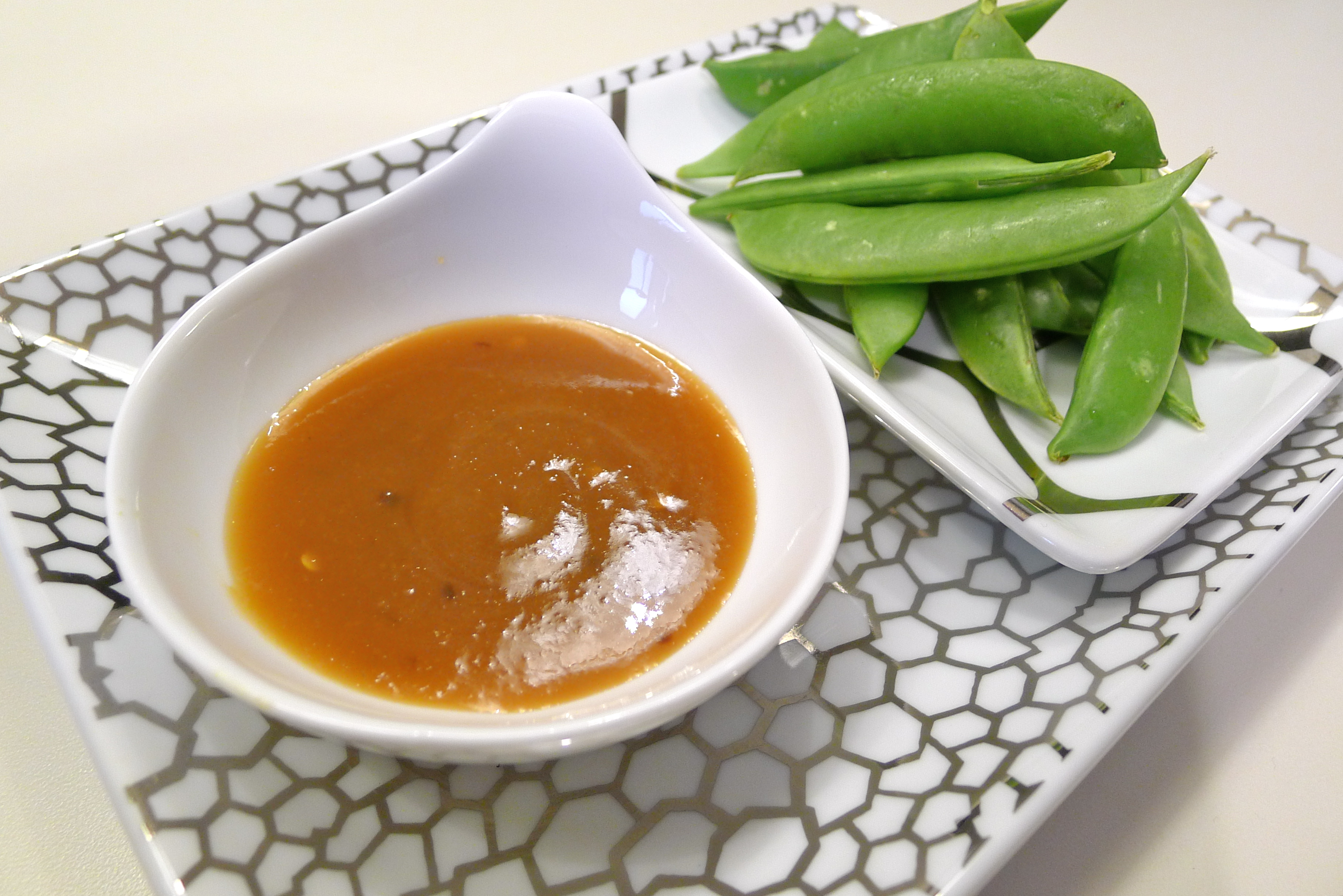
Spicy Miso Dip


I recently made dinner for Laura at her apartment. Saddled with overwhelming piles of work, she seemed on the verge of exhaustion and in much need of some TLC. As I like playing personal chef, I was more than happy to oblige.

I didn’t have much for lunch that day and was scrounging around in her fridge for something to nibble on while cooking. She directed me to some miso dip that she had made earlier, and a nice little mound of snow peas. Maybe she hadn’t thought that I would eat all of her snow peas and inhale the dip like air . . . but I did.

Sorry, Laura.

This recipe is a riff on her riff on a recipe posted by blogger extraordinaire, Heidi Swanson. Heidi’s website (she has a cookbook too), 101 Cookbooks, is a treasure trove of delicious, healthy recipes that taste great and make you feel good. As the weather gets oh-so-slowly warmer, eating more fruits and vegetables sounds like a welcome and wholesome idea.

Ingredients:

3 ounces of white miso paste

3 ounces of red miso paste

1/4 cup of sake

1/2 cup of mirin

4 tablespoons of agave syrup

Red chili pepper flakes to taste

How to prepare:

1. Combine the miso pastes, the sake, the mirin, and the agave in a small saucepan. Bring the mixture to a boil over. Once the mixture has started to boil, reduce the heat and simmer it for about 20 minutes, whisking occasionally. You want the dip to thicken a bit.

2. Once it has thickened, add the chili pepper flakes. Remove the dip from the heat and let cool. The dip will keep in the refrigerator for between 1-2 weeks. Serve with fresh vegetables, blanched asparagus, anything really!

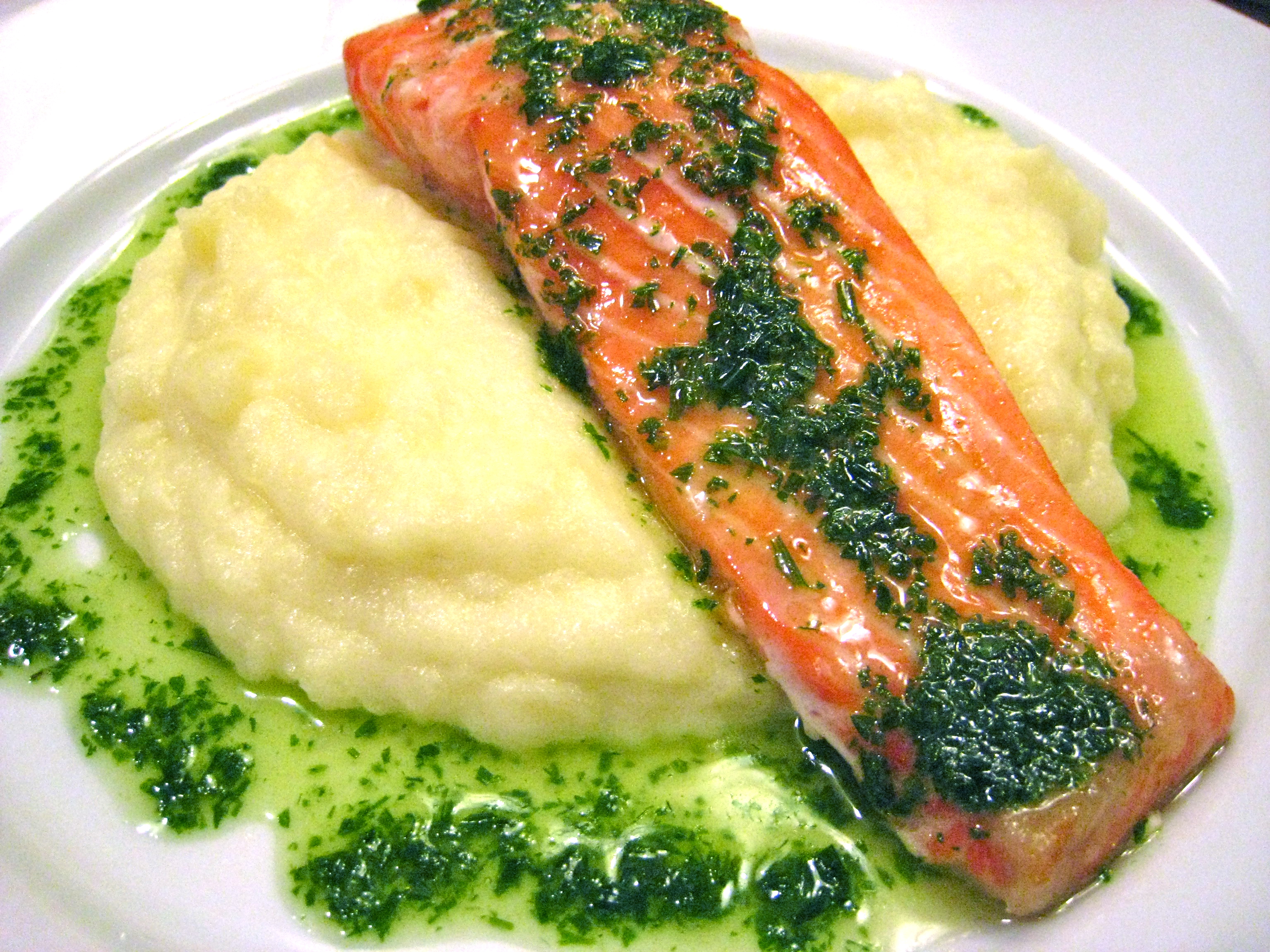
JGV’s Gently Cooked Salmon with Mashed Potatoes and Broken Chive Oil


People always ask me if the recipes on this blog are mine. Some of them are, but I also love trying out great recipes that I hear or read about. In all honesty, does it really matter? I mean, how original are anyone’s recipes anyway?

Enamored as I am of the New York Times‘s Dining Section, I picked up The Chefs of the Times a couple years ago. It’s a terrific cookbook. The contributing chefs are a “who’s who” in the culinary stratosphere: Romano, Vongerichten, Samuelsson, Boulud, Palmer, Portale, Keller, Richard, Trotter, et al. Each chef has a chapter devoted to them. What is great is that, as a preface to each recipe, each chef has composed a short written introduction about what they wanted to achieve and how they became satisfied with their finished product.

It is reassuring to keep in mind that for all their talent and ingenuity, chefs don’t exist in a vacuum. The concepts they are hoping to make reality on a plate are influenced by all kinds of things: nostalgia, personal experience, individual taste. I would also suspect that many of them owe a great deal more to Julia Child and Mastering the Art of French Cooking than they would admit in public. Certain taste combinations? They had to taste them first somewhere. The specific smoothness of mashed potatoes, for instance, that they are seeking? They must have compared theirs to either the incomparable smoothness of someone else’s potatoes, or the chunkiness of another’s.

Regardless, these little introductions are great windows into someone else’s creative process. It is true though that if you read a lot of cookbooks, you do start to see how much everyone’s recipes resemble one another. Everyone seems to have a version of Jean-Georges Vongerichten’s molten chocolate cake for example (if there was ever a recipe to which one person can lay the claim for “I was the first,” it would be this:  JGV’s extremely lucky “mistake”).

Sometimes, you just make a recipe so many times, you stop actually needing to consult a recipe anymore.

This is one of them. I don’t even remember what the original recipe was. I make it a little differently every time, but the components are the same, as is the technique. This is from The Chefs of the Times. It is a Jean-Georges Vongerichten recipe and a damn good one. You can look up the original, or you can just feel your way through this one and make it your own.

Ingredients:

Factor in one portion of salmon per person. You want to ask your fish monger for a center-cut fillet, about 2 to 2 1/2 inches wide. Skin on. Ask them to kindly remove the bones if you don’t want to do it yourself.

Estimate about one Russet potato per person. This will give you enough fluffy mashed potatoes for each guest, and just enough leftovers to eat cold out of the fridge at 3 o’clock in the morning the next day.

About 2 tablespoons of butter per potato

Heavy cream or milk, or a combo of both

About a tablespoon of grapeseed oil per person

About a tablespoon of roughly chopped chives per person

Salt and white pepper (optional) to taste

Special equipment:

A hand-held blender, food processor, or blender

How to prepare:

1. There are a million ways to make mashed potatoes. Some people like really loose spuds, some people like it like Spackle. For this recipe, I like the potatoes creamy, but not too watery. Bring a pot of well-salted water to boil. While you are waiting for the water to boil, peel the potatoes and cut them into large dice. Boil them until you can easily crush a piece of potato against the side of the pot with a wooden spoon. Drain the potatoes in the pot. Add the butter and mash the potatoes with a potato masher. Add some heavy cream, milk, or a combo of the two, and continue to mash the potatoes. Keep adding as much liquid as you like, a little bit at a time, until you have achieved the consistency that you want.

2. Meanwhile, preheat your oven to 250° (this is JGV’s genius idea). Lay the salmon fillets out on a baking sheet lined with parchment paper. You can put them skin-side up or down, depending on what you like better (I prefer up). You can smear them with a little grapeseed oil, but I’ve forgotten sometimes and no one has noticed. Put the salmon in the oven and set a timer for about 10 minutes. I’m serious. Just 10 minutes!

3. While the salmon is in the oven, blend or process the chives with the grapeseed oil and a little pinch of salt.

4. After 10 minutes, check the salmon. The meat should flake. It might look undercooked, but if it flakes and the skin comes off easily, it is done. If you would like it more done, just leave it in the oven for longer, checking it again every 2 minutes or so. Remove the skin. You can scrape any gray, fatty stuff or white protein off of the fillets before plating the dish.

5. Put a nice mound of mashed potatoes on a warmed plate. Top the potatoes with a piece of salmon. Drizzle the broken chive oil on top of the fillet and around the plate. Serve immediately.

Pipe Rigate with Broccoli and Capers


Most people know, but few believe, that I was a vegetarian for 11 years. I have no regrets. What started as an act of pre-adolescent self-rightiousness turned into a decade-long stint. It left me with a deep appreciation of weird, gnarled tubers and difficult squash, as well as a persistent, daily craving for bitter leafy greens.

When I moved to France (an act that effectively ended my vegetarianism), I took with me only two cookbooks: The Paris Cookbook by Patricia Wells and Vegetarian Cooking for Everyone by Deborah Madison. Wells’s book was a huge influence on me; it became my neighborhood guidebook, as many of her featured haunts were less than a few meters from my apartment in St-Germain-des-Près. However, it was Madison’s book that became my daily go-to, a constant source of information and inspiration. She showed me what to do with and how to eat so many of the things that I saw in the markets and had never prepared before.

Over the years, I think that I have cooked almost every recipe in the book. If you do every recipe in any cookbook, you start to feel a real intimacy with the cookbook author. Madison was a great teacher. I credit my food fearlessness, not to the hip, new restaurant du jour serving liver and brains, but to Madison. Rutabaga? Bring it on. Kohlrabi? Yeah, baby! Celeriac? Love it!

Another thing Madison taught me? Recipes are great to follow, terrific for ideas, but ultimately you have to find your own style. Now when I turn to her book — or any book for that matter — I feel confident to change it up, switch things around, and adjust it to my taste.

This recipe is originally from Vegetarian Cooking for Everyone, but of course, I’ve played with it a little bit.

Ingredients:

1 1/2 pounds of broccoli

3/4 pound of pipe rigate, lumache, or conchiglie

1/3 cup (or more) extra virgin olive oil

2 fat cloves of garlic, finely minced

1/4 cup of capers, rinsed

Red pepper flakes to taste

The juice from half a lemon

Freshly grated Parmesan

How to prepare:

1. Cut the tops off each stem of broccoli and divide the tops up into small florets. Using a vegetable peeler, peel the stems. Cut the stems into bite-sized pieces, roughly the same size as the florets.

2. Boil the pasta in a large pot of salted water. When the pasta is half-way cooked (about 5 minutes), add the broccoli florets and stems. Continue to cook, uncovered, until the pasta is al dente. Drain the pasta and broccoli into a large colander and wipe out the pot.

3. Heat the oil, garlic, and capers over medium heat until fragrant. Add as little or as many red pepper flakes as you like (I like a lot). Sizzle the red pepper flakes in the hot oil for a few seconds, being careful not to let them burn. Add the pasta and broccoli back to the pot with the lemon juice. Toss everything together well.

4. Turn off the heat and transfer everything to a large warmed bowl. Shower the pasta with freshly grated Parmesan and serve immediately.