Pumpkin Soup with Chipotle Chili Purée and Pumpkin Seed Oil


A few weeks ago, I was possessed with the urge to buy an entire cheese pumpkin. Cheese pumpkin is somewhat of a misnomer as it is neither made of cheese, nor does it taste remotely cheese-like.

Cheese pumpkins actually have nothing to do with the cheese-making process.

Instead, the cheese in cheese pumpkin actually refers to its appearance as it resembles an old-fashioned cheese box. Okay, sure, boxes are square or rectangular, and cheese pumpkins are clearly not. But they are buff-colored, low and squat — just like unfinished wooden cheese boxes.

The cheese pumpkin is the classic Cinderella pumpkin. That wasn’t a sugar pumpkin that got turned into a carriage!

Cheese pumpkins are awesome. They have sweet, soft flesh that is hardly stringy at all when you cook them. They make amazing purées, soups, and smooth-as-buttah’ custards.

They are also huge. About 5 to 7 pounds for a small one, 6 to 10 pounds for a large one. Often at farmers’ markets, cheese pumpkins are cut up and sold in halves and quarters.

But I just had to have a whole one to myself.

So consider this Cheese Pumpkin Project #1, as I only used half of a small one for this recipe.

Ingredients:

For the chipotle chili purée:

1 7.5 ounce can of chipotle peppers in adobo sauce, reserving 2 peppers and 2 tablespoons of sauce

1 red bell pepper

1 teaspoon of sherry vinegar

1 tablespoon of honey

For the soup:

2 tablespoons of olive oil

1/2 a small cheese pumpkin, seeded, peeled, and cut into 1-inch cubes

1 medium onion, diced

2 cloves of garlic, minced

2 sprigs of fresh thyme

2 bay leaves

1 quart of chicken stock

1/2 cup of heavy cream

The reserved pair of chipotle peppers + 2 tablespoons of sauce

Salt

Pumpkin seed oil

Special equipment:

A hand-held immersion blender

A fine-mesh sieve*

How to prepare:

1. Heat the olive oil in a large Dutch oven over medium-high heat until the oil starts to shimmer. Add the onions. Sauté them until they lose their opacity and begin to turn translucent. Add the garlic and sauté everything together for about another minute. Toss the pumpkin cubes in the onion-garlic mixture for another minute or two until they are evenly coated. Add the stock to the vegetables. Tuck the thyme sprigs and bay leaves under the pumpkin cubes. Bring everything to a boil, and then reduce the heat so that the liquid is at a steady simmer. Cook the pumpkin until it is soft. You should easily be able to mash a pumpkin cube against the side of the pot with a wooden spoon.

2. Remove the thyme and the bay leaves. Add the 2 reserved chipotle peppers and 2 tablespoons of sauce. Using an immersion blender, blend everything together until smooth.

* If you, like me, prefer the look and mouthfeel of a perfectly creamy and even-colored soup unmarred by any specks of green from the thyme, or any red from the peppers, you can pass the soup quickly through a fine-mesh sieve. By sieving your soup, you improve the texture immensely. Cheese pumpkins are much less fibrous than other pumpkins, but they can still have some.

Stir in the heavy cream, and adjust the seasoning. While the soup is cooling a bit, prepare the chipotle pepper purée.

3. If you have a gas range, set the red bell pepper directly on the gas burner with the heat on high. Turn the pepper periodically to make sure that the skin chars evenly.

If you have an electric range, rub the bell pepper with olive oil and place it on a cookie sheet set underneath the broiler. You can also rub the pepper with olive oil and pop it into a 450° oven. Remove it when the skin is blistered and blackened.

4. When your pepper is nice and charred, put it in a clean plastic grocery bag or a small pepper bag and wait for it to cool. When it is cool enough to handle, you should be able to gently rub off all the charred skin from the pepper. Seed the pepper, and discard the seeds and stem. Cut the pepper into 1/2 inch pieces.

5. Using the immersion blender, combine the remaining chipotle peppers, adobo sauce, the roasted red pepper, the sherry vinegar, and the honey together until smooth.

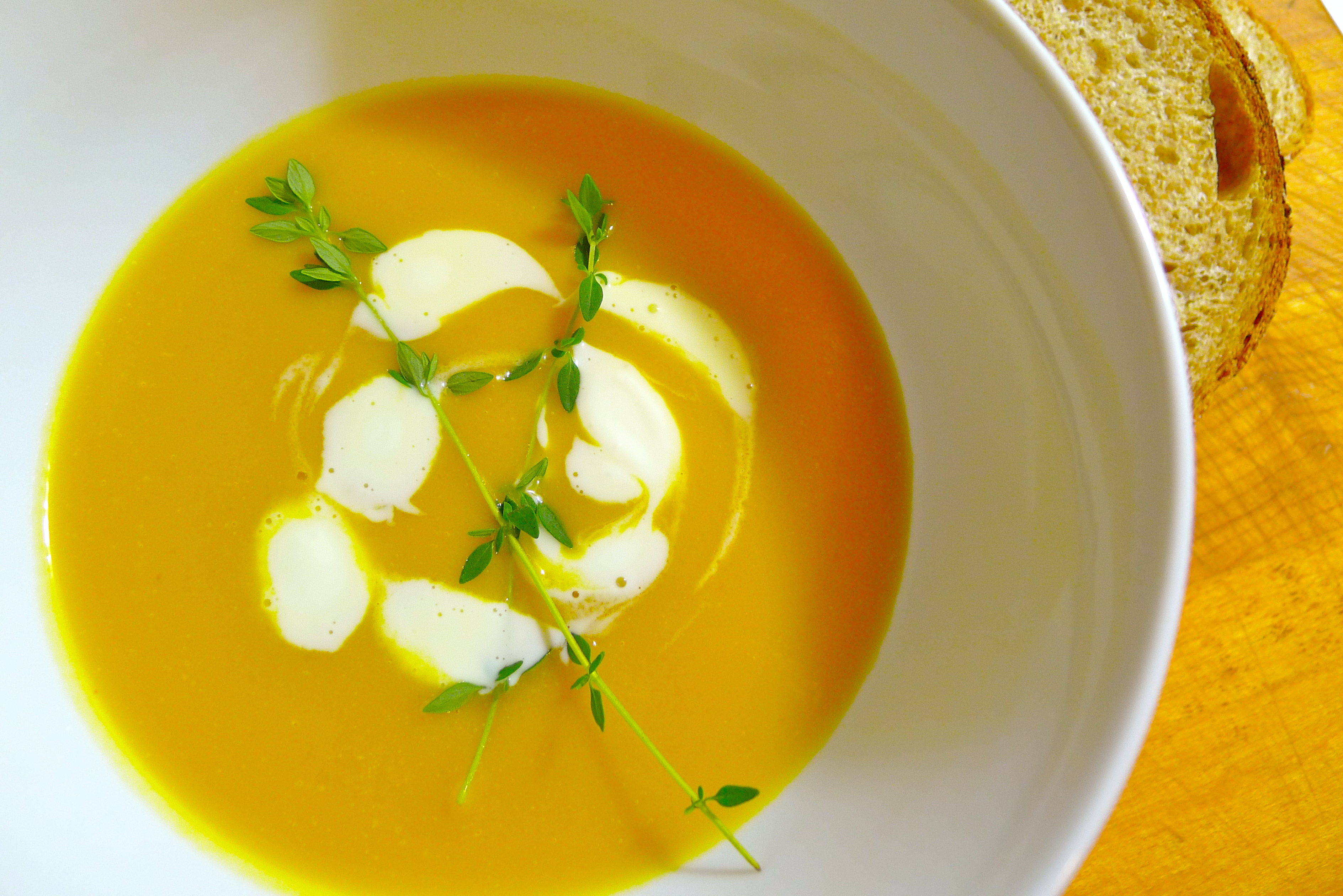
6. To serve, top each bowl of soup with a dollop of chipotle purée and a drizzle of pumpkin seed oil.

Porchetta-Style Bone-In Pork Shoulder

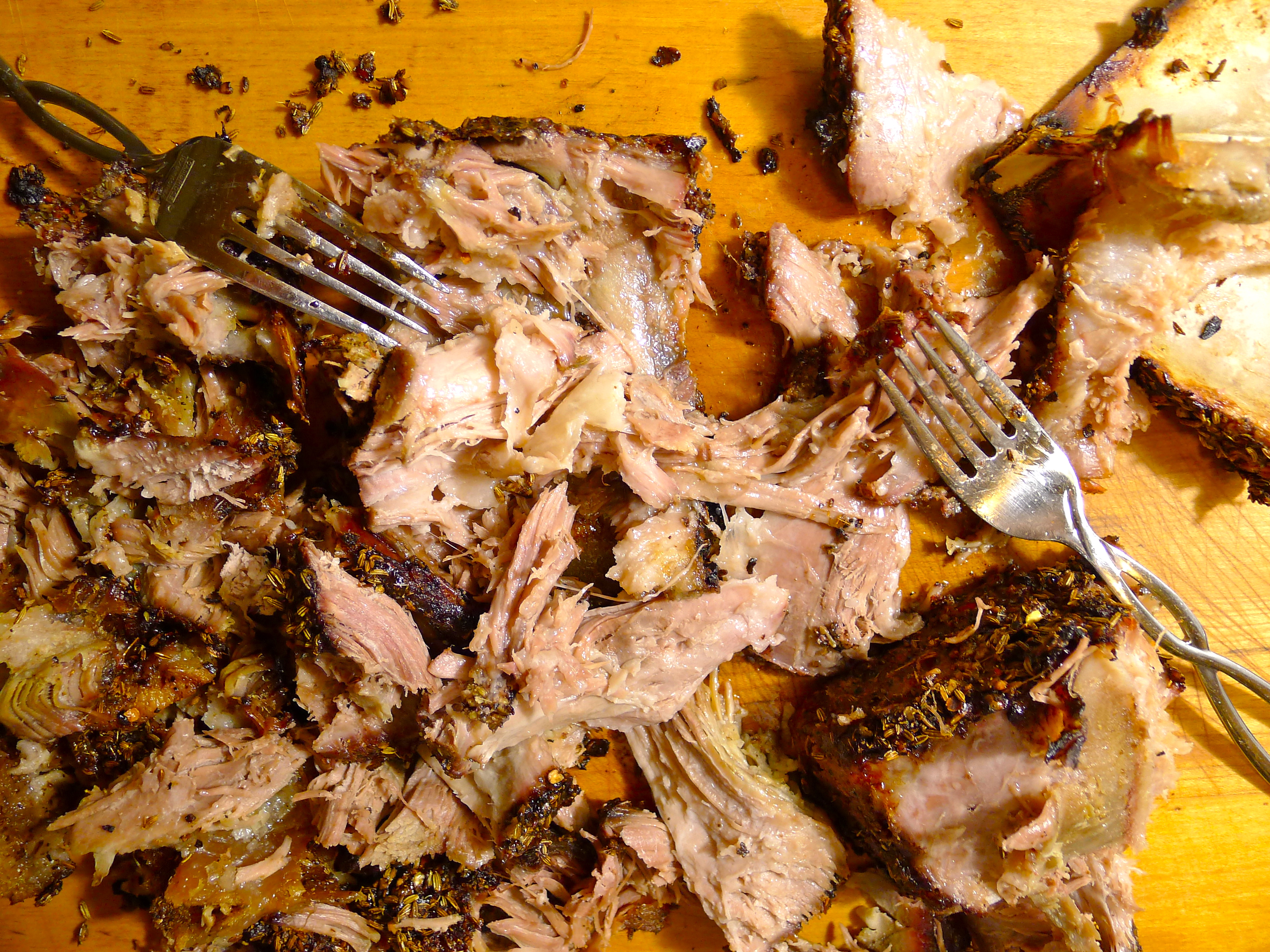
Gifted with a Boston butt (also known as a Boston Blade Roast, or a Bone-In Pork Shoulder) with an almost half-inch layer of fat, I just had to challenge myself to give porchetta a try at home.

I’ve always been a little intimidated by porchetta. Traditionally, porchetta should be a giant slab of boneless pork roast covered with a thick layer of fat and skin. After crusting it with garlic, fennel, and wild herbs, it’s roasted low and slow until the skin is crackling on the outside, and gooey on the inside. The meat should fall apart in a sloppy, delicious mess in your mouth.

I don’t know why I have always been a hesitant to make it at home. Maybe it’s because I rarely think to buy such a large and fatty cut for myself. Or maybe it’s because I live so close to Sara Jenkins’ Porchetta, it just seems easier to leave the slow roasting up to professionals.

Though Jenkins does give a recipe for porchetta away on the restaurant’s site, this is actually a different one. This ridiculously easy recipe is from Epicurious, but it does take some advance scheduling before going for a long comfortable ride in the oven. Do plan ahead accordingly.

Because I used a bone-in cut instead of a boneless cut, the meat for this recipe will have a different texture and a little more give than porchetta normally does. However the flavors and fantastic fattiness are there. It is still heavenly to eat — which is the most important thing.

Porchetta is terrific crammed into ciabatta rolls, or even just spread on a plate with some nice contorni to accompany it.

Ingredients:

2 tablespoons of fennel seeds

1 tablespoon of kosher salt

2 teaspoons of black peppercorns

1 teaspoon of dried crushed red pepper

6 cloves of garlic, finely minced

1 2-3 pound bone-in pork shoulder (also known as a Boston Blade Roast, or bone-in Boston Butt) trimmed of over-hanging fat, but with its outer layer of fat intact

Olive oil

1 cup of Riesling, or another aromatic white wine

1/2 cup of chicken stock

Special equipment:

A spice or coffee grinder, or a mortar and pestle

A leave-in meat thermometer

How to prepare:

1. The night before, toss the fennel seeds in a pan set over medium-high heat until the they are toasted and fragrant. Transfer them to your spice grinder. Add the salt, the peppercorns, and the dried crushed red pepper flakes. Grind everything together to an even consistency, but not a powder. You are looking for a medium-coarse grind.

2. Using paper towels, pat the pork roast dry. Rub the finely minced garlic all over it. Rub the spice mixture in afterwards, pressing it into the meat so that it makes a nice and even crust. Wrap the roast up in a large piece of waxed paper, and refrigerate it overnight.

3. Preheat your oven to 450°. While your oven is heating up, remove the roast from the fridge, and let it come closer to room temperature.

4. Place the pork in a roasting pan, fat-side up. Drizzle it with olive oil. When the oven has come up to temperature, roast it for about 30 minutes before dropping the temperature to 300°. Continue to roast until the pork is nice and tender. This will take about 3 hours or so. The meat should register about 190°.

5. When the roast is done, remove it from the oven and let it rest for about 15-30 minutes. While the roast is resting, pour the fat and the juices from the roasting pan into a saucepan. Skim off as much fat as you can (this might be a little tricky, but do the best you can). Set the saucepan over medium-high heat, and add the wine and the stock. Whisk everything together, dissolving any crunchy bits you can. Reduce the sauce until you have about 3/4 of a cup. The sauce will be thin.

6. Pull the meat off of the bone with two forks, spoon the sauce over the meat, and eat lustily.

Happy Thanksgiving!

This year, my parents could not be dissuaded from a 22-pound turkey. A 22-pound turkey! I don’t really know how to cook a bird that big. When I give it more thought, it’s kind of frightening to cook something that is almost a quarter of my body-weight. Seems wrong somehow.

Holidays with family are often exercises in compromise. Sometimes the path of least resistance is also the least stressful path as well!

So as I take a quick break from cooking, this will be just a quick post to wish you all a very happy Thanksgiving from the Midwest.

Kabocha Squash Simmered in Dashi, Soy Sauce, and Mirin

“If you buy that,” Tomoko said, “I’ll tell you how to cook it.”

Sold! And suddenly I was the proud owner of a cute little kabocha squash, eagerly awaiting directions from my Asian food-guru.

It’s a toss-up really as to which “hyper-detailed” step was my favorite one from Tomoko. Either, “Okay. Dashi, soy, salt, sugar.” Or, “If it’s not yummy enough, add some mirin.”

No, wait . . . the winner for “clearest” and “most concise” instruction is: “I don’t know why, but we just kind of (insert miming the act of scraping squash skin here).”

But you know what? Sometimes that’s how you learn recipes and new cooking techniques. Some of the best cooks I know are instinctive cooks who rely on past experience, sounds, smells, and what they see to guide them more than a written recipe.

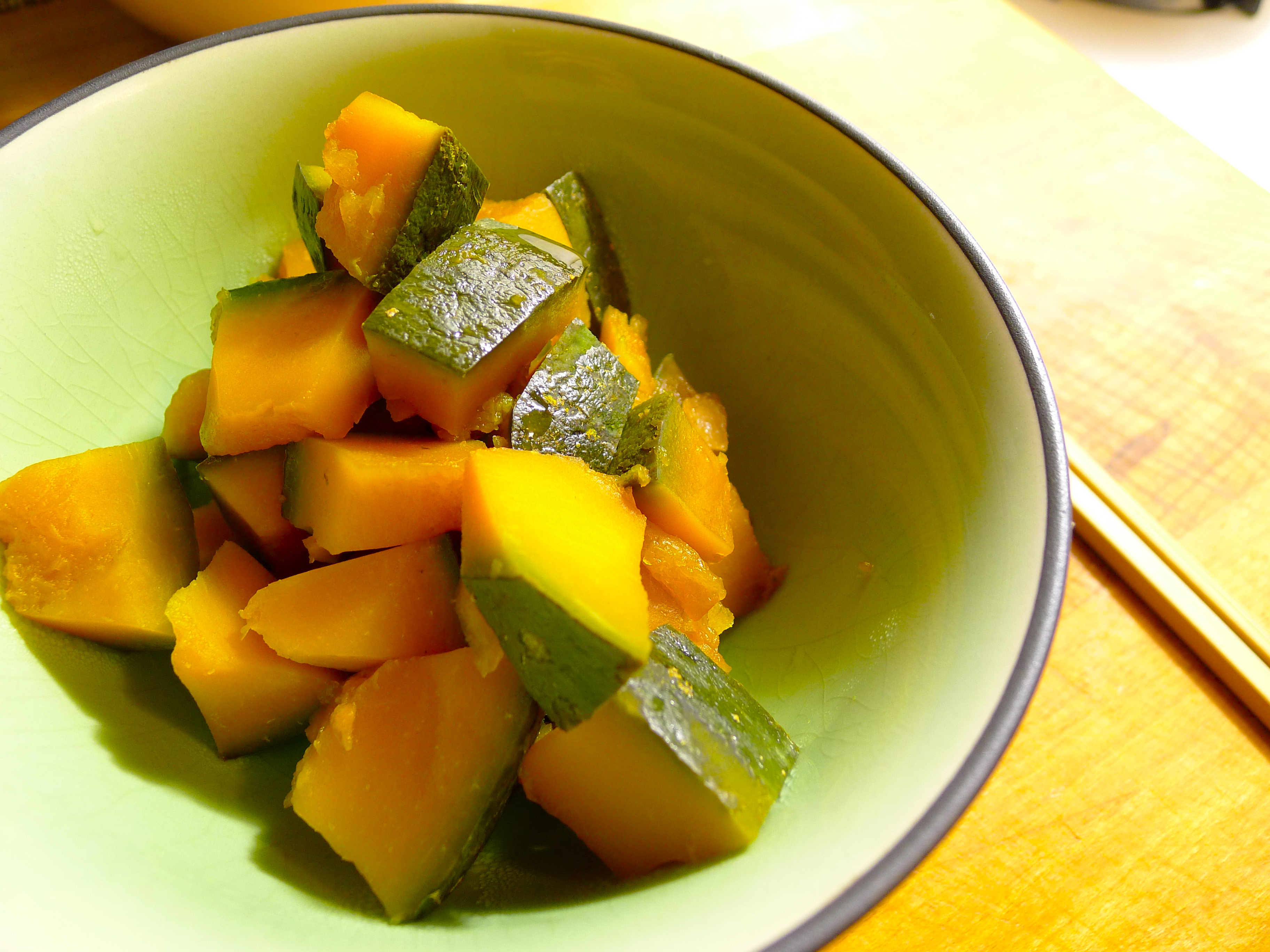
I don’t know if this is what Tomoko meant or intended for me to cook, but the result was unbelievably delicious. Probably the best thing that I have made in months. I actually loved it so much, I ate an entire pumpkin in one sitting by myself. And when there were only a few pieces left, I actually wished that I had another one. It was that good.

When I texted her later, she said, “Hee hee! Yeah, it’s one of those recipes that is so simple, no one ever explains it.”

That may be true, but I am going to try for you.

Ingredients:

4 cups of water

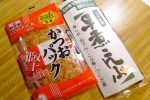
1 largish piece of kombu

1/2 cup of dried bonito flakes

1 small kabocha squash

Japanese soy sauce

Salt

Sugar

Mirin

How to prepare:

1. First, you need to make your dashi. Dashi is incredibly easy to make and consists of basically 3 ingredients: kombu (dried kelp or seaweed), dried bonito flakes, and water. For more details, I defer to La Fuji Mama, who completely demystified the whole thing for me.

Basically you take a largish piece of kombu and rehydrate it in a medium sauce pan with 4 cups of water. Let the kombu soak for about 15 minutes. Bring the water to a boil, and right when it starts to boil, remove the pan from the heat and add about half a cup of dried bonito flakes. After 3 or 4 minutes, remove the kombu and strain the broth through a fine-mesh sieve, or a coffee filter.

Voilà! You have made dashi!

2. Cut your kabocha squash in half. Scoop out the seeds. Cut each half into quarters. Using a paring knife, scrape the skin of the squash. You don’t want to remove the skin, but just clean up the outer surface. That way, your squash will cook more evenly. Cut the squash into 1-inch pieces.

3. In a large Dutch oven or casserole, try to spread the squash pieces out in a single-layer skin-side down. If that isn’t possible (it wasn’t for me), just make sure that the squash isn’t too crowded in the pot.

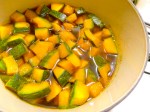
4. Sprinkle the squash with salt, sugar, soy sauce, and mirin. Fill the pot with just enough dashi to barely cover. Bring the liquid to a simmer, and continue to cook the squash until the pieces are easily pierced with a knife.

5. Using a slotted spoon, gently remove the squash from the cooking liquid, and enjoy your delicious kabocha.

Tiny Potatoes Roasted in Parchment Paper with Garlic, Rosemary and Thyme

Last week I saw the cutest little potatoes at the Greenmarket. About the size of thumbnail each, they looked absolutely adorable — and I knew exactly how I wanted to cook them.

I wanted to roast them. In parchment paper.

I cannot express to you how essential a roll of parchment paper is in my kitchen. I use sheets of it all the time. They’re non-stick. They make clean-up a breeze. They line my sheet pans when I roast vegetables. They keep my pie weights away from my delicate tart crusts when I par-bake them.

And they make it possible to cook things en papillote, which is a fancy French way of saying that you cook your food in an “envelope” that you have made out of parchment paper.

Parchment paper is amazing. It lets just enough moisture release while cooking so that your food comes out perfectly moist and juicy, but not water-logged. Potatoes done in this way are crispy on the outside, and meltingly tender on the inside. They are practically like little orbs of confit.

It’s so simple to do, yet looks so impressive — like a beautiful present.

And who doesn’t like presents?

Ingredients:

About 1/2 pound of tiny potatoes per 12 x 16-inch sheet of parchment paper

Olive oil

Kosher salt

Pepper

1 sprig of rosemary

A few sprigs of thyme

1 fat clove of garlic, lightly smashed but still in its papery skin

How to prepare:

1. Preheat your oven to 400°.

2. Thoroughly wash and dry your potatoes. Put the potatoes in a large bowl and drizzle them with olive oil. Sprinkle them liberally with salt and freshly ground black pepper. With your hands, toss the potatoes together so that they are evenly coated with the oil and the seasonings.

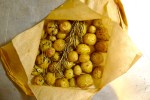
3. Take a large sheet of parchment paper (about 12 x 16 inches) and fold it in half width-wise. Lay it out on a baking sheet. Turn the potatoes out onto one half of the paper. Arrange them in a single layer. Add the garlic clove to the potatoes, and lay the sprigs of rosemary and thyme on top. Fold the other half of the paper on top of the potatoes.

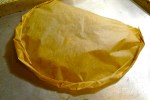
4. Beginning at bottom corner of one side, fold over or crimp the edges of the parchment paper as you move from one side to the other until you have a half-moon shape.

Now, traditionally you’re supposed to fold your parchment paper in half, and trim it into a heart shape (just like you did for Valentine’s Day back in school) before stuffing and crimping. However, I don’t know if this does anything other than make your half-moon a prettier shape. Maybe it also gets rid of excess parchment paper if you have cut off a sheet that is too big.

In any case, you can do it if you want to, but it’s not necessary.

To help you visualize crimping, here is a video with Chef Paul Prudhomme, who will pronounce en papillote any dang way he pleases.

5. Roast the potatoes for 45 minutes. Your kitchen will fill with the heavenly smell of rosemary, garlic, and thyme. Remove the potatoes from the oven. The parchment parcel will be all puffed up from the steam inside. Let the parcel sit for about 5 minutes before carefully (watch out!) using a pair of scissors to slit it open. Remove the garlic, thyme, and rosemary, and serve the potatoes straight from the paper.

Balsamic-Roasted Butternut Squash and Apple Soup

This is a neat little twist on butternut squash soup. Roasting the squash concentrates its flavor. Roasting it in a buttery syrup accented with balsamic vinegar adds a little bit of bite, and a whole lot of interest.

Ingredients:

1 butternut squash, seeded, peeled and cut into 1-inch pieces

1 tablespoon of butter

1 tablespoon of olive oil

1 packed tablespoon of dark brown sugar

1 tablespoon of balsamic vinegar

2 teaspoons of salt

1 pinch of cayenne pepper

1 large shallot, minced

Olive oil

1 Gala apple, cored, peeled and cut into 1-inch pieces

3 cups of chicken stock

1 cup of apple cider

3 tablespoons of maple syrup

1/3 cup of heavy cream

Salt

crème fraîche to serve

Special equipment:

A hand-held immersion blender

How to prepare:

1. Preheat your oven to 400°.

2. In a small saucepan, heat the butter and the olive oil together over very gentle heat. When the butter has melted, add the brown sugar, balsamic vinegar, cayenne pepper and salt. Stir everything together until everything is well-incorporated. Continue to heat everything for a minute or two more. The mixture will become syrupy, and the harshness of the vinegar will soften a little bit.

3. In a large bowl, toss the butternut squash and the butter mixture together. Spread the squash out evenly on a parchment paper-lined cookie sheet. Roast the squash until it is tender, about 15-20 minutes. When the squash is done, transfer it from the hot pan to a bowl.

4. Heat some olive oil in a large casserole or Dutch oven over medium heat. When the oil starts to shimmer, add the shallots. Sauté them until they begin to soften. Add the apples to the shallots, and heat them together for about a minute or two. Add the butternut squash, and stir everything together. Add the chicken stock and the apple cider. Let everything simmer for about 20 minutes, skimming any foam that rises to the surface.

5. When the apples are tender, blend everything together with an immersion blender until smooth. Adjust the seasoning. Add the maple syrup and heavy cream. Stir everything together, and adjust the seasoning for a final time. Garnish with a dollop of crème fraîche and serve.

Irish Bacon and Cabbage Soup


From the archives!

As I am currently a little out-of-commission, I decided to revisit some meals that I have made in the recent past, but haven’t blogged about yet.

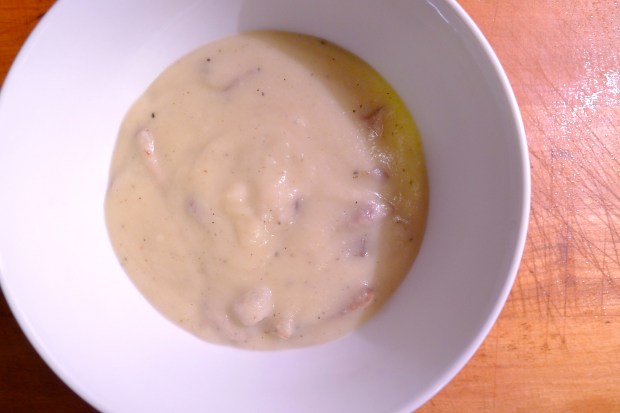
This soup is one of them. A few months ago, I got some Irish bacon in my CSA. What is the difference between Irish bacon and regular ol’ streaky bacon? Well, according to Wikipedia — the be-all, end-all arbiter of everything — regular bacon is made from pork belly (which is why it’s so nice and streaked with fat). Irish bacon, on the other hand, is made from center-cut pork loin — which is along the backside of the pig. Because this kind of bacon is not from the belly, it tends to be much leaner. There is usually a narrow band of fat that rings the edge, but each slice is generally more pork than fat. Similar to Canadian bacon, Irish bacon isn’t supposed to get crispy like belly bacon. It still has incredible flavor though, and holds up well to things like thick soups and stews. This recipe, adapted from Epicurious, makes a warm, wonderful, and traditional stick-it-to-your ribs kind of meal. Perfect for the rain and newly arrived cold weather. Ingredients: 1 pound of sliced Irish bacon 3 tablespoons of butter 1 medium onion, chopped 2 large Yukon Gold potatoes, peeled and diced 1 quart of chicken stock 2 bay leaves 1/2 of a small head of Savoy cabbage, cored and thinly sliced Salt and pepper Special equipment: 1 hand-held immersion blender How to prepare: 1. Place the bacon in a medium saucepan, and cover it with about two inches of cold water. Bring the water to a boil. Reduce the heat so that the water is at an even simmer, skimming any foam that rises to the surface. Cook the bacon for about 7 minutes. Drain the bacon, and when it is cool enough to handle, cut it width-wise into 1/2-inch strips. 2. In a large casserole, melt the butter over moderate heat. When the butter begins to bubble, add the chopped onions. Sauté the onions, stirring often, until they begin to soften and turn slightly translucent. Add the potatoes to the onions, and sauté everything together for about 2-3 minutes more. Add the stock and the bay leaves. Adjust the seasoning, and bring everything to a boil. Reduce the heat and simmer everything together until the potatoes are soft and tender, about 8 to 10 minutes. 3. When the potatoes are ready, add the cabbage to the pot. Simmer the cabbage until it is soft too, about 5 minutes. Fish out the bay leaves and discard them. Don’t forget . . . like I did! 4. Once you find and remove the bay leaves, blend the soup together until it is smooth. If the soup is really thick, you may want to add some water to it to thin it out a little. If you don’t have an immersion blender, you can use a regular blender or a food processor, working in batches if necessary. Once the soup is puréed, stir in the bacon. Adjust the seasoning for the final time, and rewarm the soup if needed before serving.

Roasted Miso-Curry Delicata Squash with Pork

Yet another recipe adapted from Heidi Swanson’s Super Natural Every Day. This dish is a marvelous mixture of flavors and textures. It also shows off some of the first of Fall’s bounty: the gorgeous Delicata squash.

Oblong and streaked with golden yellow, forest green, and ivory, Delicata squash have a thin and delectable skin that does not need to be peeled. It cooks quickly, and yields a sweet, pure taste.

Though Swanson’s original recipe, like all of her recipes, is vegetarian, I find that the addition of thinly sliced pork goes well with the miso-curry sauce.

Ingredients:

A scant 1/4 cup of white miso

A scant 1 tablespoon of Thai red curry paste

Olive oil

1 Delicata squash

About 1 pound of small red potatoes, quartered or cut into even chunks

1 boneless pork chop (about 1/2 a pound), cut into 1/4 inch-thick slices

1-2 handfuls of shelled pepitas

Half a bunch of roughly chopped lacinato kale, stems removed

2/3 cup cilantro, roughly chopped

The juice of 1 limes (2 if the limes are small)

How to prepare:

1. Heat your oven to 400°.

2. In a small bowl, whisk together the white miso, the red Thai curry paste, and about a 1/4 cup of olive oil with a fork. Add more oil to loosen up the mixture if it seems too thick.

3. Trim both ends of the Delicata squash. Cut it in half lengthwise. Scoop out all of the seeds and discard them. Cut each half into 1/2-inch half moons.

4. In a medium bowl, combine the squash and the potatoes with about half of the miso-curry mixture. Toss the vegetables together with your hands until they are evenly coated. Turn the vegetables out onto a parchment paper-lined rimmed baking sheet. Spread them out in a single layer, and bake them for about 20 minutes.

5. In a small bowl, toss the pork with half of the remaining sauce. After the potatoes and the squash have roasted for about 20 minutes, evenly scatter the pork and the pepitas over the tops of them. Continue to roast everything until the pork is cooked and the potatoes are done, about 15 minutes more.

6. In a large bowl, combine the kale, the cilantro, the remaining miso-curry, and the lime juice. Add the roasted pork and vegetables to them. Toss everything gently together. Serve and enjoy.

Peanut Butter and Jelly Tart with Concord Grape Sauce


Fall is my favorite time of year.

I love the crisp air, and harvest time, and hayrides, and watching the leaves turn colors.

I love squash, and apples, and spice, and all those nice things that we start eating when the weather begins to get cooler. I love being able to turn on my oven again without turning my apartment into a sauna. I love roasted meats, and roasted vegetables. It is wonderful that is getting chilly enough to be able to eat cheesy, creamy sauces again. I love stew.

We are currently in the throes of Concord grape season — not for much longer, but long enough to partake in what must be the very essence of childhood. Concord grapes have that grapey grapiness that turns your tongue purple with nostalgia. The taste instantly transports me back to lunch in the third grade.

This tart is far from the PBJ’s that I ate as a child, but the flavors are still there — just in a more refined way.

The original recipe from Epicurious seemed a little too sweet to me, so I eliminated the extra brown sugar in the peanut butter topping. Also, the recipe calls for the Concord grapes to be halved and tossed with Concord grape jam as a topping. However, as Concord grapes are pretty fabulous on their own (commercial jam is usually too sweet anyway), I opted to get rid of the topping and make my own Concord grape sauce with local grapes.

Ingredients:

For the crust:

12 5×3-inch graham crackers, broken into pieces

1 cup of salted, roasted peanuts

1/8 teaspoon of allspice

1/2 cup of melted butter

For the filling:

4 ounces of cream cheese, softened

3 tablespoons of butter, softened

1/2 cup of smooth peanut butter

1 cup of heavy cream

1/2 teaspoon of vanilla

About 1/2 cup of Concord grape jam*

For the sauce:

1 pound of Concord grapes

1/2 cup of water

3/4 cup of sugar

A pinch of salt

The juice of 1 lemon

Special equipment:

1 11-inch fluted tart tin with a removable bottom

1 food processor

1 half-size sheet pan

1 strainer

1 fine-mesh strainer

1 hand immersion blender

How to prepare:

1. Set your oven to 350°.

2. While your oven is heating up, blend the graham crackers, the peanuts, and the allspice in your food processor until the nuts are evenly ground up. Add the melted butter, and pulse everything together until the crumbs are evenly moistened.

3. Turn the moistened crumbs out into the fluted tart tin. Using your fingers, firmly press the crumbs evenly into the bottom and up the sides of the tin.

4. Set the tart tin gently on a half-size sheet pan that is lined with parchment paper. Bake the crust in the oven for about 10 to 15 minutes. When the crust is lightly browned and “set,” remove it from the oven and let it cool.

5. While the tart crust is cooling, blend the peanut butter, the butter, and the cream cheese together with an electric mixer set at medium-high speed until the mixture is fluffy. In a separate bowl, whip the cream and the vanilla together until soft peaks form. Fold the whipped cream gently into the peanut butter mixture.

6. Very carefully spread the jam over the bottom of the cooled tart crust. If you have an offset spatula, this is a little easier to do, but it’s okay if you don’t (I do have one . . . something I realized only after the tart was done). Wipe off your spatula, and carefully smooth the peanut butter topping over the top of the jam. Chill the tart in the refrigerator until the tart is firm, about 3+ hours.

7. While the tart is chilling (tart be chillin’!), prepare the sauce. Over a small bowl, slip the skins off of all the Concord grapes (they should come off easily, and if you do this over a bowl, the bowl will catch all of the juices). Reserve the skins, and keep them in separate bowl.

8. Bring the pulp and 1/2 cup of water to a boil in a small saucepan. When the peeled grapes have turned opaque, pour them into a mesh sieve set over a medium-sized bowl. Using a spatula, push the pulp through the sieve. Discard the seeds.

9. Add the grape skins to the bowl of grape pulp. Using an immersion blender, purée the skins and the pulp together. Push the mixture through the fine-mesh sieve set over a bowl, pressing the remains of the grape skins with a spatula to extract all of the juice. Discard the grape skins.

10. In a small saucepan, combine the strained grapes with the sugar and the lemon juice. Set the pan over medium heat until it begins to boil. Skim any foam that you see off of the top. When it begins to boil, lower the temperature until the sauce is just barely at a simmer (be careful that it doesn’t boil over). Keep the sauce at barely a simmer until it has thickened and reduced to a syrupy consistency. When it gets to that point, turn off the heat and let the sauce cool.

11. When the tart has cooled and set, cut it into wedges. Make a pool of grape sauce in the middle of a dessert plate, and place one tart piece on top of the purple puddle. Serve immediately.

* My recipe actually makes quite a bit of sauce, and I imagine that if you prefer to not have any commercial jam in your tart at all, you could just cook the sauce down further — with the addition of a 1/4 cup more of sugar — until you have a thick syrup. Use this instead of the jam as a layer.

Black Bean Salad with Oven-Roasted Tomatoes, Corn, Almonds, and Lemon Zest


This is another great recipe adapted from Heidi Swanson’s Super Natural Every Day. Swanson, whose blog 101 Cookbooks is an amazing source of ideas and inspiration, makes food that is healthy, wholesome, a little quirky, always delicious, and never preachy.

The great thing about her vegetarian recipes is how amenable they are to your tastes. You can substitute chicken for tofu, or add shrimp, or beef, or pork, and the dishes will still be great.

For this recipe, I added local corn and the farfalle. Since Hurricane Irene, our farmers need all the help we can give them. Though NYC was mostly spared, many of the farmers and growers who bring the literal fruits of their labor every week to us were not. Almost no farm was left untouched by the flooding.

Support local and please make a donation here.

Ingredients:

1 pint of Sun Gold tomatoes (cherry or grape tomatoes work too), halved

Salt and pepper

Granulated cane sugar

Olive oil

3/4 cup of raw almonds, halved width-wise

1 cup of corn kernels (about two ears)

2 15-ounce cans of black beans, rinsed and drained

1/3 pound of farfalle, prepared according to package directions

The grated zest of one lemon

The juice of one lemon

1/4 pound of French feta, crumbled

How to prepare:

1. Preheat your oven to 350°.

2. Line a rimmed baking sheet with parchment paper. Spread the tomato halves over the sheet and sprinkle them liberally with salt and sugar. Drizzle the halves with olive oil. Toss everything together so that the tomatoes are evenly coated in the oil, salt, and sugar. Arrange the tomatoes cut-side up. Roast them until they have shrunken, and have begun to caramelize around their edges, about 45 minutes. Remove them from the oven, and when they are cool, scrape them into a large bowl along with all their caramelized juices.

3. Meanwhile, heat the almonds in a single layer in a large cast-iron skillet set over medium heat. Toss them around every couple of minutes until they are fragrant and toasty. Be sure to monitor the nuts closely; they can burn in a minute! When the almond halves are toasted, add them to the same large bowl as the tomatoes.

4. Wipe out the skillet and add about 1 tablespoon of olive oil. Heat the pan over medium-high heat until the oil begins to shimmer. Add the corn, and toss the kernels in the hot oil until they begin to brown. Add the corn to the same large bowl as the almonds and tomatoes.

5. Add the remaining ingredients to the bowl and drizzle everything with olive oil. Toss everything together well. Adjust the seasoning and serve.